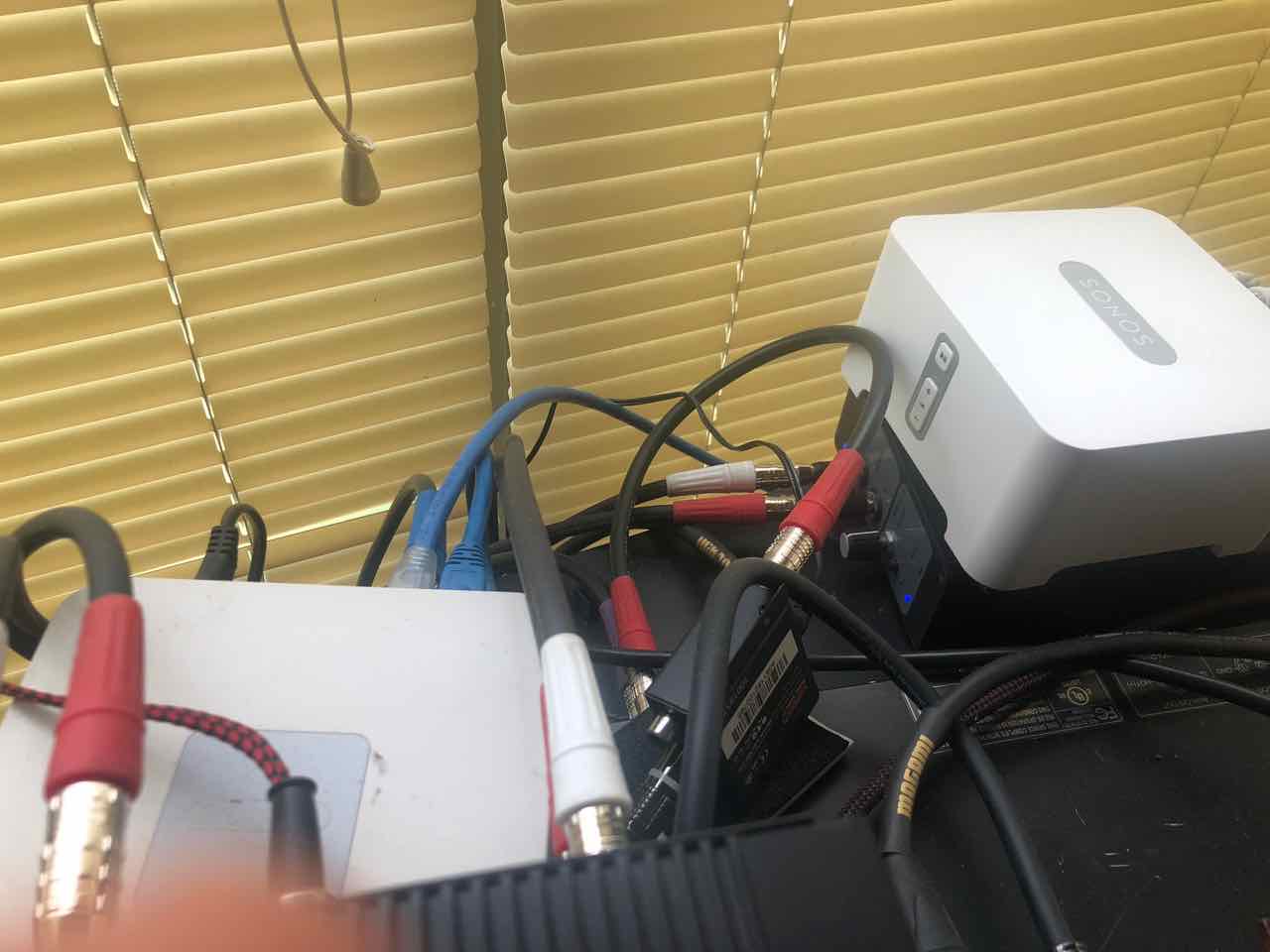
Monday, September 13, 2021

Gain Structuring

 For complicated reasons I'll describe below, I decided to turn the gain up on all 3 Emotiva Stealth DC-1 DAC's I use in the living room system by 4dB.  The current levels are

Tweeters: +10dB

Subwoofers: -11dB

Panels: +2.5dB

It's actually become extremely convenient that these DAC's have 0.5dB resolution gain switching that goes way down and up to +12dB.  Functionally it's like getting a preamp with your DAC.  Though purists might rather have their own high end preamp, the gain here is provided by an impeccable LM4562 with a 2005 generation digital level control (that was when they got about as good as an LM4562).  If I ever switched to another DAC w/o gain, it might be difficult.  But now thanks to fixed digital rate of 48kHz from the miniDSP (and 96kHz for the tweeters) I can simply time align the DAC's (and the speakers) for these fixed rates and it's done.  (Previously, where the rates could vary from 44.1kHz to 96kHz...causing different delays in different DACs, it was impossible.)  So, I can fairly easily use different DACs on each way of the system...but few have the nice digital level controls of the Emotiva and with 12dB extra gain.

The actual tweeter (crossing in at 20kHz) levels are so low that boosting the gain there is never going to cause the DAC to overload...or the following amplifier.  The SVS subs are just very sensitive and I have their local level controls turned down also.  The DAC feeding the Hafler 9300 driving the panels had one time been at -6dB so I could set the higher gain Aragon to 0dB.  The Aragon is currently offline because the DAC feeding it now needs repair.  Just before this latest adjustment shown above, the DAC feeding the Hafler had been turned to -1.5dB.

Well I decided to do this after seeing that even turned all the way up, to no digital attenuation on my Tact, I was getting peak levels at -87dB C weighted.  That's not very loud.  But you'd think at "0dB" it would be.

But when I was setting up the miniDSP for the midrange, I detected clipping problems if I set it's input gain control above -4dB (so ultimately I chose -6dB to be on the safe side of no digital clipping).  This is because the miniDSP use a 48kHz ASRC input for the digital input.  Such asynchronous sampling can be pushed into clipping by "inter sample overs" because there can be (and are, on many pop recordings) peaks up to 6dB (theoretical maximum) higher than the nominal level.  This is another reason why units with SPDIF or AES digital input and digital output should use SYNCHRONOUS not ASYNCHRONOUS transmission.  Asynchronous should only be used, if at all, in a terminal DAC unit which does not output digital.  But totally unwarranted fear of JITTER has led to the near abandonment of synchronous digital receivers, despite the fact that the better ones did a nearly impeccable job with typical low jitter levels and considerably beyond.

The 1999 Tact RCS 2.0 did in fact have synchronous digital in and out, at rates from 44.1kHz to 96kHz.  My living room system uses this as source pre-selector (to the input of the home-controlled switch, which switches between FM and everything else, and from there on to a splitter to the 3 miniDSP's) and level controller.  I don't find the DSP in the Tact system meets my needs, with a trifle re-programming it could.  The Tact preserves the input rate--and timing--from input to output.  There might be some smoothing in the timing, I'm not sure of the details actually.  But if I were to build something, I'd have it like this.  I'm unsure if the synchronous receivers are made anymore.  Or updated to 192kHz, which I don't consider of much importance.  Actually my miniDSP's are limited to either 48kHz or 96kHz anyway.  So it would be useless to lust over a front end controller ("digital preamp") with more than 96kHz anyway.  And as I've many times stated, I think all that's needed is 96kHz, everything above that is a WOMBAT (Waste of Money, Brains, and Time).  Peter Aczel and the near entirety of "Objective" audiophiles would say 44.1kHz is enough and that nobody has "proven" otherwise in reproduced blind testing.  But I'm allowing margin over 44.1, for various reasons, though I recognize that 44.1kHz sampling can be damned good (and likewise 16 bits) and the vast majority of what I listen to is just that, and I'm still often (and pretty much always nowadays) wowed and so on.

So, the unfortunate loss of 6dB gain in my digital processing means I have to make up the gain somewhere.  If I were to increase the output of the Tact, I'd get actual digital clipping (not just intersample overs) at the miniDSP inputs.  So the only thing to do is to raise the output "after" the digital conversion.  Which I can conveniently do with my Emotiva Stealth DC-1's because in fact the level control can be increased to +12dB.

But what happens with a digital signal at 0dB with the Emotiva at +12dB.  Distortion rises from 0.0005% to 0.02% which doesn't matter audibly.  That's because the output circuitry of the Emotiva can actually drive 25.65dBu (14.85V RMS) !  (Well, that's into balanced...) The output with the control at 0dB is 14dB, or 3.88v RMS, into 4 ohms, which is a bit low for some high end power amps, but you can crank it up.

I got that information from this Pro review.  Pro's are interested in these sorts of things, which often don't get tested by audiophile reviewers.  (John Atkinson always tests maximum output level, but it seems Amir did not, he simply tested with the level control at 0dB which is not the maximum.)

In unbalanced I likely have half the output, or about 7.92V, which is still almost 11.95dB higher than the standard output of 2V with the level at 0dB.  So I can crank the level up to at least 11.5dB without concern basically (at least as far as the DAC is concerned), even if perchance there were a maximum digital level signal.  (Perhaps to allow for inter-sample overs in the DAC itself...it might not be a bad idea to keep the level below +6dB for ultimate fidelity.)  In my case, where the signal itself is deliberately -6 dB, I'm good with the 11.5dB level even before intersample overs become an issue.

The amplifier has "headroom" (above it's 1.1V rated input for full output) and besides such signals are way below the average level, due to both the mandatory -6dB processing reduction, and the crossover itself.  If the amplifier is working too hard, I will hear it, just like someone with an all analog setup.  What I strongly want to avoid is "invisible" digital clipping from ASRC for example.

Basically the signal is never going to go to the peak level (for one thing it can only go to -6dB on average) and the panels only get frequencies above 120 Hz, which also reduces the level.  If there ever is a transient peak (which is all it could be above the -6dB level because of my miniDSP attenuation) it won't stress the analog at all.

Well now that I've checked the Emotiva capabilities, I'm thinking of cranking up the DAC's another 2dB.


Monday, September 6, 2021

What to do with CD's after Ripping

 It seems that hardly anyone recognizes the ethical and legal issues regarding first ripping CD's, then selling or donating them.  Essentially two copies of music have been created, but only one was legally paid for.  This issue gets only a tiny bit of discussion (while being dissed everytime it comes up) in this thread.

Some keep their old CD's for this reason or other reasons, while others donate or sell.

I had been planning to keep all my old CD's.  But as I acquire more and more, this is looking untenable.

I was hoping someone had already "solved" this problem with "recycling" service for CD's.  You send boxes of CD's in, and they recycle the paper and plastic and return you a receipt for all the titles you have recycled, which you can then save as proof of ownership.

Short of that, I was thinking of taking photos of 100 or so CD's at a time laid out flat, then boxed, then trashed.

Though I suppose, old CD's are only the tip of the iceberg of my junk problem.


Sunday, August 29, 2021

Phono Frequency Response

I had a nagging to play vinyl on Saturday Night.  On top of some pile I can't remember buying I found Queen's Greatest Hits.  Having heard these same songs on digital, in some cases high resolution digital, this was different, having more presence, transparency, liquidity, and magic (and some noises).  But also, seemingly, less bass.

I think the less bass part is primarily a problem with this "Greatest Hits" pressing, which may not have the extended bass of the originals.  But also I suspected it could be my turntable system.  Often when there is less bass, we hear it as greater presence and transparency.

So I got out Hifi News and Record Review Analog Test LP, and played Track 7 Side 2 which is a sweep tone.  One of the very annoying things about this record is that each band is walled off from the others.  In order to play Track 7, you can't just cue to the space in between 6 and 7, because that just reverts back to 6.  You have to pass the wall at the beginning of Track 7, and cue precisely there.  It's hard to hit that point precisely, and when you do, the tonearm is still stabilizing at the beginning of the track.  That might, partly expaln the bass below 30 Hz in this recording shown here in Audacity.  There's also a matter of intermodulating with the tonearm and antiskate system resonances..


 The bump at the bottom where it more or less stabilizes is 30 Hz.  Up from there to the midrange level represents about a 1dB increase.  So it appears the bass below 100 Hz is gradually rolled off by 1dB at 30 Hz, then looks funky.  (The scale above is linear so it shows changes that look larger than they would on a logarithmic dB scale.)

I wouldn't think that 1dB loss would be that big a deal, I routinely make changes of that amount or more in the bass level, and in fact I tried adding 5dB (by changing the DAC output level from -15dB to -10dB) and the Greatest Hits recording still sounded like no bass, until the last track.

The instability below 30 Hz might be a problem, but possibly worse there is a peaky resonance just below 20khz which shouldn't be there.

Another measurement I made indirectly shows the instability below 30 Hz is not a matter of initial tonearm/table stabilization.  I happened to drop the needle at 30Hz instead of 20 Hz, and the reproduction is pretty clean, only showing the barest overlay of the needle drop stabilization, which disappears after 13 cycles of 30 Hz (just over 1/3 second).  That initial instability could also relate to the slight peak (small fraction of a dB) at 30Hz shown in the previous measurement.  This means that the instability shown above is caused by something else, presumably interaction with tonearm vertical and horizontal resonances that needs fixing for good bass below 30 Hz.  I'm showing higher magnification in the selected portion just after the needle drop (also shown) for clarity.


Digging through my files, I found a measurement with my Mitsubishi LT-3 linear tracking turntable, with damping added to tune the bass just as with the Linn (though it was an earlier job I didn't do as much or as well).  They both have a Dynavector 17D3 playing through an Emotive XSP-1.  I'm showing this somewhat aligned with the Linn result above.


The Mitsubishi is on top here.  I think it has slightly flatter bass below 120 Hz (perhaps 0.5dB loss down to 30 Hz vs 1.0dB for the Linn), it lacks a weird resonance in the Linn around 120 Hz, and the bass extends possibly a tad farther before it becomes unstable below 30 Hz--but they are so little different in that regard it's hard to tell, in both cases the bass becomes unstable just below 30 Hz.  They both seem to have a resonance just below 20kHz, I'm wondering if that's coming from the cartridge body or the screws.

I wonder if the resonance around 120 Hz in the Linn is the infamous flexible subchassis resonance and "flabby midbass."  From the day the LP12 was introduced people wondered why they were getting such a thin and flimsy subchassis with an expensive turntable, when even much cheaper turntables like the AR Turntable had very heavy gauge metal.  HP of Absolute Sound denounced both the subchassis resonance and the flabby midbass in his first review of the LP12.

Famously Linn doesn't have a subchassis upgrade except for the very expensive Cirkus bearing.  I figure this is because the original bearing has a noise that is absorbed by the flimsy subchassis.  The expensive Cirkus bearing eliminates that resonance, so you can even have specially cast and machined subchassis with it.  Such were never offered for the original bearing (except by outside vendors...and they were not universally loved).

The flimsy subchassis could have eliminated a bearing noise.  But the price may be that funny ripple in the frequency response around 120 Hz.  Remember the cartridges are the same model.

Although the Mitsubishi turntable yields better frequency response, I don't think it sounds as good.  It has larger and more undamped arm/cartridge resonances and/or motor and bearing noises.  The movement of the linear tracking tonearm subtly affects tonality.  I could possibly fix the larger arm/cartridge resonances, with the application of more damping material, and the electronic motor is probably due for a tune-up.  My Linn Valhalla board has been replaced at least twice, the Mitsubishi has it's original electronics and it's a wonder they're even still working.


Wednesday, August 25, 2021

Testing the M50

In May 2012, I decided to reward myself for something or other, and bought the M50 I have long planned to buy.

The Earthworks M50 is the king of measurement microphones nowadays, with calibrated (and quite flat) response to 50kHz.  It costs far less in real terms than the standards of old, such as B&K's with their custom amplifiers and such.

I think John Atkinson of Stereophile uses an M50, either that or an M25.

Until now, I've had no proof that my system even has frequency response above 20kHz or so, something I've invested thousands of dollars and endless fine tuning to achieve.  I have no idea what the proper calibration for my previous custom 25kHz calibrated Dayton Audio above 25kHz.  Given the different calibration curves for different angles, it's also hard to know which of several calibrations to use.  I didn't really trust it to 20kHz let alone 25kHz (but in fact I was wrong...it matches the M50 amazingly closely!  Perhaps I needn't have bothered.  Nah.  Anyway I plan to use my old mike for general purposes and the M50 for calibration and "final" measurements.)

For the measurements here, I recall I put the microphones straight forward.

Here is my system response with the 25kHz Dayton Audio microphone:


Here is the response with the M50, which I finally figured out how to calibrate correctly (the calibration they supply cuts off below 700 Hz..for ARTA I had to add in fake points at that exact same level).


The M50 shows a slightly cleaner HF peak at 22kHz, and about 3dB more output at 40khz, and that's about it.  If I had an accurate calibration above 22kHz for my Dayton I could probably make them match even better.

I think the speaker system response, shown in much higher resolution that you usually see above 100 Hz (and less below, thanks to FFT techniques) is pretty good.  It slopes nicely downward from 1kHz (though perhaps a bit too early and there is more loss than desirable above 8kHz or so.  The inaudible 22kHz peak merely restores the highest treble to the midrange level (and less than the deep bass), and also makes possible the response extension to 40kHz where there may still be more output than at 14kHz.  Many highly esteemed tweeters have much larger ultrasonic peaks from fancy construction.  My 21mm Dynaudio D21AF's have factory response curve showing flat from 1200Hz to 39kHz measured with close microphone but they don't account for a lot of variables here, including the polar response dilution of a cloth dome tweeter (which is good enough to even make 40kHz response possible--which can't be done with many materials including of course my electrostatic speakers).

Anyway, there clearly IS ultrasonic response at useable level at 40kHz, which has been my goal, and now proven with a top calibrated microphone.

Instead of huge peaks and valleys in the bass in the unequalized bass response, or where the wall bounce isn't properly corrected (I dodge that with my 4 foot wall spacing and crossing subs at 125hz with 8th order linear phase crossover) it's pretty flat 80-800 Hz (amazingly flat in my building and measuring experience), with just a soft rise below 80 Hz (which I may have reduced with subsequent adjustments as I'm writing this months after these measurements were recorded.)  It sounds natural.  1/6 octave omni measurements on my phone show less difference below and above 80Hz than these FFT measurements.

Some measurements last year were made before I figured out how to run the supertweeter miniDSP at 96kHz.  So it was running only at 48kHz like my other DSP's (the 48kHz plug in is more flexible than the 96kHz...but that flexibility is not an issue for my supertweeter...so I run only the supertweeter crossover at 96kHz where the highest sampling rate matters).  So measurements through the middle of last year showed a steep dive at 24kHz, the Nyquist Frequency of 48kHz sampling.  It took me awhile even to figure out that sampling rate was a problem, and until I did I greatly feared that I was basically getting zero response above 24kHz.  I remembered that fear into the present.  By that time I was thinking the microphone calibration explained the rolloff above 22kHz...but in fact the peak there, and the general response, shown by the Dayton...extending the highest calibration to all higher frequencies...is very close to that shown by the M50, with hard-to-see difference at 40kHz where useable response is ending with a precipitous roll off.  Also the Dayton curve shows a little notch where the calibration ends, whereas the M50 shows a smooth peak at 22kHz.


Sunday, June 20, 2021

Automating Music Reproduction

Entry Switchplate (Labeled)


After decades of thinking and dreaming about such things, I've finally automated my main audio system.  I think it's the best upgrade ever, and I'm still working on making it even better.

Automation, in the context of audio reproduction, means two things (and preferably both):

1) Powering up and making whatever other connections, protocols, or other actions are required for the system to begin to play music.


For a personal device system, this includes:
1) enabling device, getting past authentication
2) dealing with personal device issues necessary (upgrades, identity issues, expirations, selection menus, etc) to run app, and running music app.
3) Connecting headphones to device, and headphones to ears.

Good luck automating that.  This is also an illustration of why I have kept personal device centered audio, and even USB (which means some sort of authenticating computing environment) away from my living room system.  Computer based systems nowadays are designed to authenticate and then spy on you, while gaslighting you to gauge your preferences ever better.  The whole point is to keep you making choices through actions.  Being able to bypass all that crap and just press a single button to start the music would be antithetical to that primary point of such systems to their makers.

I want a realm if not an eternity away from the general issues of such devices, which are anything but relaxing and inviting in my opinion.

I deal with the much conceptually simpler situation of automating the powering up my living room audio system, which I can and do listen to from all other rooms in my house.  Especially from the Kitchen, which also serves as my home office, audio and video mastering center, as well as kitchen, dining room, and snack bar.  Nowadays it's the single room I spend the most waking hours within, so it's also where I listen to the most music in Background.

The kitchen has it's own fairly high end audio system, featuring Revel M20's plus a subwoofer, AND surround speakers.  It's a fine system for mastering or watching video.  But as Background Music, I find playing the living room stereo much much better.  It is of course fundamentally a better sounding system, because full range electrostats combined with subs and supertweeters and far more and better fine tuning.   I lose the stereo image from the Kitchen.  But for Background Music, having no stereo image makes it less distracting, and that's the key.  If it were more distracting, I couldn't tolerate it and get other things done.  Not only is there no stereo image, I do strongly get the feeling that the music venue is in an adjacent room.  Therefore it can't get in my way, but it can create an ambient vibe that helps me feel better, like being in your own private room at the club.

I consider background music just as important as serious listening.  Not because serious listening isn't a wonderful peak experience (when everything works and it clicks) but it's comparatively rare event in one's life, at least in my experience--I never had very much time for it.  Background music may ideally be something for nearly every waking hour, except when you need absolute silence for perfect concentration or talking to somebody.  But if it's not easy to start up your main system for this purpose, you might hardly ever enjoy it for such. 

If all you ever use your main system for is serious listening (and/or serious listening or other tests), then I suppose a fairly time consuming startup procedure may be tolerable, or even help prepare the mind.  Many audiophiles have startup procedures taking many minutes.  I've always wanted to make system startup as quick and easy as possible, in the hopes that this would get me actually listening to music more, and I started using home automation devices for this purpose inconsistently and with varying success since the 1980's.  Mostly, recently, I've had no automation whatever, and had to power up the amp and fiddle with preamp and other components before starting, and that almost always involved getting down on my knees to fiddle with the preamp buttons, often waiting to scroll through volume levels for an appropriate volume...

2) Selecting the music, playlist, or station to begin playing.

This is really the important thing, and I believe, ultimately the most difficult thing.  And I mean in merely selecting what to play next, though in some cases the mechanics of getting that thing playing may be considerable also, though I usually count those actions as part of step 1 above.

When I started on this article in January, I had no idea I was going to be able to construct an automatic playlist generator this year, if ever.  Having a computer program select the music seemed too far fetched an idea.

Partly it's because my dreams were too far fetched.  What if the computer, acting as your personal concierge, would sense you mood from moment to moment, and pick the perfect music to elevate your spirit?  Well, yes, that would be nice.  Closer to earth, algorithms in Pandora are supposed to select similar music, but in continuous varying mood, because that's supposed to be better.  Perhaps.

My own finding is that given the set of music I like as both background and partly as foreground, that is particularly to me music without words, or too much stress, which can be classical, jazz, electronic, or ambient, I can just mix it up at random--done properly without replacement to minimize repeats and let you hear everything in shortest order, and these simple playlists have revolutionized my music listening more than anything.

With the new playlist generator I am programming now, I can listen to automatically generated playlists designed to play so I hear everything in my music library with as few repeats as possible--that is until everything has been played (or at least auto-selected and possibly skipped).

Roon automatically loads my playlists.  For other programs, though I have not tested this for other audio programs yet,  I can also create virtual directories of soft links which take very little space, and works unless the audio folders are moved, which isn't an issue for a near daily playlist generator, and would be the case for a normal playlist also.

I haven't yet set this to automatically make a new playlist every every day.  But generally it takes very little action on my part, at least when the still under development playlist generating program is fully working despite yesterday's changes.  [As of June 2021, the playlist generator has a known bug when a too high percentage of albums has been played, which I haven't quite reached yet, but will require a major rewrite to fix.]

If I ever work this up for Rock music as well, I'l have to improve the customizeability.  In that case it might be more like the computer program making suggestions I can accept.  I think this approach is far better than the old logo what do you want to do today.   I don't know what music I want to play today.   It's great to have a program make suggestions if not the choices...and in many cases the choices themselves ...or perhaps the choices following a chosen scheme.  Making more choices is hard work.  Too hard to bother with in the course of daily living.  Let the computer do the choosing.  If I'm in the kitchen or phone I can skip an unwanted track or album in the Roon interface.

Automated System Start Up

This is something that seems of zero interest to any of my audiophile friends.  They've simply not responded to my self congratulation.  I've had great difficulty writing about it, because among other reasons I want to capture why I believe it is most important, yet others can't see why it would be necessary or even useful.

In the pursuit of audio perfection, many if not most audiophiles have the opposite of automation.  They have start up procedures that may take many minutes, perhaps even an hour or more for total warmup.  Of course they believe that all these steps they must take before playing music are absolutely necessary (though skeptics may wonder if they aren't superstitious rituals).  And while many of these audiophiles have been devotedly making the circuitry in their system components ever "simpler," through adept acquisition or modification or construction, this often means even more work in starting up each day.  Or switching from one source to another.  They may have to replug whole chains of equipment to switch from analog to digital sources (which I'm including in the "startup" part of the equation).

Many audiophiles also believe any attempt to make anything automatic must involve compromises at some level.  They would be utterly opposed, for example, to adding switch devices in any AC path.  I will have to explain why the switching I do is perfectly fine, at least in the living room system, yet I'm sure many audiophiles will never believe me.  However, I should note that I've been unable to add any kind of automated AC switching device in the kitchen, where due to multiple outside antenna grounds, AC grounds, and whole house network connections, and low power devices on micro switching supplies, is a virtual RF oven in the AC path of the power amp.  Anything but the most highly shielded AC cord introduces hum and noise.  But the living room has no such problems, despite 3 AC circuits, and network connections from the Kitchen.  This is an issue I hope to get fixed sometime possibly by moving some things around.)

Now you might think that turning on the stereo to play FM would be a fairly simple process taking about 5 seconds, as it once was for me, long ago, when I used a Marantz 2270 receiver (purchased in 1974).  To play FM, I would press the ON button and turn the selector switch to FM and possibly readjust the volume control, with all those controls being in one fairly convenient place.

But in fact it hasn't been that simple since the days when I had my Marantz 2270 right next to my bed, in my college dorm room, which was long ago and not for very long.  And of course for anything other than FM there was a matter of deciding what media object to play, obtaining said object, preparing it, mounting it on the playing device, and initiating playing.  So playing anything beyond a favored FM station can be a lot of work, which is impossible to have the time and energy to do, simply for background music.

Before long my Marantz receiver, and/or the Kenwood KT-7500 tuner I later plugged into it for better FM reception, was not right at hand, but typically across the room from my bed or chair.  I did that mostly by something like necessity, but often rued the day when I had to give up direct reach control of my system for "passive" line level switching and attenuation boxes.  (I denounced passive as lossy sometime around 1998 and stick to that now btw, but I was a passive fan from 1980-1998.)

By the early 1980's I owned a house with stereos in both living room and bedroom.  Partly because of inconvenience, and partly due to lack of free time, I didn't actually use either one very much.  The living room stereo had grown (and kept growing) into many components.  I once figured I spent far more time modifying audio equipment than actually using it.  I had become similar to what one friend calls a build-o-phile from 1980-1982 when I finally built my own tube preamp after having been a tube modifier for 5 years.  Well, so what, if I was having fun that way?  But it would have been nicer to run that show with music but in fact I rarely did.  One a handful of occasions by the late 1980's I had enjoyable audio parties.  But it was only on a small multiple of other occasions did I have time for extended serious listening.  And it almost never worth the bother to switch on my tri-amplified system of 1985 just to play background music on FM.  If I did switch to FM, it was only after already having played something else, and not being able to decide what to play next, I put on FM, which more often took more work than I wanted to bother with.  It should be the other way around, being easy to pop on FM at the spur of a moment, or perhaps the beginning of the day, and then switch to some collected music in higher fidelity form when time and energy permits and desire calls for it.

Some time around 1985, I set up my most beloved FM tuner, which was then a Fisher FM80R which always sounded marvelous (though in mono, I didn't care) atop the side table near my listening seat.  This was a marvelous innovation, as once again I could tune in different FM stations without having to get up.  And that was particularly important then as there were two fairly nice, if still far from perfect, FM stations, but between the two of them I could usually find something good to listen to.  But generally I didn't start my system to play FM.  If I started it to play a CD, and the CD ended, I have to walk across the room and fiddle with several controls to get it to play the FM tuner right next to my listening chair playing again.  Which I rarely did.  But at least I did that more often than switching on the system just to play FM.

I spent much time imagining a system which would let me switch from CD to tuner without having to get up, or maybe do anything at all.  I imagined a system which would sense that the music was not playing anymore, and then automatically switch to the FM tuner.  I figured I could simply add some relays somewhere, and I think I purchased a couple relays, but that was as far as this kind of automationproject ever got, until now, 35 years later.

But even with these early insights, I could begin to see the essential ingredients in effective automation:

1) It should be convenient, eliminating the need to get up and do things, such as with a push button reachable from where you are sitting without getting up.  It could be even more convenient, such as turning on music from a background source automatically when the primary source has stopped, or perhaps even when you get up in the morning, etc.

2) It should simplify, reduce, or eliminate the need to make decisions about what to play next.  Channels such as FM radio stations can do this, as do streaming channels or Pandora.  (One complication may be that FM stations are not always good to listen to and you may want to choose another FM station or source.  I am very fortunate in having a very good listener supported Classical Music FM radio station I love.  But it's not merely good fortune, because it's also something I've contributed to for about 30 years.  Some sort of personal contribution is probably necessary to make any such channel good.  Recently is the second time in 25 years I've been nagging them to clean up their sound, now they have a digital skipping problem which is apparent on both their analog and digital feeds.)

So the two essential ingredients are (1) reducing/eliminating need to do stuff, and (2) reducing/eliminating the need to make decisions.  Frankly I believe that it is the decision making that is the hardest of all.  Yet I've never heard other audiophiles even think about it.  Perhaps it's something that's uniquely hardest for me.

Enter Sonos

I may have thought about it the automatic music selection problem, but didn't do much until I learned about the Sonos system in 2006.  I quickly obtained a Sonos ZP80 and CR100 and a Windows XP machine to work as my Music Server.  Sonos didn't originally support Macs, and my Mac was ancient anyway.  These support uncompressed digital over wireless or ethernet, produce bit perfect (when no volume control or other features used) reproduction over their digital outputs, and have fairly decent 44.1 uncompressed digital analog to digital conversion for one analog input.  I wouldn't bother with their amplifiers, speakers, or other devices.  I have "high end" component audio systems in every room.

With Sonos, I could control everything (except turning my components on and off) with the convenient CR100 controller, which I kept on my bedside table.  Up until 2009, my primary audio system was the one in the bedroom.  The living room stereo was lower spec components I used only when playing the living room TV, which I only did for parties.  In 2009 I had a dental near death experience which opened me up to splurging on my dream system with electrostats and subs, as I imagined in 1992 when I bought the house.

Thanks to its combination of hard and soft buttons, the CR100 still represents a high water mark in semi-automated audio convenience.  I rued the day that Sonos no longer supported it.   Smartphones are not a very good substitute because you must do a lot of fiddling just to open the phone, select the Sonos app, and then get it to do some audio thing.  This is by necessity a two-handed operation which may even require putting your glasses on, and often results in failures and curses for an endless number of reasons, such as unsuccessful overnight smartphone update.  With the CR100 I could simply reach over and press the Play button to start when I woke up in the morning.  No securanoia.  And then press the Pause button when going back to bed.  Sonos occasionally did do updates, but back in the early days they went quickly and always succeeded.  No passwords or passcodes were ever required.

One of the reasons I bought Sonos devices was that I really lusted for the Random play mode, which Sonos had from the day I bought it.  I imagined this would finally solve the Selection problem, which had always been the key stumbling block to having music playing all the time, or even very often.  The other reason was line-in, which enabled me to play the FM tuner, which only worked decently on an indoor antenna in the living room, in the bedroom.  Running a cable between the two points was highly impractical.

I soon discovered it was very useful to organize my music files not just in one folder but in multiple folders.  When Sonos became available on the Mac, I created one folder for Classical and Ambient music suitable for background music in one folder, the original iTunes folder actually, and all the Rock and Jazz music which was too loud, jarring, or distracting for background music in another folder, which I called altTunes.  I imagined being able to play the background music randomly forever.

This seemed like a dream come true at first.  I also added an X10 Appliance Module* to start my power amplifier so I wouldn't need to get up from bed to turn it on.  The subwoofer plate amplifier has a music sensing auto switch.  

For a few years after 2005, X10 appliance modules were still working in my house.  But about then they started becoming more and more unreliable because they are sensitive to the noise created by DC power supplies, particularly things like cell phone chargers and computers.  The noise created by DC power supplies blocks X10 transmission.  There are various means of fixing this, such as using line filters and X10 signal extenders.  I clung to X10 for another 4 years accumulating all sorts of additional equipment like filters, extenders, and X10 signal vs noise meters.  Finally around 2014 or so I abandoned X10 for Insteon, which has been my chosen home automation device brand since then, working very reliably after being not-always-easy setup, and for which I also use a Universal Devices ISY994i controller, which is key to the way I do things in Home Automation now, and gets my highest recommendation of all.  It allows very flexible programming which I would not be happy without.  Universal Devices supports Insteon and some other automation device standards.

But back in the day, I could have done just about as much with simple X10 modules as with Insteon (or other systems) now,  if only X10 had just kept on working, using the fairly open computer programs and interfaces available.  Notably I do not at all believe Scenes are necessary, or in most cases even useful, except that certain things with Insteon (like full control of the lights on touchpads) require you to use Scenes.  The old Macros I used to cook up for X10 could have been about as useful as the combination of Programs and Scenes I use on Insteon now.  In my view, this is another area of geekdom where everyone says you must have this shiny new idea, but actually the old approach could have been made to work almost as well.  I think I would actually have hated Insteon because of all the more complex, but closed and ultimately more limited controllers made available from Insteon itself.  The magic piece is the ISY994i, which opens up the system to more capable programming.

I show the Living Room wall controller at the top.  This is right by the front door.  Most often I don't much bother to label the wall switches and mini controllers because I know which button does what (including a few choices that require 2 button presses).

Bedside Insteon 8 Button Module (unlabeled)


*****

But soon I found that simple "random" song playback as implemented by Sonos was unacceptable for various reasons.  Despite my using separate folders for different kinds of music, so I could have all classical/ambient music which is suitable background music in one folder, and loud talking music which demands your attention in others.  

Some of the reasons included:

1) The Sonos random play seemed always to start from a particularly tedious small file.  From this I concluded that Sonos implemented a deterministic randomization procedure.  It is much better for this purpose to seed the random number generator from a non-deterministic or at least less-deterministic source, such as clock time, or as exists in Unix and MacOs, the number of clock clicks since startup (which is a larger number and therefore better than the number of seconds since starting).  Then it should never start the same way or repeat the same random pattern.

2) Also the fact that Sonos random play started from the same song revealed another fault.  It implemented a simple with-replacement randomization strategy.  Thus no matter how many times a thing has been played before, it would still play as the first song at the beginning of a deterministic random play.  The with-replacement strategy also means you will hear other songs you had heard at the beginning of the last random play.  (They might have fixed this since then.)  A with-replacement strategy also has many other faults.  One is that there is no guarantee the same song won't be played twice in fairly close succession.  A Square Root of N Rule applies: you will hear a repeat about every square root of N times, where N is the number of songs in your library.  Finally, sometimes, without-replacement search rule is implemented, sometimes it may be lost every time there is a power cycle or power failure.  So then you're back to the same only forever heard songs.  Finally, the Square Root of N rule also has a dark side: as well as some songs being repeated over and over, there seem to be an endless number of songs which are never heard at all.

3) In my opinion anyway, whole album song play is better.  In other words, albums should be selected randomly, then all the songs in that album played in their correct order.  (If an album contains multiple Titles, it might be OK to play per title, so long as the titles are not too short.)

So while it seemed like Sonos random play ought to be the new millenium in automatic music, it wasn't.  I quickly grew tired of it.  (Cynically you might wonder if that wasn't the plan.)  Before long, I had subscribed to Pandora and quickly upgraded to Pandora Premium.  Pandora did a pretty good job of selecting new music to my taste and in different categories.  However, I would never use Pandora as a Featured source, it was just some level of MP3 compression.  I discovered a lot of new-to-me artists on Pandora.  But sadly, eventually even Pandora became tiresome as background music.

I haven't used Sonos Random Play in over a decade.  All services push Radio Stations which i haven't yet found acceptable in digital form.  I like my local classical radio station KPAC best broadcast in FM Stereo.

Just as my 1980's automated background music idea centered on FM radio, so did the beginning of my new one last year.

Actually, it started from an attempt to improve on the time shifting of my favorite program on KPAC, Performance Saturday.  Often I was at the Symphony itself, or doing something else on Saturday night.  So I recorded via in incredible path.  Starting from the indoor antenna in the magic spot for KPAC, to my Pioneer F-26 tuner, into the analog input of a Sonos Connect, through hardwired ethernet connections to my large DLink gigabit switch, on on the hardwired ethernet connections into the bedroom, through another Sonos Connect, and into my Nakamichi RX-505 and onto Chrome tape, with Dolby B.  This actually produced wonderful sounding recordings, I still say.  But I thought it could be better and simpler.

Plus, it would be useful to have a digital recorder deployed in the Living Room for making digital copies of LP records as well, and LP record tests (which is mainly what I have done so far, yielding hugh improvements in tonearm resonance control).  So, sometime in 2019 I purchased a Marantz PMD 580 recorder for the living room.  (Strangely, I was not happy with the digital recordings until many furthher changes.  Until now, maybe, it hadn't been as good as the previous system based on a Cassette recorder!)

But before I realized the PMD 580 had a crappy sounding analog to digital converter, even crappier than humble Sonos, I figured I was at the dawn of a new era in good sounding FM and recordings from it.  (Actually, I was at the bottom of a steep hill.)

While purchasing another impeccable Henry Engineering AES splitter from Markertek for splitting the digital from my Lavry AD 10 analog to digital converter off to the Marantz so I could use the better Lavry for making digital copies of Vinyl, and listen at the same time, I noticed another very interesting product from Henry Engineering.  A 3 way AES digital switch using relays.


This is a powered pushbutton switch.  You push one of the 3 buttons and it sets the relays for that particular input.  And the light on the button lights up (a very cool touch).

And, not only that, this 3-way switch can be controlled by the pins on a DE-9 connector.   That was the key ingredient to make automated background music from FM radio work.  Those pins work on contact closures which can be controlled by various means, but trivially easily from an Insteon home automation system using the marvelously flexible Insteon I/O module.  I use 3 of them (plugged into a  Hammond power strip connected to a non-audio AC circuit) for the 3 possible selections: Background Music (FM radio), Feature Music (Oppo), and Mute.


One absolutely essential thing for Automated Background Music is an independent volume control for the foreground and background sources.  You may have been listening to vinyl last night with the system cranked all the way up.  Or cd's.  The system has to set the volume for the background music source independently of that somehow to make automatic switching useful.

Modern Day Levinson preamplifiers feature something that would work.  You can assign relative and starting volume levels for different sources.  Sadly few other high end preamplifiers, or any preamplifiers, have such a feature.  My Tact digital preamplifier, just as costly as a Levinson when new, does not.

But using the Henry Engineering switch at the to switch the input to my miniDSP crossovers from the Tact to a new separate digital converter for the background music source, and I could use a Behringer DEQ 2496 to fine tune the digital level, aka volume, specifically for the FM tuner.

So that was the answer for me, with zero degradation, to switch the AES balanced digital stream (with relays) from one path to another.  I needed to create a new digital conversion path for the background music source, my Pioneer FM-26 tuner.

I had originally figured I'd use the Marantz PMD-580.  But by the time I'd purchased the Henry Engineering switch I'd already decided the PMD-580 conversion just didn't sound good enough.  I couldn't use my Lavry for this because if I were using the Lavry for something else, such as listening to Vinyl, then I couldn't just go to the FM signal at the push of one button.  Many changes would need to be made...changing the source input on the XSP-1 preamp, and changing the level.  I still can't automate that.

But in my closet I had a never-used-by-me nice looking (and it turns out, very nice sounding) Analog to digital converter.  It's a Black Lion Sparrow (now known as the Sparrow 1).  And in my testing it sounded even as nice as the Lavry on FM when buffered and stepped up slightly by minty Musical Fidelity X-10 V3.  The AES digital from the Sparrow then feeds a Behringer DEQ which trims the level.  Levels from -15dB to -6dB are useful, I generally like -12dB or so for background.  Sure I lose resolution by this attenuation, but only in the context of 24bit audio transmission.  Subtract 12dB from the 24 bit resolution of 144dB and there's still 116dB.

Sparrow ADC shown beneath Sonos Connect in crowded back of shelf

Marantz reccorder, Behringer EQ, and Musical Fidelity Buffer


The Fixed Output of the Pioneer F-26 FM Tuner goes to the Musical Fidelity X 10 V3 tube buffer.  The unbuffered output goes to a Sonos Connect, the buffered output goes to the Black Lion Sparrow Analog to Digital converter running at 48 Khz.  The AES digital output of the Sparrow goes to the Behringer, which fine tunes the output level in digital usually with about a 12 dB reduction.  The adjusted digital signal then goes out from the Behringer in AES balanced over mogami cable to the Henry Engineering 3 way AES switch.  The switch feeds an AES splitter which feeds the 3 miniDSP digital processors that make up my "crossover."  The Tact is completely bypassed when I'm listening to the tuner, and therefore the Tact digital level control has no effect on FM, only the "Feature" source.

The Optical Digital output of the Behringer is converted to coax by an adapter and fed to the Marantz PMD, which also accepts an balanced AES digital from the Lavry I used when digitizing vinyl through a Henry Engineering digital splitter (the other path is for my stereo itself).  In no case do I use the analog inputs (and therefore the analog to digital converters) of the PMD 580 which I consider inferior and grainy sounding.

This new pathway for the FM tuner, combined with now using an outdoor antenna run through the Kitchen have improved the sound of FM immensely.  This, and the electronically controllable an lossless audio signal switch, and the independent level control, were the essential ingredients of an automated background music switch.

But you'd still need to turn the power amp on and off.  I find, that on the living room circuit, and Insteon On/Off module works flawlessly, adds zero noise, grips the outlet and the plug very tightly, and has no detrimental sound quality impact.  This works perfectly with the Hafler 9300 which is well within the ratings of the device.  It did not work so well with the Aragon 8008 BB which has 2.2kW of primary power transformers.  The Insteon is rated at 1800W.  Strangely, however, in the radio frequency tunnel of my kitchen, the 2 inches of unshielded wire inside the Insteon On/Off module picks up noise big time, like you can't ignore it. That was true with unshielded power cords used there as well, on an otherwise equivalent Hafler 9300 I use for the Revel's in the Kitchen.


So now I can turn on the Living Room stereo to play the FM tuner, regardless of what it was playing just before, and even turn the amplifier on if needed through 3 wall keypads in my house and keypads by my kitchen chair and bedside.  And mute or turn it off too.  It turned out that when the Henry Engineering switch is set to an input with nothing conveniently, very conveniently the 3 miniDSP crossovers which are in line with it's output (through a Henry Engineering AES splitter) mute perfectly.  Even when the Hafler power amplifier is turned off the muting is important to keep the subwoofers and supertweeters from playing.

And then the third button (and corresponding Insteon I/O module) selects "everything else" other than the FM tuner.  I originally called the FM tuner input Background Music and the "everything else" input "Feature Music," thinking like a Featured artist is why you go to the concert, the Feature is what you must select, whereas the Background is preselected.

However it did not occur to me that the term Feature Music has the unfortunate initials FM, which could be confused for my FM tuner used as background music.

Anyway, the Feature Music designation itself is somewhat obsolete since now my "everything else" can be preselected by my computer program, not actually human selected/featured.

Now on the Living Room wall keypad, I've designated the two selections as FM (as in FM tuner) and DVD (as in my Oppo BDP-205, which serves as my high resolution disc player AND streamer with SPDIF 24 bit digital output to the Tact digital preamplifier) even though that would also be the selection for listening to Vinyl (with a different selection on the Tact).  It would be nice if I could control the Tact as nicely as I do then Henry Engineering source switch, with contact closures.  The Tact has a proprietary digital interface that its program on a 2000 era PC communicates with.  I very rarely use that since I do not use the Tact's room correction or even measurement anymore.

But it was still a bother to get up from the Kitchen to switch the Oppo in the living room on to listening to harddrive and streaming musing through the Oppo 205 digital output which feeds my Tact.  Those work best using the DC triggers.  So I have a pair of Insteon On/Off Modules which power regulated 12DC adapters which are connected to the trigger inputs of the Oppo 205 and the Emotive XSP-1.  The Oppo is automatically turned on whenever I select "DVD" in any of the wall switches and keypads in the house.  The Emotiva is best switched on by the ON button of the other On/Off module.  Both are automatically turned off for "bedtime" or when the mute button is pressed a third time.  (The first press is soft mute, which permits background music to come on in one hour, the second press is hard mute which keeps the music off indefinitely, and the third press is system off.)  The two Insteon modules are connected to an all metal noise reducing power strip which is connected to the "main" living room circuit and not any of the 3 dedicated audio circuits.  I bought that strip for reducing the pops in my stereo system created by switching the Tensor lamp for the turntable and other purposes, but it is also good for giving Insteon modules a true AC connection (not going through my Panamax) and not polluting my line audio devices with yet more DC power supplies.


My Playlist Generator for Roon (which is my current music program).  Sadly it seems you can't trust streaming services, or even subscriber-funded Roon it seems, to implement a decent playlist program.  Like everything else, Roon is always trying to sell you new music.  That's what Roon Radio does.  I find that when any program (except Pandora, which did it fairly well) tries to sell me new music, I hate nearly every song it selects.  Especially the first one.

But, fortunately, Roon does provide a way to import playlists, including from simple M3U files.  I've recently discovered what a powerful idea this is.

What needs to be created is a Daily Playlist.  That's not too often, I think just right.  Thanks to using an across-session without-replacement randomization strategy (based on a stored dot file listing all the files currently played) combined with automatic-replacement-reset-on-exhaustion, you can be sure that today's Daily Playlist won't repeat something on yesterday's, or in my case going way back, except in the rare case that still occurs right after a reset.  To overcome the reset problem, an additional reset window is applied for N/4.  For the first N/4 of random selection, nothing in the previous N/4 is permitted.

It is also critical to use an unbiased shuffling algorithm, like Knuth's (also given other names).  The  most intuitive shuffling algorithm is biased, meaning it can only reproduce a limited number of the possible shufflings.  I believe this can lead you to just feel what is coming up next, and make everything seem dull.

Roon applies a very nice level compensation on an album basis to keep the playlist at the same level without compromising the musical integrity of any album.  Roon also nicely stops and remembers its position when the Oppo is shut down through my automated system.  (I keep it going until I hit the sheets at bedtime.)  However, Roon does not restart the playlist when I restart the Oppo.  I wish it did that though I'd have it apply only to trigger-starts not front panel pushbutton starts.  Now I have to go into a Roon interface such as on my computer to restart the playlist playing, which is very easy since it brings it right back to the position when the Oppo was shut down.

Roon playing playlist generated by my program "mplay"

Roon doesn't list track numbers any  more, which is a misfeature in my opinion and others.  Track numbers have been replaced by "play" buttons.  Somehow I remember calling for visible play buttons in the past.  Perhaps I even said they could replace the "useless" track numbers.  Well now I find those track numbers are not at all useless to a serious music lover, for which we play a hefty fee.  If I asked for this, I was wrong, and I am sorry.  Somehow the track number should be made into a visible "play" button, combining both concepts.  Or just bring back the track numbers and have a Play dropdown menu if the combo I describe is impossible for some reason.

Monday, January 4, 2021

2020: Biggest Year for Audio Improvements Yet

 It was not a good year in many ways because of COVID-19.  I especially missed hearing the San Antonio Symphony after February 2020.  Fortunately, so far, all of my close friends and associates and I are still in good health, and staying as safe as possible.

But for improvements to my audio system, it was probably the best year yet.  Major improvements included:

1) The Semi-Automatic Music System (SAMS--a long post about this is currently being written) was implemented.  I had been thinking about something like this for over 4 decades if not 5.  This is the integration of my Home Automation system (based on Insteon and Universal Devices) with my living room stereo.  From 5 keypads around the house, I can turn on Background Music (an FM tuner set to the wonderful classical radio station KPAC), Mute, or enable Feature Music (everything else).  When I hit the sack for sleep at night or a nap in the afternoon, I press the Bedtime button on my bedside keypad and the stereo shuts off.  So now I can very easily enjoy the classical FM station every day, all day long, with little effort.  Previously I could go days without even turning the stereo on, partly because doing so was such a big hassle.  Unlike some of my dreams, it doesn't automatically read my mood and select music, nor does it even automatically turn on (except after a Mute that hasn't been made Mute Hold), but nevertheless it has quickly made a big change in my lifestyle.  I now can and mostly do have music playing every waking hour, and almost every waking minute, since I only need to shut it off the second I hit the sack.  Audiophiles generally don't seem to be interested in such things, but I think it's very important and I will continue making it better.  Although I have long been and remain a "good stereo in every room in the house" kind of person, the living room system very nicely distributes background music through the house, all the better much of the time for not being "in your face."

None of this requires an app.  It does not require logging into a smartphone first.  It's simple pushbuttons in wall and table keypads.  No menus or popups.  I hate things that require apps to enable.  For one thing, it's not reflexive, unless you're a phone addict who never lets go of it.  For my "ambient light" home program, I have a very cool ceiling projector that can only be operated by push buttons.  But the manufacturer isn't interested in DC trigger control, only app control.  Everyone wants you to use their apps.  It fits into the planned obsolescence modern computing monopoly bundled "services," advertisement, and spyware model, not the independent audiophile and DIY mindset.  Computing apps and services fold in years, good audio equipment remains wonderful for decades.  Contact closures and DC triggers are open system ways of controlling things that move from one "system" to another eternally.  I still haven't recovered from when Sonos de-certified their CR100 dedicated controllers with no replacement except an app.   The CR100 was always there at my bedside, always a touch away from carrying out some function (until the later days when they were frequently making updates).  It wasn't much a vehicle for advertising (though I'm not sure about spyware...I didn't read the fine print) so that meant it had to go with no replacement.  Apps are fine, great indeed, for adjusting things, like the new app for my SVS subwoofer.  Apps are not great for turning on or off the stereo.  Apps require too much work for something that needs to be simple and reflexive.  But everyone want you to be hooked into their stereo ecosystem, through their app.  So, of course, you'll buy more stuff from them, and not anyone else.  So they avoid universal and compatible solutions such as contact closure and/or DC triggers, and boast about their wonderful apps to run all the things in our lives, or at least one of them--with other apps for each of the others.

2) Linear Phase Crossovers were rolled out.  I first heard about linear phase crossovers decades ago--from Siegfried Linkwitz himself!  (He chose not to go this route.)   This is my first ever attempt to do this, and it sounds great.  Greatly improves transparency and reduces excess bass overhang.

3) Steep Crossovers were rolled out.  I did this just before the Linear Phase crossovers, and it might have even been more important than the latter.  It made a huge and obvious difference, as well as enabling me to play louder without various Acoustat and Subwoofer artifacts.  I went from LR4 crossovers to LR8, ie from 24dB per octave to 48dB per octave.

4) Both the Linear Phase and Steep Crossover improvements were made possible by putting 3 miniDSP OpenDRC processors in line with my 3 "ways" (sub, panel, supertweeters).  Meanwhile I did not give up the still useful Behringer DEQ's, thanks to AES digital interfaces, there is no loss having more digital processors in line.  I first purchased these miniDSP's over 2 years ago but never had the time to set them up and program them.

5) Living room FM tuner is now connected to an outdoor antenna.  I had two outdoor whip antennas installed in 2017, and immediately put one to use with my Kitchen FM tuner, which is handy to tune different stations on.  However I did not connect the second whip antenna to the living room FM tuner until just a few months ago.  I had intended the second whip for my Scanner, which I finally got around to buying in 2020.  But comparing kitchen and living room tuners...the living room sounded good but was quite a bit noisier...I decided to repurpose the second whip antenna slightly.  After trying two different FM Separators, I finally settled on a 2 Way Splitter to split the antenna signal between the FM tuner and the Scanner.  On the tuner, it seems to make almost no difference as compared with no splitter.  In fact in my first and only test, the FM seemed to sound better going through the splitter.

The lowered noise level was only one of the improvements this made in the sound.  It's far nicer sounding, more transparent (almost like uncompressed digital recordings) and a continual bass rumble has mostly gone away.  That was the bass rumble which sometimes caused my Krell to shut down, when I was still using the Krell.

The SAMS would have been pointless without the improvements in sound from the living room FM tuner.  I couldn't bear to keep KPAC turned on all day before this.

6) Speaker wiring improved.  Nearly all speaker wires are now hand-twisted silver plated 14g copper with PTFE insulation.  I picked up a roll of this milspec wire a couple years ago on eBay.  It had original list price over $3000 but I paid less than 1/10th of that.  Strategically, the one speaker wire which is different (Canare 4S11) is a longer run, and the lower impedance Canare wire helps balance it out.  The Canare would have to be replaced with hand-twisted 4 quad of the milspec wire to keep things balanced.  Also Furutech locking bananas are used consistently for the Acoustat signal wiring.

7) Improved digital encoding for FM tuner.  This was a necessary step for the SAMS, and also for better time shifting of FM broadcasts.  And it sounds better too.  Previously I almost always listened to the FM Tuner (itself a classic Pioneer F-26) though Sonos (Sonos analog in and Sonos uncompressed digital out--Sonos was converting the F-26 analog to digital).  Now the FM tuner output is buffered by a Musical Fidelity X10-D, digitized by a Black Lion ADC, monitored and optimized with a Behringer DEQ 2496, and sent in AES form to my Henry Engineering AES switch (which also makes SAMS possible).  This is about as good as going through the Emotiva XSP-1 and being digitized by my Lavry, but I decided to make a separate dedicated path for convenience.  One of the big things here is that I set the volume level on the DEQ, so I don't need to make level adjustments for the FM tuner on the Tact anymore.  Having a separate level control for the tuner is very very convenient (and needed for SAMS).  For time shifting, the optical digital output from the Behringer is converted to coax with a Xantech XT-Dig-11 (which works as well as the M-Audio CO2 I used to use but are now long out of production and beginning to fail).  The coax then feeds a Marantz PMD 580 for digital recording.  I listen to the Marantz through its coax output feeding a new Kramer Tools 4x1VB coax switch, which then feeds Digital Input #3 on my Tact. 

8) AC Power Distribution was improved by getting a Furutech outlet box on the Amplifier circuit (needed for the DACs and digital splitters used on that circuit).  The two main power amplifiers themselves (Hafler and Aragon) have always plugged directly into the wall (though the Hafler now connects to AC power through an Insteon On/Off module, rated at 15A, which I believe to be lossless) and the Hafler now also has an upgraded 18 inch power cord from Cullen.  To power the miniDSPs I got a 2nd Cullen Power Box on the digital side of my system.  To power the new dedicated digital encoding path for the FM tuner I got a new metal power strip, and to power the Insteon IOLink that control the stereo for SAMS, I got a second Hammond 90 degree angled power strip.  (I love these Hammond angle strips for powering accessories and wall warts).  The thump producing Tensor Lamp is now plugged into a CJE surge suppressing power strip with 15 foot cord, which plugs into a non-audio circuit.  The frequent thumping from the hallway Bag End E-Trap has been eliminated with a Greenwave Filter.

9) The living room system was Time Aligned better than ever before.  I purchased the ARTA analysis software and figured out (and extensively documented here) what seems to be the best way to do the time alignment.

10) DVD-Audio and SACD discs are played on the Oppo UDP-205 through HDMI using my Kramer Tools De-Embedder so no analog resampling is required.  I had this de-embedder before, but had given up with it until I finally figured out how to use it correctly this year.  (And I only did that because of goading from a helpful local audio society member who insisted I could and should do this.)   When the red light on the De Embedder is switched on, it means it is converting everything to 48kHz stereo.  That's handy for DVD-Audio's like Hotel California which is encoded at 192kHz...which is above the 96kHz limit of many of my components.  Otherwise, when the red light is switched off, there is no conversion, and whatever the Oppo is putting out is obtained.  The Oppo is then set to output PCM for SACD, and it nicely outputs 88kHz for that.  Other DVD-Audios such as Fleetwood Mac are encoded at 96kHz, and I get that when I've selected the stereo tracks with the red light on.  DVD-Audio and SACD reproduction is now far more transparent than when I was resampling the analog output of the Oppo through my XSP-1 and Lavry converter, which I may still need to do in some cases.

11) HDCD Decoding.  I re-established the path to decode HDCD from titles on my server by sending the digital content through Sonos to my Denon DVD-9000, and then re-sampling the analog to digital on the Lavry.  I also started, but only started, looking deeper into this.  I obtained software that can de-compress HDCD recordings, and also determine which HDCD features particular songs use and how often.  I discovered there is (or was) a whole community of people who have been exploring HDCD.  Most now seem to believe that the HDCD digital filter selection feature is not used.  If that is true, I could just play a fairly good number of my HDCD tracks directly, without decoding and re-sampling, simply pre-uncompressing files that use the compression features.   But I have not verified it myself yet and find it hard to believe since many of the titles I think especially need HDCD decoding, such as the HDCD set from Fresh Aire, don't even use the compression features only the filter selection features.

12) Wires neatened.  After many of the changes this year, the wiring for the living room had gotten very jumbled.  I think this is especially bad when unshielded speaker wire gets twisted around digital cables and so on.  By the end of the year I had found the time to neaten up all the cabling, with help from Cable Elevators and Dark Field Mini Cable Elevators. 

13) Equipment failures corrected.  The living room stereo had at least 2 significant failures this year.  The 4.9 year old Emotiva XSP-1 (barely still in warranty) developed a noise in the Moving Coil section.  Emotiva repaired it for free under warranty, sending me an Audio Precision analysis of performance after the repair.  While waiting for the repaired preamp, I moved the barely used and only 2 year old XSP-1 from the bedroom to the living room where it continues to work fine.  The repaired unit went to the Bedroom Stereo.  As the display on these units tends to wear out if kept on continuously, I now turn the Emotiva XSP-1's off when not being used.  I'm now planning to automate the living room unit, automatically turning on or off as needed.  Though they don't always do this under warranty, Emotiva graciously replaced the somewhat faded display on my 4.9 year old unit while doing other repairs.  I also got to talk to an interesting Emotiva engineer.

The plate amplifier in the right SVS PB 13 ultra died and I was sent a free upgraded replacement from SVS.  The new unit is controlled through Bluetooth, which turns out to be very convenient, especially for setting the correct polarity.  At first I was shocked at how much simpler the new unit looked--no controls.  I was worried they sent me the wrong replacement.

At least 2 out of my 8 (!) Behringer DEQ 2496 units failed.  That's just a little above normal because it seems they last about 5 years on average.  (A third unit might have failed early in 2020 or late 2019, I don't recall.)  I'm working more and more on spacing these units apart for better ventilation.  The 2 failures in the bedroom system might have been pushed by a ground loop in the digital input of the top unit (which did NOT fail) which then feeds the bottom unit (two bottom units failed prematurely despite ample ventilation).  In addition to fixing the ground loop in multiple ways (belt and suspenders) by using optical connections and now-ordered unshielded ethernet jumper to the Sonos node which feeds the top Behringer, I'm thinking the miniDSP units might be more reliable, and I'm planning to migrate the bedroom system to use miniDSPs instead of Behringer DEQ's.  I don't need any of the dynamic features or displays of the DEQ's in the bedroom.  As each Behringer in the bedroom system fails (like right now) it will be replaced with a miniDSP.

As problematic as the above failures were, I had worse troubles in my video system.  The key HDBaseT digital video extender from the kitchen to the Living Room failed, and I then spent months working out a replacement.  The first 2 replacement units ordered, first from Monoprice and then Gefen, introduced serious ground loops into the Kitchen audio system.  I then decided to use the newest Gefen unit in the bedroom system and repurpose the earlier model Gefen that had been in the Bedroom for the Living Room, because the bedroom TV is only optically connected to the bedroom stereo and thereby immune to ground loops in the video system.  Then, months later, either the newest Gefen deteriorated or I just hadn't noticed it at first, the colors were constantly shifting on the bedroom TV.  I then tried a 2nd Gefen replacement model which looked very similar to my earlier Gefen model and used the same 24v power supply.  I figured because it used the 24v power supply like the earlier model, it would be immune to ground loops.  That 2nd Gefen replacement model introduced the same ground loop as the first Gefen replacement in the living room system but I was able to return it to Markertek on time to get a full refund.  Finally I obtained 2 replacement Gefen units identical to the one I bought in 2016 which work fine on all my systems and don't create ground loops--on eBay.  One of the replacement units lacked power supply, but I was also able to find a replacement 24v Gefen power supply on eBay also.

And as bad as my trouble with video extenders was, I've really been more put out by the sudden failure of my four year old HDMI 4x4 digital video matrix just a few days before Christmas switch than almost anything.  (Merry Christmas...your video system will be down until further notice.)  This ties my computer, DVR, and other video sources to all of my TV's.  Scouring the internet, I found a identical replacement to my original unit at the SolidSignal radio dealer, not wanting to repeat the endless circus I endured regarding unusable HDMI extenders.  However I neglected to pay for express shipping (I should have though of that) and so I've had to wait now 2 weeks over the holidays without my video distribution system and I still haven't heard that the replacement unit has even shipped.   I've discovered that using mere 2 way splitters can introduce endless "negotiation" issues between the sources and the monitors.  This was the second HDMI matrix switch I've owned which failed in the last 10 years.  I hate HDMI and HDCP with a purple passion and hope the people who saddled us with these endlessly problematic and failure prone "intellectual property protection" technologies will burn in hell.  Professional digital video users can use coax-based systems with solid connectors which are very reliable because they aren't endlessly trying to catch you "stealing" content.  Over the past 15 years I have spent thousands of dollars on special HDMI cables, splitters, switches, and extenders, which would have been much much cheaper (or not even necessary) except for HDMI and HDCP.  The typical HDMI switch, splitter, or extender only seems to last about 4 years...and they want you to replace them even more frequently because of endless planned obsolescence, there's a major new feature added every 2-3 years and you must upgrade everything for that.  But I don't follow the curve, I've never watched anything higher than 1080p (sometimes with 3D) and I don't have any plans to.  "Video" is just screen space to me, not magic like audio, no matter what they do.  I think you need a large screen or projector for even 4k to even mean much, and then 4k projectors and screens are way more expensive than 1080p.  Just making a 1080p image wall size makes it far more immersive than 4k in a 40 inch TV--who needs that?  And now they're talking about 8k! This makes as much sense as 192kHz sampling and above or DSD 512--also useless IMO.  I feel fairly certain, 96kHz sampling is all we need.  It hasn't been scientifically established we need anything higher than 44.1kHz.  And for what is that super fidelity for anyway?  Could something have really even been recorded that well, or require it?

The small 12V battery in my 2006 Prius died also, though it worked well enough for me to drive to the dealer and get it replaced after I used a jumper battery to boost start.  It turned out that the 12V battery was 9 years old.  I can only hope my next HDMI devices last that long.  I've got hard drives over 14 years old that are still spinning too. 

14) Listening position, relative levels, and EQ adjusted.  I am always doing this, so it's hardly worth mentioning, except that it is one of the most important things.  Recently I have decided to go for "flat as reasonable" as my target curve, instead of one rising in the bass.  This generally makes things sound more transparent, better overall, freer of bass booming, and I can play louder without irritation.  From the low end to the high end, however, there remains a very gradual downward tilt, along with slight depression around 4kHz--only the latter being deliberate but both are desirable, I believe.   A rise above 19kHz leads to a peak around 20khz where the super treble level almost exactly matches the bass again, and then quickly declines as best I can currently measure (though I should have response to 40khz at some level, perhaps 30dB down).  I suspect a rise in super sonic level to at least match the bass level, making up for a gradual treble decline, is also a good thing.  However I would prefer that bass matching peak to occur around 40kHz rather than 20kHz.  But I can't do much better with a microphone only calibrated to 23kHz and perhaps my current tweeters either.

15) Bedroom System Restoration and Upgrades.  I set up the year long disconnected Mitsubishi LT-3 (and did measurements--it had greater arm/cartridge resonances than the Ittok on my Linn).  When the repaired XSP-1 arrived, I had to reconnect the preamp and everything all over again.  Then I decided the Denon DVD-5000 "dac" in the bedroom was sounding grainy I replaced it (and the Audio GD DAC used for the TV) with Topping E30's, which still sound a tad grainy but have zero noise.   I replaced the optical connection between Behringer and E30 with a new 3 foot Lifatec, which seemed to reduce grain a bit more.  Then the Behringer DEQ 2496 used for the Revel M20 monitors died and was replaced with a new unit.  The new unit died within two weeks.  I have still not resolved that, however I determined that the Cat6a jumper from my home distribution network was wrongly a shielded STP and not the unshielded UTP cable I had intended to use.  That may have been partly responsible (along with poor quality AES implementations) for the recent bedroom Behringer and Tact failures.  AES is supposed to be resistant to ground loops not only because it is balanced but also all receivers and transmitters are supposed to be transformer coupled.  I am currently waiting on a new Cat 6a UTP jumper cable, and a second Lifatec fiber optic cable for coupling from the Sonos node to the first Behringer...another measure to break ground loops and protect the Behringers.  I am hoping that breaking the ground loops in the digital paths will reduce or eliminate the grainy sound the Bedroom Stereo has had recently too.

16) Oppo UDP 205 now used as main Streamer.  Only a few weeks before the wonderful audio party I hosted in the beginning of March 2020, I realized I could use the Oppo UDP 205 as streamer, and thereby stream high definition recordings on my server using Roon.  Previously I had done all streaming through my old Sonos nodes, which are limited to CD resolution.  The Oppo sends digital via coax to my Tact preamp through digital input #2.  The Oppo has the lowest jitter I have ever measured as well as being capable of the highest definition signals my system can handle (24/96).

17) QOBuz added.  I already had Tidal and Roon, but in 2020 I added QOBuz, which fills in some missing recordings Tidal does not have, and adds many High Definition recordings.  This didn't seem to be important until I discovered I could stream through the Oppo.

18) Tuner evaluations, tests, and repairs.  I removed the Kenwood L-1000T from the kitchen to determine how to fix the drift.  It became apparent that the power supply gets far too hot and needs vent holes in the top cover.  I tried other measures, such as loosening the side cover, which was good enough to fix the drift but not good enough to satisfy my concerns about the power supply.  I am planning to have a machine shop cut holes in the top cover.  Meanwhile I first tried the Sansui TU-D99X tuner I had been planning to give away, but was shocked at how good it was.  I kept using the Sansui for a long time, then switched to my Yamaha TX-1000, another excellent tuner, more open sounding but also more noise than the Sansui.  Finally, I finally repaired the meter lamps in the Kenwood 8300 tuner I bought a decade ago and rolled it into the kitchen.  Sadly it is higher noise and possibly even higher distortion than the other tuners, and is especially bested by the Pioneer F-26 (on a different and probably lesser antenna).  It might be better with alignment.  Having also had a few other legendary Kenwood models, the only one that has sounded good to me is an L-1000T (and I suspect the L-02T might be even better).  There were times when I thought my life had been ruined because I gave away an 8300 and kept a 7500.  Then I got a KT-917 and thought it was a joke.  Then I got a 600T and thought it was wooly sounding (but I still love the linear strength meter).  Then I said (wrongly) if only I'd kept my 8300...that must have been the best.   Present experience suggests it might be better than a 7500, but not that much.  I should have considered other brands like Pioneer more.

19) Adjusting Kitchen Surround System.  I added a Behringer DEQ to the kitchen system (the second DEQ in that system now) in order to properly adjust the levels to the two rear surround speakers, and then fine tuned both 5 and 7 channel using the AIX test disc, so surround recordings sound way better than before.  But I have no way to adjust the side surround speakers independently at this time, so a readjustment through disc menus is required to switch from 5 channel recording to 7 channel recordings with proper levels.  (With a 5 channel recording, I play both sides and rears but at a reduced level, as compared with 7 channel.)

20) Expanded Drive Space

My "music server" is my Kitchen Mac, a Late 2012 Mac Mini.  Until midyear 2020, I'd stored everything in the factory 1.1Tb Fusion drive, which was backed up with a trio of 2-4Tb backup drives.  Recently I had been constantly deleting files to keep it from maxing out, and in 2020 I created a special program to find files with identical contents and delete them.   However, this only saved about 130Gb, so I bought a 5Tb external drive, but after some thought I decided to make the 5Tb drive my first 5Tb backup drive, and repurpose one of my 2Tb drives as the "expansion" drive.  The backup drives need to be the largest drives of all, I realized.  Anyway this 2Tb drive expanded my max storage capability from 1.1 to 3.1Tb, so for the time being I have no worry about running out of space for music files.

21) New Test Equipment

I did a number of interesting technical investigations in 2020.  Some involved checking out the technical performance of equipment.  Sadly, however, I broke my ST1700A about midyear when my Tensor Lamp fell down from the "workbench" slightly above the input binding posts and knocked the "+" post off.  It would not be until the first days January 2021 that I got around to clearing the bench, examining the inside of the ST1700A, and deciding which replacement binding posts to order, and ordering them.

That possibly would not have happened had I not finally acquired a long desired piece of new test equipment, which I have not done anything with yet.  An HP 3582A.  This is HP's ultimate audio frequency spectrum analyzer.  I've seen many interesting speaker investigations done using it.  However, so far, I've only gotten about half way through the Tutorial, despite having set a goal to finish the Tutorial before buying an Earthworks M50, which I still haven't done either.

Such tests as I have done have either used ARTA, the program I bought in 2020 to do speaker time alignment and other analysis, or such primitive instruments as my long cherished Meguro MN-445B Noise Meter, which I used to exactly verify the noise fault that had arisen within my Emotiva Preamp, or one of my Fluke 8060A meters--which I use constantly, or even the program Audacity, which I used to study tonearm cartridge resonances, and Feickert Test Disc and Platter Speed app, which I used to verify my Linn has very accurate speed.

Another new, treasured, and already proven useful piece of test equipment is the Greenwave EMI Meter, which shows noise on AC lines.  This enabled me to quickly rule out the idea that failures in my bedroom system were due to AC line noise, which led me to the ultimate discovery that the Cat6a patch cable I thought was unshielded was actually shielded and introducing a ground loop into the digital input.

22) Passwords and IDs