Sunday, April 17, 2022

Upper midrange PEQ's not right

 I was astonished by the 3 dimensionality of my long time favorite Crime of the Century by Supertramp.  But also thinking the voices slightly disembodied, as if the midrange were sucked out, but you were still hearing the raspiness.

My previously very ad hoc midrange EQ settings, designed to correct some apparent Acoustat peakiness, and yield a "Linkwitz-Gundry" dip, which I thought was pleasing, were:

2729 Hz, 1/3 octave, -2dB

5200 Hz, 1/2 octave, -4.5dB

9038 Hz, 1 octave, -2.5dB

To see how the voices would be affected, I turned all 3 PEQ's off.  The result, somewhat counterintuitively, was less raspiness, and more wholesome sounding voices.

I had actually added the upper PEQ's to combat this kind of problem.  But strangely they weren't helping.

It could be that the factors which lead to some peakiness in the mid highs are not minimum phase, and trying to correct them with EQ messes up, rather than improves, the phase.

I don't actually know what causes the apparent peakiness that I was trying to correct.  I was not following my own guidelines of "correcting by the model not the measurements."  I was just correcting to measurements, and mostly to sometimes highly misleading 1/6 octave RTA.

I'm not going to assume that "no eq" is the way to go.  It simply needs to be done more carefully, including with tests like there where ALL of the PEQ's are turned off, rather than just one or two PEQ's.

For now, I'm back to scratch, with no midrange PEQ's (except the phase corrected crossovers at 125 Hz and 17000 kHz).

Later I was rediscovering Peter Gabriel.  His voice sounded real but just a bit husky.  I bet that's how it was recorded.

I need to set up my ABX to switch PEQ's using midi (as I have done before).  The amplifier test setup is currently dysfunctional anyway (one DAC died...and I also need to get it fixed).  And I have shown over and over that I can't tell the differences between Krell, Hafler, and Aragon amps, though I want to retain the capability of doing that kind of testing.

I also have a weird idea that introducing a small peak around 1kHz might even help.  The original Rogers LS3/5a have a driver with a >10dB peak at 1kHz, which much of the crossover is designed to correct, but perhaps not perfectly.  Perhaps the thing to do is to have a 1kHz peak with an equal and opposite 1kHz null.  What would this do?  Reduce phase information.  That might actually make it sound better.

Vinyl records also have an inherent peak around 1.5kHz I believe, a ubiquitous cutter resonance.

But perhaps also the Acoustats have that very sort of resonance also, that actually compensates for the overdamped nature of the system, and trying to correct it to flat isn't right.

I should also try running Acoustats full range w/o subs and supers.  I have the capability of doing that, I think, with a minute of knob turning.

Another weird thing is that from my adjacent room (kitchen) listening position, where I most commonly listen in background, voices and such inherently do sound more wholesome.  It's mainly as you get right up to the Acoustats that they can sound a bit phase-y.

At the same time, a very close listening position can be astonishingly good, and improves the bass somewhat.

Swapping my high back chair for a low back chair did not affect the voice quality much, and though it makes a big difference in measurements it hardly seems worth changing for most listening.  But still worthy of more testing.

It occurs to me that one way of improving the low frequency room modes is to have a FIR filter designed to move the effective origin of the subwoofer to the listening position.  This can be done by creating a model of what the sound is at the listening position from the subwoofer at it's current position, then inverting it.  This wouldn't yield "perfect" response, but the best available response without making other locations worse.

I think that same sort of "best available performance" is the secret of the Trans Nova amplifier design of the Hafler 9300.  Feedback does not even try to correct the power supply sagging, which is maintained by the inherently high transconductance of the mosfets themselves.  Feedback is taken from the gates not the output.  Despite that, every measurable parameter (except max power), even high frequency high power (20kHz, 100W) damping factor, was equal to if not better than the Krell FPB 300, which uses feedback in the whole output stage by itself (hence very wide bandwidth...equivalent to the Hafler).  When feedback is taken from the output, the feedback tries to squeeze more and more power from the power supply making it sag more and more.

Update May 8, 2022

Looking for an LP to play, I discovered an as yet unplayed Extended Version of Purple Rain by Prince.  It sounded way way way too aggressive in the highs.  Also very thin as if no midrange.

So I tried playing the same thing from Qobuz in high resolution.  I sounded a bit better, but still too aggressive.

So I dialed in the old PEQ's, just as I had them before.

That fixed it.  It's a very hot sounding album, but still listenable with the PEQ's I had dialed in previously. 

It could be the PEQ's are fully perfected yet, but it appears that having them all on is better than all off.


Monday, February 14, 2022

Worthy of Further Investigation

 I've never enjoyed my audio system as much.  It sounds so wonderful, and once clear and also deep, both spacious and holographic.  The latest phase of measurement-based time alignment and phase correction, while still not perfect, is good enough to be a vast improvement over anything I've had before, and almost everything I've heard elsewhere.

And I can and do enjoy it anywhere in my small house, which couples well acoustically to the living room, and an advantage in having a small house.

And I can turn on and off the system from push buttons all over the house.  And now I don't even have to bother picking music, which I could hardly even do once a month, but have a computer program for doing that too.  So I can effortlessly have endless music, wonderful but mostly rarely if ever played before, playing.  The Classical FM station has also been fixed (with my successful prodding) and I often listen to that also, as it's the easiest thing to select via a single push button.

I've been recording albums I haven't heard in decades, and making nice pop-removed (using the Audacity "repair" function, which works perfectly on tiny transients) transcriptions that sound more wonderful than playing the discs live (because I can play back louder than when I made the recording, with no fear, and it's now it's the same exact bits as I would have been listening to then, though lacking the variation on each replay that the phonograph system makes inevitable).

I've tried listening to a playlist of all my "other" music, the music not suitable for background music because it's too loud or has words, and to my pleasant suprise, THAT mostly works as background music too.  I generally don't mind having Beatles or Pink Floyd playing in the background, and it often draws me in for a serious listen.

And I'm accumulating lists of other music to explore, which I can do conveniently through my Tidal and Qobuz subscriptions.

One such list just appeared in the NYTimes, which mentions a lot of interesting artists and musicians.

https://www.nytimes.com/2022/02/10/t-magazine/black-psychedelia.html

Monday, January 3, 2022

Absolute Polarity Revisited

 I am a critic of the idea that absolute polarity is readily audible or particularly important.  A friend of mine has been a leading proponent not only of the idea that absolute polarity is audible, but key to musical enjoyment, and that the recording industry has deliberately reverse-polarized 92% of all CD's to sucker us to buy more and more with less satisfaction.

I've long cited the unsurpassed Lipschutz double blind testing published in JAES in the 1980's.  Lipshutz showed that polarity is not audible in complex music period, but that it is audible on test tones and certain solo instruments like trombone using headphones more easily or speakers in some cases (and Lipshutz used the speakers with unmatched phase coherence, near perfect square wave reproduction, the Quad ESL-63).  However, Lipshutz said it normally costs little to keep polarity correct, so that should be done when possible.  (My friend discounted this research immediately.  "Electrostatics can't do bass, and if you can't do the bass, polarity is moot."  Even though he mostly found the effects of polarity in the midrange and highs.)

The lack of audibility of absolute polarity seems to also be the prevailing view among audiophiles I have met (other than friends of my aforementioned friend) so much that few even bother to get the absolute polarity correct when connecting speakers.  If the speakers are out-of-phase, they simply reverse one to match.  (I always track down where the error is and correct it, to preserve absolute polarity.  I also use an up-to-date acoustic testing app and manufacturer provided audio files to verify the polarity on systems when I've completed setup.  Or sometimes my own constructed audio impulse signals and an oscilloscope.)

I have conducted 3 double blind tests on my polarity-theorist friend, and he has failed to reject null hypothesis p < 0.05 on every one.  All three were of a designs (changed each time, often taking years to construct) he was certain he could pass, as in piece of cake (he was going to market a polarity test kit).  None of this altered his POV of course (it would be plausible to continue to maintain that polarity is somewhat audible, but not so much that it's obvious and therefore a big deal).  Nor does the fact that he has sometimes changed his strong convictions about which recordings are correct (less so with equipment).  Most of his judgements are subjective, though he sometimes also uses (incorrectly, I have many times explained) a schlocky polarity check gizmo, or "simultaneously" starting CD players.

My friend has very often asked me to test polarity subjectively (I have done so only a few times) and criticized me for buying equipment, such as the Oppo BDP-205, and Emotiva XSP-1, which lack a absolute polarity reversal switch.  For a long time he only purchased CD players which had absolute polarity reversal switches for single ended (which are extremely rare, like a few NEC models).  He also criticized many of my purchases as having reverse polarity by default (I tested them and they didn't, then he said they were tricked out to pass polarity correct for test signals only).  To date, the only device out of 100 I have objectively tested having reverse polarity was an iPod at the headphone jacks.

If such switches even exist on CD players they don't control the digital outputs, which is all I ever use.

It has infuriated me that neither the Emotiva XSP-1 nor the exceedingly flexible (but now discontinued) Behringer DEQ 2496 have ways to control absolute polarity either.  I believe there is such control in the miniDSP OpenDRC, but only if you connect a computer device to the miniDSP...there is only one physical rotary selector switch on the OpenDRC, which is used to control "settings" (you could make two otherwise identical "settings" with only polarity being different--what a hassle--but I use the "settings" differently than that anyway).

But I have long, long, long, overlooked the fact that I CAN control absolute polarity using the Tact 2.0 RCS preamps I use.  I just have to press the menu button, scroll to the polarity control, and then the polarity screen comes up.  From there, I can set the polarity of each speaker independently.  This makes instant A/B testing impossible, which is why I have long, long, long overlooked it.  When I first got the Tact I was hoping to do the polarity experiments my friend was asking me to do right away, but finding that I could not do instant A/B tests, I lost interested, and disparaged the Tact as having "no absolute polarity control."

But yet it does have absolute polarity control, it's just not "instant."  It takes about 5 seconds to do the operation.

By that point, 5 seconds on the music has moved on, and is not directly comparable to the preceding music.  Plus your short term direct audio memory is lost, all you have left is whatever memes you encoded from the music previously.  The comparison is far harder...and virtually certain to produce false positives if you believe you must be able to hear differences.  This is even more true if you play something all the way through, or just a few dozen seconds, in each condition.

But this is the type of thing "serious" audiophiles often do anyway.  Including gray hat near-objectivists like me.

So I finally got around to playing with the Tact polarity control on New Year's Eve 2021.  And my first subjective result was that being out-of-absolute-polarity sounded a trifle smoother.  I might add that I am very skeptical I could hear this effect double blind.  It's probably an artifact of the fact that I can't switch instantly.

Other than the likely null effect I am glorifying, I theorize something very different from my friend.  In fact, it was one of many reverse arguments I made to him.  I suggested his all-cone speaker system had magnetic distortion that caused more distortion when transients were played one way vs the other. 

Notably, my friend did all of his actual double blind tests using headphones, which he considered most sensitive to everything...the best window on the recording.  But it may well be that the headphones didn't have the asymmetrical distortion that his speakers may have had which made him believe so firmly in the importance of absolute polarity in the first place.  However, he no longer listens to speakers but only headphones and continues to maintain the uppermost importance of absolute polarity and that most recordings get it wrong.

I don't have an all-cone system...but I do have a cone subwoofer going up to 125 Hz (crossed with linear phase LR8 implemented with FIR DSP).  So, the woofer is important, and it's magnetic, and years of leading transients which tend to do one way could (I imagine) cause a slight magnetization inducing increased distortion.  I imagine the distortion would tend to be reduced, and eventually undone, using reverse polarization.

So, taking my position that reverse polarization will diminish distortion immediately, and in the long run de-magnetize the woofer system, I've decided to try running my system in reverse polarity for awhile.

If I'm wrong, well polarity didn't really matter anyway.  And if that is wrong, and my friend is right, 92% of CD's will sound better anyway.  He taking this very seriously for over a decade now, and he finds reverse polarity nearly always sounds better.

My theory, that dynamic speaker magnetization causing distortion is involved, is objectively testable.  I am doubtful I will find it, though I'll add that to the list of experiments I want to do in 2022.

According to my theory I will continue to get lower distortion in reverse polarity until I have operated the subs for the same number of years in each absolute polarity.  Then I should reverse them again.

Come to think of it, electrostatics could have a long term "memory" distortion effect too,  in both the transformers and the diaphragms too.


Saturday, January 1, 2022

Audio Achievements for 2021

 1.  I programmed an automatic playlist generator, now called "mplay" (but possibly renamed for distribution so as not to be confused with other things with same name).  I am now planning to "release" it to the public within a few months, I just barely started thinking about a release package in the last week of 2021.  It is likely to be useful only to computer geeks like me who like music.

This has made programming background music from my wonderful album collection a snap.  It also means my vast collection (800 albums and more being added all the time) is actually being used, and not just my top 10 favorite albums.

I was working on this on and off during 2021.  In the last week of 2021 I finally got around to fixing some major bugs.  It actually works as intended now, I think, for the most part.  Previously it had a tendency to keep getting stuck (and never finishing), ignoring all my latest albums (which I hadn't realized), and repeating the same things far more than intended (which I long suspected, but I worried would it be hard to figure out and fix, but in fact only took a few hours of concentrated effort).

I never thought I would do such a thing.  I now wonder how I ever got along without it.  Why did I bother collecting so many albums I hardly ever actually played?

2.  Improving the home automation control of the living room stereo.  I already bragged about this last year, but the job had not been finished.  I added home automation control of the Oppo (just in time for use by mplay generated playlists).  Considerable work was also done making the programming and reprogramming the home control system to make control of the audio system more convenient.

3.  Keeping the local Classical Music FM station sounding good.  Twice this year KPAC developed audio problems.  I reported them and they got fixed.  The first time, the problems didn't get fixed for months.  The second time, in late December, they got the problem fixed in less than a week after I reported it, and I even got a friendly call from the station engineer.  The audio problems were identical on both FM and streaming.  The station engineer said it was a network problem.

4.  Tracking down a peculiar distortion problem.  I figured out that sometimes Sonos attempts to add digital gain when it shouldn't.  A Sonos Update appears to have fixed the problem.  But I mostly use the Oppo nowadays anyway, except for testing, and when I do testing I'll be aware that this issue could pop up again, though I'm taking some measures (like not fiddling with the volume change buttons on the Sonos Node) to prevent it.  This problem might or might not affect some earlier results, such as the miniDSP seeming to need 6dB extra headroom.  I will be aware of that next time I do serious testing.

5.  Fixing a low level buzz.  I discovered I had a buzz about -55dB from normal levels, or -80dB from peak levels.  This was fixed by cutting the shield and ground pin on the AES digital cable feeding the Emotiva DAC.  Funny I had just written a post arguing that audiophiles shouldn't be much concerned about -110dB distortion potentially being added by jitter or other digital anomalies, while often ignoring -60dB noise and distortion.  It turned out that I was yet another person ignoring a -60dB noise.  The fact that this made no difference when I was comparing Hafler and Krell a few years ago suggests that if you can't hear a noise at the listening position, it probably doesn't matter much.

6.  Testing and adding a new digital recorder.  My biggest audio purchase this year was a brand new Tascam DA-3000 digital recorder, for making digital transcriptions of vinyl records and FM radio.  I tested this to be certain it is bit perfect when used with the Lavry AD10 analog to digital converter, and with a clock cable.  Without the clock cable, it is not quite bit perfect.  Unlike my previous recorder, the Marantz PMD-580, the DA-3000 allows the Sample Rate Converter to be turned off, so I am recording the exact bits produced by the Lavry.  I've already recorded a bunch of Sheffield direct-to-disc and Reference Recordings vinyl albums.

7.  Switching to XLD (X Lossless Decoder) for copying CD's to my harddrive.   Up until last year I had always used iTunes for copying.  But iTunes does not always produce perfect copies, and I was becoming disturbed by the errors from some CD's I had acquired from an estate sale.   XLD uses the Accuraterip database to ensure accurate rips.  I also find it easier to use since I can place files into a folder of my own choosing.  Before settling on XLD I also tried Poweramp CD ripper, but I didn't like it as much.

8.  Over 100 albums have been added to my harddrive, including new transcriptions from vinyl.  There are many hundreds more where those came from.

9.  I now use Audacity's "repair" effect to remove pops from vinyl transcriptions.

10.  Minor adjustments to the EQ since the last system crossover and EQ tuning work in 2020.  I itended to do much more work but never got around to it.  Anyway, the system sounds great, far better than anything I've ever had, mostly thanks to earlier work.

11.  Reworked how my Sonos nodes in living room and kitchen are connected.  I'm back to having two nodes in the living room, one dedicated to making HDCD decoding through the Denon DVD-9000.  I have a labeled switch in the Kitchen which determine which kitchen source plays thought the Sonos Line in.  Previously it seemed that always the wrong thing was connected and it was hard to change.  I changed to unshielded CAT6a cables for the Living Room nodes, eliminating another possible source of hum (as compared with using the shielded cables).

12.  Oppo now connected through Ethernet (with unshielded Cat6a cable).  I hadn't even realized I had the Oppo on wifi only.  That possibly explained a few (but very few) previously inexplicable dropouts.

13.  Upgraded my computer CD/DVD drive to a metal cased Other World Computing unit.  My old LG DVD drive started having problems.

14.  Leveled the turntable stand.  This required removing all the equipment from the stand--no easy job--and adjusting the feet on the stand to make it level, then putting everything back.  Previously I hadn't trusted the "wobbly" feet on the stand.  But once the stand is on it's feet, the wobble goes away.

15.  Read the Linn LP12 Setup Manual.  I am hoping to get my LP12, whose suspension started becoming very erratic in late 2021 (probably after I wrongly but briefly flipped the turntable on edge) fixed soon.  But after trying unsuccessfully to fix it myself, I read the LP12 Setup Manual so I have some basic understanding.  I hope to have my LP12 expert, Mark, over here soon to fix and, and now I'll have a better idea of what he is doing.  I tried, unsuccessfully so far, to order a Linn Setup Jig from England.  I obtained a Linn Spindle Oil Cap from a Linn Dealer in USA.  (It's a black OEM one that the dealer claimed to hold tighter than the red original.)

16.  Discovered the source of occasional audio distortion in the bedroom system.  It turns out that I have sometimes set the audio level on the Mac to way over 100% by mistake...this is done simply by moving the scroll wheel while the mouse is over a VLT window.

17.  Got an actual SanDisk interface for reading Compact Flash cards.  This works about 100 times faster than the old Compact Flash reader I had from the 1990's (built into a floppy drive...).  What had been taking 6 hours is now done in 6 minutes.

18.  Copied all my Reference Recordings HRx high resolution discs to my harddrive.  I didn't even realize until recently that I could do this.  These are some of my favorite recordings, and now they are much more accessible as well as being available to my playlist generator.

19.  Labeled all the Surround controls on my Kitchen system.  I use two chifi preamplifiers and two Behringer DEQ's to adjust surround sound on the Kitchen system, and I could never remember which box or control did what.  Now they are all labeled.

20.  Verified acoustic response to 39kHz using M50.  I had a vast array of microphones and systems for measuring up to 40kHz.  Unfortunately, none of them were functioning completely, including my Mighty Mike, which needs a new capsule.  I need to create an usual adapter cable for my Bruel and Kjaer SPL meter which could properly power a few B&K capsules I have, but I've never gotten around to it.

So, in at least a second major purchase in 2021, I purchased my long time dream, an Earthworks M50.  I measured my system using that and my previous standard, a Dayton mike calibrated to 25kHz and compared the measurements.

It turns out my Dayton mike was essentially showing the correct response, with a few minor corrections in the very high end.

The HF curve is:  a dip to 17khz, a peak above 20kHz (the Dayton was showing that peak a bit lower than actual) and ultimately a steep decline in the upper 30's, but not going below the 17kHz level until 39kHz.  (The M50 shows about 4dB more response at 39kHz than the Dayton.)

I think a curve like this is fairly inevitable without a different supertweeter technology, such as my old ELAC 4pi, which could possibly be used now that I can create very steep phase linear crossovers.

Interestingly many of the highly regarded tweeters have peaks like mine in the 20-30kHz region.  Lousy tweeters have peaks in the 10-20kHz region, or steeply rolled off response at 15kHz.  The HF peak helps mitigate the loss of angular dispersion at the high end of a dome tweeter.

Of course, I do use a highly regarded cloth dome tweeter, I think one of (if not "the") best ever made for supertweeter usage, the Dynaudio D21AF, which the manufacturer rated to 40 kHz.  I only wish I'd bought a bunch more of these in the mid 1980's when I had the chance.

But the magic is also in my crossovers, etc.

Dynaudio's response curve doesn't show any peaks, however.  I think that's because it's an anechoic on-axis measurement.


Setbacks

1.  The Linn LP12 developed a terrible suspension wiggle.  I hope to have this fixed soon, but meanwhile I've been using the Mitsubishi LT-30, which isn't too bad I think, and this has also given me the opportunity to make transcriptions of 45 RPM records, which especially includes the ones from Reference Recordings.  I should also be fixing some of my other turntables.

2.  One of the two Emotiva Stealth DC Dacs used for amplifiers powering the Acoustat speakers failed.  This means I can no longer do A/B amplifier comparisons without changing cables.  I also hope to get this fixed soon.

Conclusion

Overall another excellent year for playing music and doing Audio Investigations and Improvements!


Sunday, December 12, 2021

Fixing a very tiny buzz

Every now and then I put my ear up to the Acoustats to see if a tiny buzz has been created by recent changes.  Sometimes I think I hear a sound but most often it's the air conditioning compressor (either mine or my neighbor's which is just outside the living room window), the refrigerator, or something else.  I pride myself nowadays on having a very quiet system.  Despite it's complexity.  This is partly because of design, and partly hard work like I just did today and yesterday. 

It wasn't always that way.  For 30 years I just took a small amount of hum and noise for granted.  Most often I could hear a quiet hum distinctly from the listening position with nothing playing.  Then around 2000--my 31st year of audio foolery--I finally started taking hum and noise seriously, and I strangely found that the biggest source of hum in my system then was not my MC225 tube amplifier, which I had long suspected of needing a refurb, but my pristine looking solid state 4 way analog crossover, the highly esteemed Pioneer "Series Twenty" D23.   Apparently because of a failing power supply, it was injecting hum directly into the audio signal.  It was not, that time, a ground loop.   I never fixed the D23, instead I tried many other approaches to doing speaker crossovers, and ended up using DSP around 2006 and ever since.  No matter how much DSP you do, and no matter how many DSP processors, there should be no hum and noise added.  Though you might get ground loops.

A few days ago I was thinking this time I was hearing a very tiny buzz, just barely audible.  It didn't sound like the air conditioning compressor or other noises happening right then, and it was clearly at it's loudest right in front of the Acoustats.  It wasn't easy to be sure, for awhile I thought it was just my hair rubbing against the Acoustat "socks".  I went back and forth between the speakers hearing something similar in both.  I was thinking to myself this could be the Acoustat power supply failing.  So, I shut off the Hafler 9300 amplifier.  It was pretty clear this made the tiny buzz go away.

I then though of doing something I hadn't done in awhile.  I hooked my Fluke 8060 A DVM to the Acoustat terminal with nothing playing.  For a lot of reasons, the Fluke is not necessarily an optimal way to measure audio signals.  But it's very convenient.

I was shocked to see 2.23 mV on the meter, way more than I would have expected.  


So then I put shorting plugs into the Hafler 9300, and measured 0.00 mV.  The Hafler not only was not at fault, it is one quiet amplifier.


So then I tried muting the Emotiva Stealth DC Dac driving the Hafler.  The buzz measured barely different.  While it was still muted, I pulled out the XLR connector for the AES/EBU digital signal.  And then again the noise measured 0.00 mV.

Clearly this noise is a ground loop from the source of the digital signal to the Emotiva.  I was immediately thinking I knew the Emotiva wasn't perfect wrt AES input.  I was thinking AES should not have a hum and noise problem because it's balanced, but the Emotiva implementation isn't very good.  I'm not sure if it uses a transformer.  I remember maybe reading a review which complained about something like that.  (But the Emotiva's AES transformer or lack of transformer is not actually at fault I concluded later, as I will explain.)

I started thinking I should buy a better DAC.  (And perhaps I should.)   But meanwhile I could switch to one of the DACs I have in storage, including an Audio GD Dac 17, and an available Denon DVD 9000.  As far as the Audio GD, I need to do some retesting on it, after a wrongly blamed it for causing the Krell FPB 300 to shut down frequently.  I want to be sure I know how good or bad the Audio GD is before putting back online.  Meanwhile if I used the Denon or most other DACs I have in storage I'd need to convert the AES signal to Coax.  I have several converters for that, but do I know if THEY are isolated or will just propagate the ground loop via the shield of the Coax?  With any of these converters, or even just the Emotiva itself, I might be tempted to use Toslink, which would certainly eliminate the ground loop problem.  So, if I'm going to use Toslink with some other DAC, why don't I just use Toslink with the Emotiva DAC that's already set up?

I tried Toslink and indeed it reduced the noise down to 0.00 mV with the Emotiva muted.

But I don't like Toslink.  I think it's a weak connection very much more subject to jitter than coax or AES.  So after reading online about ground loop issues with AES connections, I decided to do something radical that several people suggested, except perhaps not the way they would do it.  I took the 3 foot AES cable I had been using, and cut out the shield for about 1/2 at the end using wire strippers and cutters.  Along with the shield, there was a drain wire I cut too.  I patched it up with lots and lots of white electrical tape.


Sure enough, this also reduced the noise down to 0.00 mV with the Emotiva muted.  And it worked just fine apparently playing music.

Ground loop fixed!  It rarely gets this good, noise going down from 2.3mV (horrible) to 0.00mV (perfect, so good it's unreal) with one little change costing nothing.

Then with nothing playing, and in fact the Tact preamp itself was muted, I unmuted the Emotiva.  I was shocked to see the noise rise up to around 1 mV (sometimes as high as 1.5mV).  It was still silent at the speakers, but it almost seemed like 1/2 of the measured noise had come back.

Perhaps this was because I hadn't cut the #1 wire also, I wondered.  (Actually, the shield and drain wire carry the #1 pin wire, so in fact I had cut those as well, though possibly not a connection between the Emotiva chassis and the shell of the XLR connector.)

I tried the Toslink unmuted and sure enough, it had slightly more of this noise voltage, over 1.6mV.  That a Toslink connection also had this noise, with no XLR connected to the Emotiva, proves that the noise is not being "introduced" by my having cut the shield on the cable.  The noise appears to be related to the digital signal itself interacting with the Emotiva.

I now figured this was probably very high frequency noise generated by the DAC, perhaps caused by the ASRC, even for the supposedly muted signal.  Perhaps the Toslink connection had even more because it added jitter on top of jitter.

I was still uncomfortable about this new measured noise the next day and I decided to do some more tests.  I bypassed the ASRC containing miniDSP units, and the Crystal 8620 containing Behringers (I'm not sure if they enable ASRC or not) and plugged the DAC straight into the muted (and with no signal playing on anything either) Tact 2.0 RCS preamp, which uses fully synchronous digital receiving and transmission.  The spurious noise was about the same.  So it was not being "caused" by the ASRC's.

But I still really wanted to be sure this was not hum or buzz or any audible noise like that, even if it might not be audible simply because it was much lower than before (and it was barely audible then).

So I got out my Meguro Noise Meter, which has an A Weighting filter enabled.

I ran these tests with the shield-broken XLR cable.  With the Emotiva muted, I measured 0.076mV at the output of the Hafler.  With the Emotiva unmuted, I measured 0.13mV on the Meguro.


So the A weighted noise does not show the dramatic increase to 1.5mV shown in the Fluke's semi-wideband measurement.  This proves in fact the noise remaining, after fixing the ground loop issue, is essentially inaudible.  It is likely to be supersonic noise.

I can see some strange noise on the spectrum display of the Behringer DEQ that does midrange EQ after a miniDSP does the crossover.  Even when the Tact is muted, there is noise around -140dB or so shown on the Behringer display.  THAT may be the effect of dither and/or the ASRC in the miniDSP's.  But the ultrasonic noise we are measuring is much higher than -140dB, compared to the full output of the amplifier (around 34 volts) it is -106dB down.

So it's probably mostly above 20kHz, the cutoff on the Behringer spectrum display.

Not much to worry about.  The big thing this time was the ground loop which was easily fixed.  I grabbed another XLR cable, without the broken shield, and measured noise at 1.8mV on the Meguro.


I got the same results with Toslink and AES disconnected, so once again it's not my broken shield, though for that I repeated the Toslink only connection with the Fluke, and consistently measured just over 1.6mV, about the same as my Coax connection.

BUT, wait...I tried having no input connected to the Emotiva at all, and still measured the same everything...

Apparently this is just the wideband noise of the Emotiva DAC when it is operating, and it is slightly quieter in audible noise when it is muted, but way quieter in ultrasonic noise.  Here I should add that I have the Emotiva gain control set to +2.5dB.  The Gain of the Hafler 9300 is 29.  So the noise appears to be about 0.0016V / (29 * 1.4), which would only be 94dB below 2V.  This seems rather high, though I've never paid much attention to the "Unweighted" noise specs of DAC's if I've ever seen them at all.  Virtually all of the specifications we read are "A weighted," which makes most everything sound better than it is.  The weighted measurement on the Meguro is just over 20dB better, which would be a bit above 114dB, which is a bit below spec.

It's strange, very strange to me, that the DAC has way more wideband noise than my amplifier.  Way more audible frequency noise too, though so low in level it's hardly audible in practice.  I would have never expected this.  I wonder if this DAC is failing.  I already had the Emotiva DAC for one living room amplifier fail (so I can't run ABX amplifier tests right now, I have to disconnect input cables to switch amplifiers).  I'm going to have to look at other DACs.  But the audible portion of this noise problem appears miniscule, so it's not a high priority as was fixing the ground loop.  Back when I didn't care about hum and noise as much, I had the opinion that a little bit of hum and noise might actually make things sound better.  That's still a possibility I haven't fairly tested.  But now I presume that noise should be reduced as much as easily possible (without doing something that might increase distortion, etc).

It occurs to me that whenever you have a DAC with an AES connection, and outputs to coax audio, it is certain to propagate a ground loop.  The ground of the coax output is going to be referenced to the shield ground of the incoming AES.  It therefore makes sense to me that Pin 1 should be completely disconnected on AES devices having coaxial output.  AND the XLR shell should be isolated as well.

Or, maybe it's just that the Emotiva isn't grounded to it's AC input.  Perhaps gear with AES input MUST BE grounded, so that there is a separate chassis ground to which the AES shield is ultimately referenced, which is barely in contact with the active circuitry except perhaps through a small capacitor and/or resistor.  

The other possible solution is to have a cable (like mine now) with the shield and ground connections completely broken.  Rather than crudely strip off the shielding as I did, it would be better to make the cable this way from the beginning.  But so far as I can see, nobody sells a shield-broken AES cable, only a pin 1 lifter (which might not work if the shells are connected).  The shield should be broken on the male XLR pin side (outgoing signal).

Meanwhile, the importance of the tiny buzz I fixed, which could be faintly heard with ear right up to the Acoustat socks, is seriously questioned by the following line of reasoning.  This buzz problem that I just noticed and fixed must always have existed to a greater or lesser degree when I used an AES connection to the Emotiva to a single ended amplifier connection.  That means when I was comparing the Krell FPB 300 and the Hafler 9300 and in blind level matched ABX tests, and found no audible differences in music, I was comparing an amp which had this problem (the 9300) and an amp which didn't, because of its balanced input connections (the Krell).  If little buzzes like this make a difference at all, at least THAT should have been audible in the blind testing.  But it wasn't.

So, this would seem to show that faintly audible noises that you can just barely hear with an ear up against the speaker, are not important in ordinary listening.  The buzz measured approximately 2mV at the speaker terminals.  The rated output of the amplifier is about 34V.  Thats about 85dB down from peak level, or about 55dB down from soft passages.

What does that say about noises that are -110dB or -140dB ?  Perhaps not even worth thinking about ever.


Tuesday, November 30, 2021

Bit Perfect And Not

 SPDIF digital signals are almost universally decoded nowadays by a certain class of digital input receiver known as Asynchronous Rate Converter (ASRC).  These are most often integrated circuit chips, such as the Crystal Semiconductor CS 8420 (that particular chip is widely used but has a well known bug which is worked-around in higher quality equipment).

These make sense inside DACs as the best-possible way of handling jitter (source jitter, and carrier jitter) from the digital source clock and SPDIF itself.

Assume you have a DAC with a near perfect clock, but what you are receiving is a SPDIF input signal that contains jitter.  Even if the digital source had an absolutely perfect clock, the SPDIF signal from it will contain what I am calling carrier jitter because the actual clock transitions, embedded in the signal, are affected by the signal itself.  The ever varying digital signal itself will microscopically shift the "zero crossing" point enough to affect the determination of the precise clock--where the transitions occur--by enough to produce just below 200 ps of jitter.  This is the price paid for not having a separate signal for the clock itself--which would not be contaminated by the signal.  But note that all serial interfaces in the computer realm have this problem, and parallel interfaces which did not have virtually disappeared...because it's much cheaper to make serial interfaces that are good enough.

If all you have is 200 ps jitter, that is so benign you might as well leave it be.  But source clocks themselves are never perfect, so there will be additional jitter from that, and any mismatch in the speed of the source and receiver clocks will cause sample time units to be gained or lost--and that is not good.

Much has been made of the jitter issue in the subjectivist audiophile press, despite lack of evidence that jitter performance in decent equipment is audible in double blind testing, and much reason (including a major AES investigative report) to believe it would not be.  Often detailed graphs of the distortion sidebands down to -160dB resulting from jitter are shown, and people obsess over jitter sideband peaks which sometimes reach -110dB.  Meanwhile sometimes the same people may brush aside THD+N as high as -50dB (lovers of SET's for example) or -10dB aliases just above 20kHz (lovers of NOS for example) that can and do intermodulate downwards causing massive modulated noise.  If the noise process you are concerned about only causes noise peaks at -110dB, you should not be much worried about it.  Strangely, one of the best sounding DACs to me, the Denon DVD-9000 (which uses dual differential Burr Brown 1704's with an "AL24" digital filter including HDCD digital operators) has a lot of hashy looking sidebands above 10kHz starting just below -110dB and mostly just below -120dB.  Most likely those neither contribute to nor detract from the good sound.  And even those are likely not caused by the synchronous (I believe) digital interface but by the BB 1704's (the best R2R chip ever made, but not as low noise as the best Sigma Delta chips not too long after) and the fancy Denon-proprietary digital filter.  Does R2R have a fundamental advantage?  Well first it should be said the 1704's were quite good and better than the mainstream sigma delta chips for some time in ordinary SINAD measurements.  But secondly, the exact dynamic performance benefits, if any, of R2R chips may need a different kinds of analysis than frequency spectrum analysis to be apparent.  I've drawn a blank on that myself and all the converters I use on a daily basis are very low noise and distortion Sigma Delta dacs--which do sound good to me.  But I'm keeping the DVD-9000's and maybe more just for future tests....and currently for HDCD decoding as well  There are two reasons I'm not rolling DACs anymore.  I've been very happy with the Emotive Stealth DC-1 sonically--very pure sounding--and convenient size, price, and adjustability.  My system needed 3 identical DACs until last year.  Since adding the miniDSP's which convert everything to 48kHz or 96kHz for the supertweeters, the time delay will now stay fixed at different INPUT sampling rates, so I can more easily roll DACs again.  But I don't think it's as rewarding as speaker testing and adjusting.).

The landmark study published in the AES concluded that jitter would have to exceed 10,000 ps to be audible.

Anyway, jitter paranoia has guided design of digital interface receiver chips since the early 1990's.  And it was concluded around then that the best way to handle incoming jitter was to interpolate between the incoming digital values as they come in.  In this way a precise clock at the receiver gets values from the digital interface, but they are not the original numbers from the source, they are numbers interpolated from the input but at the new clock instants.  It's like you have a little computer examining the input values, and educated-guessing what the values would be at the new clock instants.  A fringe benefit of this approach is that it could intrinsically change from one sampling rate to another.  You could extract either a higher sampling rate or a lower one, just by asking the little computer for the guessed values more or less frequently.  This kind of digital input receiver is therefore known as an ASRC.

This approach provided lower distortion than the approach of using a sloppy Phase Locked Loop (PLL) like those used previously to "lock on" to the clock of the incoming digital signal with a small buffer for the digital values.  In that approach, the clock of the DAC itself would be made to approximate the incoming clock, but somewhat smoothed (to remove as much jitter as reasonably possible, including carrier jitter) but follows the clock embedded in the signal close enough so that buffer overrun or underrun never occurs.  So you have to speed up and slow down the clock of the DAC itself, which is hard to do without adding more distortion.

I was long skeptical of the benefit of ASRC until I measured it myself with my Emotive Stealth DC-1 DACS, which allows you to select either the PLL mode (called "Synchronous") and the ASRC mode (called SRC).  The default is SRC and when you select Synchronous, distortion rises from 0.0003% to 0.0004%.  I wouldn't lose any sleep over this, but it proved to me the effect is real, and that ASRC's are pretty damned good.

But this simplistic view does not account for the possibility that not all digital audio devices are either sources or DACs.  What about digital volume controls, EQ processors, Crossovers, Dynamic Filters, Displays, Limiters, and Storage Devices?

When any ASRC is used for the digital inputs of these devices, the values they are starting from on are not the original values.  The are Bit Perfect Not.

If you had a long chain of such devices, all set to "flat" or no change, the digital values passed through the system would be changed by each one cumulatively.  So each one may add only 0.0003% distortion+noise to the signal, but it keeps on adding up.

And if you are storing a digital signal, there is simply nothing better to do than store the original values in it.  Anything else is second (or third, etc) best.  The original values are the best values, having zero noise+distortion added to them, and no process which transforms those values can achieve or beat that.  Meanwhile we don't care if the digital storage process takes slightly more or less time on the order of nanoseconds or more.  It can wait, at zero cost in performance, for each value to come in, whenever it comes in.

My experiments indicate that ASRC's may have other even more insidious problems.  There is a potential for overload from inter-sample-overs.  The best-guessed new values between digital sample values can actually be above 0dB in some instances, especially with extremely highly compressed recordings.  Inter-sample-overs can be as much as +6dB which is severe digital clipping.  To be sure you will always avoid this problem, each digital processor must lower the digital signal going through it by 6dB.  This means the dynamic range keeps dropping by 6dB for each digital stage having an ASRC input.  (The presence of inter-sample-overs shows that the interpolation method used by ASRC's is not the linear interpolation we learned in High School, but a higher order interpolation method.)

This is little problem in a DAC where you can have more than the carrier number of bits operating inside the DAC itself.  You can have 32 bits for an incoming 24 bit signal, giving you way more dynamic range than needed.  In effect you have headroom above the headroom of the carrier signal.

But it is a huge issue for a chain of SPDIF connected DSP and storage devices (for which, BTW, the carrier jitter stays roughly the same no matter how may SPDIF interfaces are in the chain...at the end of 10 devices I still measure about 200ps jitter--same as from the input--because that's just inherent to the SPDIF carrier itself (as described above) and each synchronous interface reduces it internally to near zero with a PLL, then it goes back up to 200ps at each SPDIF output because of the SPDIF carrier itself...which all goes to show how much of an over hyped concern jitter is).  Each one is going to reduce the potential dynamic range by 6dB because it has to output back into the 24 bit domain.

Fortunately, many of my devices are old school synchronous SPDIF.  That especially includes my 2000 vintage Tact digital receiver, which even boasts about locking on to the clock of any of its digital inputs.  And it's true of my vast army of Behringer DEQ 2496's, each an extremely flexible DSP and Display device which is sadly now discontinued.  And, especially, my Alesis Masterlink, which records the exact digital values send to it, thanks to using a synchronous digital interface (CS 8416 I think). 

SADLY, most new digital processing and storage devices do NOT have synchronous interfaces for SPDIF.  This includes the fairly ubiquitous (as a replacement for Alesis Masterlink) Marantz PMD-580.  The Marantz uses an ASRC to accept whatever digital signal is provided, from 32kHz to over 96kHz, and convert it to whatever rate you choose to record at, maximum 48kHz.  There is no way to turn this "feature" off, and that is typical of digital recorders you see nowadays.

The TASCAM DA-3000, their current 2 channel flagship, does allow you to turn the SRC on or off.   When I saw that, I knew I had to have this unit to replace my extremely cumbersome Alesis Masterlink, and my ASRC-centric Marantz PMD-580,  to make digital recordings.  (I use my Lavry AD10 as analog-to-digital converter, and I suspect it may still be better than the DA-3000--though limited to 96kHz which is fine by me--and then pipe the AES/SPDIF signal to the digital recorder.)

It took considerable time for me to figure out a way of confirming that the DA-3000 makes bit perfect recordings.  And then my first measurements...which suggested it did not...were incorrect.  Finally I have concluded it does make bit perfect recordings at 48kHz when fed that signal from the Marantz PMD-580.

But with one strange caveat.  Once every minute or so there is an extra sample added or subtracted. 

I figure now that is because the "Synchronous" option works best when you also use a separate word clock signal.  I have ordered a Word Clock cable to check out this theory.  If that is the explanation, I'm good.

Another possibility is that this extra sample being added or subtracted is some kind of watermark.  I suspect it's not audible, but I would not be happy about it.

Using the same test procedure, I found the Alesis Masterlink is indeed Bit Perfect, though it might take one sample or so for it to lock on to a new signal.  (The DA-3000 takes 7-14 samples to lock on.)  The Alesis neither has nor requires a clock input or output.  At the 48kHz sampling rate, it just works perfectly without one.

Method

I recorded 30 seconds of music from the FM radio recorded on the Marantz PMD-580 at 48kHz.  I then played this over and over through 18 feet of Belden coax (2 pieces joined with an gold RCA double barrel...this is the "line" I have always used to play the PMD-580 on my system...but obviously not "ideal") into different digital recorders also at 48kHz, 24 bits.  I transferred the files (either on CD24 or CF) to my Mac.  There I used Sox to trim the leading zeros, and trim the end to the maximum shared length, and then to convert to a .DAT file having all the samples as numbers in a DOS text file.  Using the text editor Emacs I edit this file in several ways.  Primarily I edit to remove the column of time numbers which differ slightly between runs.  Just after the "signal" is starting in the digital recording, I look for the first matching line (pairs of values representing the sample value in each channel) in the two files being compared.  I edit out the earlier lines which result from one recording not starting as early or as fast as the other (depending on how fast the recorder locks on to the digital signal).  Then I also edit out mismatching lines after they both go back to all zeroes as that ending segment will vary depending on how fast the recording was stopped.  I then compare two files (typically both from the same recorder) using "diff" (terminal command in bash) to see any mismatches.

I have not yet tried using a word clock cable, but the current results suggest it is necessary for the DA-3000.

Results


For the Masterlink, once an initial sample or so is removed, two separate recordings match perfectly.

For the DA-3000--and with SRC turned off, once 7-14 samples are removed from the beginning of one recording or another (because of slow locking) they match perfectly, Except for about 1 sample added or subtracted every minute.  

I could not and did not need to the Marantz PMD-580 digital recorder because the SRC cannot be turned off and so it never records the original values but always interpolated values.  The specs for the AD converters aren't very good (and don't sound good to me) but no specs are given for the ASRC and I think it's fine as far as they go.  I haven't yet figured out which chip it uses, but obviously an ASRC chip.  I have never noticed bad sound when recording the output of the Lavry AD10 running at 96kHz converted to 48kHz by the Marantz, and actually the 48kHz recordings are smaller and more convenient, so it's wonderful for recording FM radio while using a better ADC (like the Black Lion) in front of it.  I'd hope for something better for recording vinyl, and it just bugs me that I cannot in principle make bit perfect recordings with this recorder.  It will always be subtracting something, measurably but likely imperceptibly, with the ASRC, when it's not really needed for recording to a flash card.  Therefore it is never giving a truly honest account of the digital signal, it is always part of the mix.  For the purposes of relaxed listening, that may be ok, but for the purpose of Audio Investigations, it is not acceptable. 

Conclusion

The digital interface receiver of the Alesis Masterlink appears to be the best I have tested, providing perfect results even in the less-than-perfect test setup.  I sure hope the errors with the DA-3000 with the SRC off go away when I add a word clock cable, otherwise I'm returning it.

Chips

Digital interface chips using ASRC

CS 8420 widely used but has well known bugs, must sometimes be restarted, so requires a design with microprocessor that can manage that, despite spec sheet alleging otherwise.  It can occasionally go into "garbage mode" or "muffled mode" and when that happens it needs to be restarted.  Some have characterized it as "evil."  It can be used in one of 9 different modes, including several which are PLL only (no SRC).  So you can give the user a choice.  But the PLL only mode may be inferior to that on actual PLL interface chips--it's just a pre-smoother for the ASRC.  The chip is supposedly discontinued (still widely available it seems) but current designs inspired by it are legion.

I see now that my beloved Behringer DEQ 2496 Ultracurve Pro units use this very chip.  I will have to investigate whether they use a PLL or an ASRC mode.  Somehow it seems they do preserve input sampling rate at the output.  The Ultracurve itself was discontinued in 2021.  I know because I've been ordering 1 or 2 a year.

AD 1896 an early reference standard following from the pioneering  AD 1890

WM 8805

Nowadays some DAC chips have the digital interface built in, and if so, you can bet it's ASRC.  PLL's require more ancilliaries which was why, historically, there was a separate chip receiver.  ASRC makes it possible to make everything cheaper. 


Digital interface chips using only PLL (Synchronous) only

CS 8416, widely used a decade and a half ago and still, has 8 digital inputs, often only 1 used.

CS8414, a slightly inferior predecessor to 8416 (though some say the reverse).

CS8412,  earlier generation, regarded by some as the best of the 84xx series.

AK 4117, possibly very slightly better than 8416 if you can find it.  I'm not sure of the design of later AK interface chips.

https://www.diyaudio.com/forums/digital-source/73446-dac-design-first-step-spdif-receiver-print.html

TI DIR9001  Possibly the best PLL chip of all at least when it was introduced.  People were saying this wouldn't be available after 2005, but it appears that you can still buy it new online.  So, it seems now, the designs and redesigns that were inspired by the widely feared impending demise of this chip were wrongly inspired.  HOWEVER, it is limited to 96kHz digital inputs.   So I say, what's wrong with that?  What high end gear that is not terminal (like a DAC) should do is use a real PLL chip for the PLL modes, not the crappy PLL of a chip mainly designed as ASRC.  And then if PLL doesn't bother with anything above 96kHz, like the great PLL chips of old (and still now apparently) that's fine by me.

The Alesis Masterlink uses AKM chips so it seems likely it uses the AK 4117 receiver (or earlier generation of same) which is said to be better than any in the Crystal Semiconductor CS841x series.  I wonder if the Tact 2.0 RCS uses the TI DIR9001 which is a high performance chip made by an American company like the Tact itself.  I have never directly compared the two but generally they both work well.  I've only rarely used the digital inputs on the Masterlink (unlike the PMD 580 it has decent sounding built in analog to digital converters that I've used instead), or even used it at all (I don't make recordings very often), whereas for 20 years I've endlessly used and tried to do impossible things (such as 100 foot cables) with the Tact, so I know the Tact is slightly less robust in locking to 88.2kHz than at 96kHz with long cables, possibly having nothing to do with the chips used.

TI DIR1703 was an early buggy version of DIR9001 from the mid-to-late 1990's.


[Update December 7, 2021]

Tascam DA-3000 Passes Bit Perfect Test with Clock Cable


I finally had time on December 5th and 6th to retest the Tascam DA-3000 using a clock cable, as I correctly surmised that it needed.

I could not do a repeat of the previous tests, except with the clock cable, as I had originally planned (and why I bought a 15 foot clock cable).  

What made the test impossible is that the Marantz PMD-580 does not have any clock inputs and outputs.  The Marantz is built with the philosophy that an ASRC operating all the time is just dandy.  It is not possible to turn it off.  You never get the exact original bits, but the Marantz meets its noise and distortion specs using ASRC.  For many purposes (except high end audio and audio investigations) that is Good Enough.

So I had to set up an even more elaborate test using the Lavry AD10, which is the important thing for me in actual use.  What I wanted to do all along is want to record the bits from the Lavry AD10, a very respected and nice sounding analog to digital converter which is still being sold as a new product for about 50% more than the DA-3000 itself.  I have always used the Lavry in the Living Room system to digitize vinyl records into my digital front end just for playback.  It was the best analog to digital converter I could afford (and still).

Since I already digitize vinyl simply for playback on my system, I would have thought an inexpensive device could simply capture those bits perfectly from SPDIF and record them to a Compact Flash card (or better yet, a USB memory stick).  Unfortunately such an inexpensive device does not seem to exist.  Inexpensive recorders actually tend to have no digital inputs or outputs at all, and definitely not AES balanced digital inputs and outputs.  Earlier generations of the Tascam had no way to turn off the SRC, just like the Marantz PMD-580.  The only commercial bit-perfect recorder that I know of other than the DA-3000 is the Masterlink ML-9600, which hasn't been made in almost 2 decades and is cumbersome to use, requiring the burning of a CDROM for every data transfer.  It's also too noisy to use in the Living Room, I decided years ago (though I now understand a tricky DIY SSD upgrade is possible, and that is said to eliminate the noise which I previously believed was caused by a non-removable fan).

I did use the Masterlink for all my earlier vinyl transcriptions, before I had vinyl playback in the Living Room.  In the bedroom, I arranged the masterlink so it's vent holes (I figured there was a fan there, but it might be just the harddrive) pointed away from the turntable, or at a different elevation, so it was never much a problem.  In the living room, the noisy vent holes of the Masterlink would be inches away from the turntable, not a good situation.  That was what led me to acquire the Marantz PMD-580.  It was only after I acquired it on eBay that I discovered you could not turn the ASRC off, which is contrary to my goals.

I had figured I'd repeat the PMD-580 to DA-3000 test, but just with a clock cable.  That would be holding everything else constant, except for the clock cable.  And then I'd test copying bits from the Lavry, the real goal, after that because it's a more complicated test.

But I had to skip straight to the more complicated, but also more important (like actual usage) test.

To do that, I connected the DA-3000 clock output to the Lavry clock input, with "Word Clock" selected on the front panel of the Lavry.  When it is receiving an external clock signal it can handle, the corresponding sample rate light lights up.  It is pointless to preselect the sample rate when you are using an external clock.

The AD10 has a Clock Input which accepts either Word or AES clock.  The DA-3000 has word clock inputs and outputs.  I do not need to change the clock setting of the DA-3000 since the work clock output is always active at the sample rate currently selected.

The AES digital output of the Lavry already goes through a Henry Engineering 4 way AES splitter (which operates like a little line amplifier buffer with zero delay) so that I can play on my system while recording, previously on the Marantz.  But now, to record on the Tascam, I ran AES cables from the splitter to both the DA-3000 and the Masterlink ML-9600.

So, whatever I record, I record it identically to both recording devices.  If the recordings turn out to be identical, then they must both be bit perfect.  I already proved the Masterlink is bit perfect, but even if I didn't know that, identical recordings on Masterlink and DA-3000 would prove they were both bit perfect, since they could not match if they weren't.

The pink noise track from the Stereophile Test CD 2 was playing over and over on the Oppo BDP-205, and the balanced analog outputs of the Oppo were feeding the Lavry analog inputs, with the Emotiva XSP-1 in between doing level setting and buffering.  So I'm not recording the actual bits on the CD, I'm recording the bits produced by the Lavry converting the analog signal which originated at the disc player.   Every recording will be different from the previous one, because the recording never starts at the exact same instant of the signal, but if both recorders are bit perfect, the corresponding recordings made from the two machines machine in the same session should match.

I recorded this track 7 times on both the DA-3000 and the Masterlink.  I primed both machines by pressing their record buttons.  (On the masterlink, I initially had to select playlist 1, then playlist edit, then every time I also had to press new track, before pressing record.  As I said, the Masterlink is cumbersome to use.)  When there was a gap in the playback of noise, I pressed Play on both machines (which is what you do to start recording, because the record button only engages "Record Pause").  Then when the track ended, I pressed Stop.  And so on, seven times.  I did it more than once in case I messed something up, and it's easy to keep doing once you get rolling.

As it happened, when I made the transfer CD24 disc on the Masterlink (containing all the 24/96 digital recordings) there had been one song from the previous tests still in the playlist.  I thought to myself "no problem, I'll just remember that when comparing."

As it turned out, by the time I was actually messing with all the files on my Mac, I forgot about that difference in track numbering.  And as a result I spent 30 minutes trying to make two files that would never match (because they were different recordings from a virtual analog source) line up because I could not find matching pairs of numbers.  I got very frustrated and angry.  But then I remembered I had to test a higher number Song from the Masterlink to the one from the Compact Flash which came from the DA-3000.

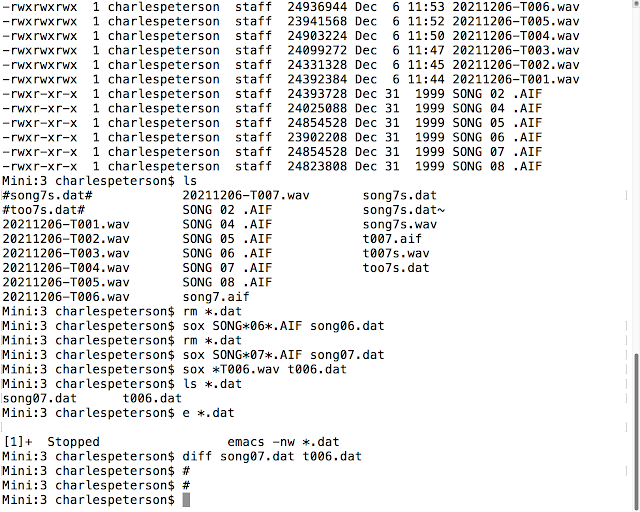
Once I got the two digital recordings to line up in time, and then removing the time counters from the files, using the method I've described before, they matched perfectly.  40 seconds of digital data at 24/96, almost 4,000,000 24 bit samples for two channels without a single difference.

The terminal on my computer screen looked like this:


(The two pound signs shown after the diff command were my initial faulty attempts to do a screenshot.)

Having passed the test, on the evening of December 6 I removed the Masterlink for storage and "permanently" set up the Tascam DA-3000 as my living room recorder.


Thursday, November 25, 2021

Mysterious Problem Solved on Thanksgiving

[See Update 2 at bottom.  It appears a Sonos update the next day fixed this problem for now.]

[Nov 27 update I filled in some more steps in the testing.]

On the evening of Thanksgiving 2021, I was playing the living room system through the Sonos Connect known as "Living Room Sonos."  Or perhaps I should say...the Sonos Connect soon to be formerly known as "Living Room Sonos."

I wasn't playing THAT loud, I had the Tact level set to -10dB or so.

There was terrible breakup on a recording from Pipes Rhode Island, the Frank Chorale in B Minor.

I was using the Sonos Connect instead of the Oppo BDP-205 because I had previously been playing the Kitchen FM Tuner in the Living Room, and Sonos has analog inputs which let me do that (the reason I selected Sonos in 2005).

I tried other things before finally determining the Sonos Connect was at fault.  I was first afraid the speakers had an issue, very afraid.  But it was hard to test that...so instead I switched amplifiers to the Aragon 8008 BB.  I hadn't done that in awhile.  I figured it *could* be an amplifier problem, the Hafler has about half of the peak output current of the mighty Aragon--which has 1100VA transformers for each channel.  It was still breaking up.

I was getting more and more afraid that the speakers were indeed at fault.  So I did something I haven't done in many years.  I got out my Koss ESP-950 headphones and listened to the same song.   Electrostatic headphones are like an auditory microscope...you hear everything.  The Koss transformer box takes coax line inputs, so I fed it from the coax line outputs of the Emotiva Stealth Dac.  I got the same breaking up sound.

OK, so maybe it was the digital processing.  I was now fearing that my FIR based digital input filters might be introducing some kind of artifacts.  ("F" stands for finite...it's an approximation over finite time...that's how it can do so many amazing things...because it's not exact--in principle.  But audio is never exact anyways.)

So then I fed the headphones (which take line inputs to the transformer box) from the output of my Tact digital preamp.  It has analog outputs (using an optional high quality DAC on an internal card) which I don't normally use because I only use the XLR AES/EBU digital outputs...which feeds my chains of digital processors).

Same breaking up sounds. 

Then it occurred to me to try the Oppo, and while streaming the file through the Oppo it sounded fine (except for a few "ticks" which I hear so consistently, even on my dynamic speakers, I believe they are in the recording itself.  These ticks are nothing like the hashy breaking up sound I was getting on the Sonos Connect).

Wondering how I could check out the digital output of the Sonos Connect (I only use the digital outputs on most Sonos nodes)  I grabbed my Sencore digital meter.

The Sencore showed nicely low jitter (just over 200ps) and no errors or any other problems with the Sonos digital output.  And when I first checked the levels, and after turning off volume leveling on the Oppo (which I play through Roon, whereas in this discussion I'm playing the Sonos boxes through the Sonos S1 Controller), the levels were identical.  While doing these tests, I was not playing anything over the speakers because I had the digital signal piped into the Sencore instead.

But then later I was doing a test when the Oppo was playing through the speakers, but running the test meanwhile on the output of the Sonos.  And then I got a bogus level of -0dB where I shouldn't have (the peak level in the recording is -0.7dB).

I switched to the other nearby Sonos node I have been using the play HDCD's through the converter of the Denon DVD-9000 by sending the coax digital from that node to the Denon.  That Sonos node happened to be the earliest model, the ZP80, which I first bought 4 of in 2005.

The ZP80 did not have the breakup issue either, so THAT is now going to be the Sonos node I'm connecting to the living room stereo.  I have rarely used the HDCD path (which sends digital audio from Sonos to the Denon DVD-9000 for HDCD conversion) and I could always temporarily change the coax output of that Sonos ZP80 back to feeding the Denon if I do want to decode an HDCD that way, that takes little more time than just turning on the Denon 9000 and selecting coax input.

I really don't know that it was the fact I was playing music (possibly causing vibration or putting noise on the AC lines) that messed up the "Living Room Sonos."  It might have been something else.  When it first happened, I thought it was because I had just clicked mute and unmute in the Sonos controller.  I had been wondering if there was a bug in which, under some conditions, the Sonos Connect does digital amplification when it should not be doing so (such as when the level output is fixed).  I had thought I had seen such a bug before.  But the test examining the level from the Sonos where it, at first, exactly matched the Oppo, disabused me of that theory for awhile.

It could have even been that the coax connection to the Sonos Connect was slightly loose.

All I really know is for some reason, that one Sonos Connect was messing up it's digital output, sometimes.  It could be the fact it is also processing the tuner input for the rest of the house.

Maybe it's better to have one Sonos Connect to handle the FM tuner input, and a second Sonos node of one kind or another to feed the living room stereo anyway.  I also trust the ZP80's as much as, if not more now, than the Connects.  I tested the ZP80's extensively, as did John Atkinson.  I never actually tested the Connects, I just presumed they were an upgrade.  I can't remember when I first started having strange issues that seem like digital gain and clipping, was it when I got the Connects or before.  Also nothing stays the same because of Sonos software updates, which may be more important than whether a node is a ZP80 or Connect (which are almost identical in appearance and apparently identical in intended function).

And most of the time, I'll just be using the Oppo through Roon anyway to play music in the living room, which is my best digital pathway.  But...I had been using the Sonos Connect to run tests, and I very deliberately did not add the test files to the Roon list of music folders for that reason.

That calls into question some previous tests...including the test where I decided I had to lower the input of the midrange miniDSP by -6dB to prevent inter-sample-overs.  Perhaps the real issue was the bug in the Living Room Sonos Connect.

So from now on, what I'm going to do for some important tests is to temporarily add the test folders from Roon when doing tests, and that way  I can use the Oppo for doing tests, without fear of selecting test recordings at other times through Roon.  And then removing the test folders from Roon afterwards.

Because of worries about forgetting to turn such test folders off, perhaps I'll still use a Sonos node for most tests, but the ZP80 which hasn't yet shown any issues, instead of the Connect.  Until there is a weird issue (like the apparent inter-sample-overs on the miniDSP's) for which the ZP80 might be at fault, which I should have thought of when I encountered the apparent inter-sample-overs on the miniDSP's while using the Connect.

It's here I might also confess that the primary issue that made me quit using my Audio G_D DAC 17, which was the Krell FPB 300 shutting down, perhaps was never a problem with the DAC 17 at all.  It was only many months after that I traced the many shutdowns to a bad transistor in the Krell itself, at least by all appearances (I can see the hot spot in IR photos for example).  And ultimately it became impossible to use the Krell anymore because it would shut down before even coming fully on, and therefore before I could zap it with a big enough signal to stay on for awhile.

It was sad that I didn't imagine that it was principally the Krell at fault.  I also blamed the speakers and other things, perhaps wrongly in other cases too.  I spent many months trying to "fix" the speakers so they "wouldn't cause" the Krell to shut down.  I still need to re-test the DAC 17 and I might even use it in the future now that my system has fixed digital rates for each way...making it possible to do the time alignment for sources of any sampling rate even with different DACs...since all sources get converted to 48kHz or 96 Khz (for the tweeters) anyway.

The Franck Chorale is sufficiently complex that despite hearing it endlessly, it sounded different every single time.  This is the actual problem with subjective equipment tests...it's not so much that things don't sound different, but that you never actually hear the same thing anyway, and then you have to decide which differences (if any) are traceable to the change in equipment (which is pretty much determined by preconceptions).  And repeats especially sounded different at different levels.  With large level differences, it sound like a different composer.

Updates: I have tested reconnecting (and tightening) the digital cable from the Living Room Sonos Connect.  I still heard the breaking up.  I'm beginning to think this particular unit could be defective.   And the line inputs might be defective too.   About the same time as I replaced the original Living Room ZP80  with this Connect node I also noticed the line input from the tuner wasn't sounding as good.  According to all I've read just now, the only difference between ZP80 and Connect (same as ZP90) was a different and better radio.  If I remember correctly, I made this change last December, about a year ago, when I was incorporating the Marantz recorder and making other changes to improve the sound of FM, and it did sound much better in the living room, but not over Sonos, where it sounded worse.  I've had this theory that the better FM antenna, which reduced FM noise, was also making it sound more crispy.  But it sounded fine in the living room because I added the Musical Fidelity X10D to that path.  It merely sounded worse over Sonos.

Also the ability to control the line level input levels was removed from the computer software.  You must use the App (on a smartphone) to control this feature.  Or originally you could use the CR100's to control everything, including the line levels and the "Uncompressed" feature, but then CR100's were unsupported, which made me very angry and I still miss the convenience of the CR100's as compared to using a smartphone.  With the CR100 the pause and play buttons were always active, whereas with a smartphone you have to do a lot of fiddling to do anything.

My tests and those of John Atkinson showed the ZP80 to be bit perfect and it performed very will in the jitter test and other tests.  But neither I nor John Atkinson have tested the ZP90 aka "Connect."

I had been disappointed that Sonos never included high resolution into the original system (I believe it is available in the new S2 units) and went the direction of making midfi convenience speakers and such, rather than sticking to true hifi interconnection units (now called "streamers") and reasonably good amplifiers.

I see now that even my old "Connect" units cannot be used with the latest Sonos software.  I hardly care, if anything, I'd like to return to the original Sonos software of 2005, which did everything I needed it to very well.  I did later get a Logitech streamer, but it was such a hassle to use I never much did use the Logitech streamer, despite the fact it had high resolution.

But I can see the name of the game for many people is supporting all the different streaming services.  That is the excuse for the new incompatible S2 Sonos units and software.  I hardly care if Sonos keeps up with streaming services because I use Roon for that purpose, and for me it makes much more sense to me that interconnection units be dumb and the smarts be put into the central software as Roon is doing it.  I'd long hoped to roll my own dumb Pi3 interconnection units that were Roon Ready, until Roon started supporting Sonos, and then I had no excuse (other than modest monthly cost) not to get Roon and use with my existing Sonos network.  But Roon has never had any ability to use the Sonos Line Inputs.

Update 2:  This morning I googled "Sonos Uncompressed" and found you can set that feature (which defaults to "Automatic") using the app not on a node-by-node basis, but on a whole system basis.  Reportedly this feature only affects line-in playback, but the App doesn't say so.

I went to check the current setting in the app, but it wouldn't even let me view the current settings without updating my whole system.  I'm not sure when this update became available.  So I updated my system, and then it appeared that the option had already been set to "Uncompressed," as I now remembered doing sometime in the distant past (but possibly when this particular Connect node was offline or before I even bought it?).

I had already been testing the Sonos Line Input between the two different living room Sonos nodes.  I think they are identical.  But anyway I had moved the tuner output to the ZP80.

So now, with these two changes (updating Sonos, and moving the line input to the other node--which might be unimportant) the Living Room Sonos Connect sounds fine, no breakup playing the Franck chorus.

The best theory now is that somehow the Sonos Connect had a bug which was fixed by the update.  After the update, no more problem.  Though perhaps it wasn't even the update but a reboot caused by the update.

A related possibility is that Roon can fiddle with the Sonos level settings and left them in the wrong settings.  I sometimes play the Living Room Sonos Connect with Roon.  Roon has two relevant settings for each Sonos node, "fixed level" vs "device level" and then, when you select fixed level, you can set volume settings: min and max.  Last night I went through all my Sonos nodes in Roon and made sure all the ones that are supposed to be "fixed level" are set to "fixed level" in Roon.  I had never done that before.  Indeed the Living Room Connect was set to "Device Level," but Sonos S1 controller always showed it as "Fixed Level" anyway.  But I don't recall that changing this last night made any improvement in the sound.  Perhaps it required to update (and reboot?) to get it changed back correctly.  Perhaps the update makes sure the settings in Sonos are the ones in effect when you are doing playback in Sonos, regardless of what some other streaming software may have been doing previously with that node.

I still consider the Connect to be questionable enough that I'm going to use the ZP80 for living room playback, and either use the Connect for line input only, or in some other room where I'm not depending on the Fixed Level setting to remain in effect.  The bug has gone away for now, but there's no telling when it might come back.

Still testing the Sonos Connect, I moved the tuner connections to the inputs on this node again, and there is still no problem.

Both Sonos nodes are now working fine, but I'm still planning to switch the living room stereo to the ZP80 which may be better...though it's possible and perhaps even likely the problem was a software bug that just happened to the Connect based on how it had been used.  It may have been, for example, that I pressed the volume up button on it, and if Roon had told it to use Device Volume sometime in the past, that may have overridden the Sonos settings when using Sonos, though it shouldn't have.

But actually I'll run the FM tuner outputs to the Connect unit because it has a better radio in case one of the ethernet links goes down.  And it will interfere less with the ZP80 that will mainly be used for tests on the living room stereo (though I've never noticed any interference including in these tests).  And the Connect will feed the Denon for HDCD encoding, so if the bug occurs again it will be noticeable as the HDCD light won't light if the bits are tampered with.