Sunday, January 19, 2020

Working out the 120 Hz notch

I knew I had at least one more day of sweeping and adjusting ahead of me, as when I last left off I had discovered the apparent notch I believed to be at 110 Hz or so in the stereo-correlated pink noise response, was actually being caused by the right channel.  I knew that after I fixed the 90 Hz notch in the left channel, after which it was quite flat in bass, the subject of my last post.  So any remaining notch had to be in the right channel, even though it was not fully apparent in the right channel response itself.

I went through a series of false theories before zeroing in on the apparent cause, fixing it, and measuring the results.

My first theory was that the notch at 110 Hz was being caused by rear wall reflection and cancellation.  Such is my tendency to view results through the prism of my own theories, that my first sweeping 50-150 Hz on the subs seemed to verify this.  The sub seemed quite flat.  Actually I hadn't turned up the level enough to be very sensitive to changes.

So figured I should fix the problem by boosting the subs to fix the panel response, and I tried that.  Sweeping had shown the suckout to be at 120 Hz, somewhat above the crossover point, but still permitting at least 4dB of correction by boosting the subs with a high q resonance at that point.

Indeed, it seemed to help.  Only after much further investigation I decided to listen to the panel response without the subs (what I should have immediately done to fully test the backwave cancellation theory).  Only then I discovered there was no "hole" in the panel response around 120 Hz.  They were smoothly rolling off down to the -6dB at 100 Hz, and that was about all.

Redoing the bass sweep, I finally heard the suckout at 120 Hz.  Now I noticed that this frequency was quite modal, and the listening position was indeed reduced about 6dB from the backwall position.  I tried fixing this by tuning my eTrap to 120 Hz, which is technically out of it's range, but I tried and got a barely measureable reduction right in front of the eTrap.  But it made at most 0.1dB difference at the listening position, so I decided to abandon this correction.

It was sometime after this I noticed something.  I had previously dialed in a 140 Hz notch into the subwoofer response.  As this was above the crossover frequency, I felt quite cavalier in a huge reduction, possibly not very well tested.

So I tuned out this 140 Hz notch, and it turned out to be entirely unnecessary.  There was no large peak in the sub response around 140 Hz, so it was hardly deserving of a 12dB notch.

Removing this pre-existing 140 Hz notch, with a width of 1/3 octave, fixed the problem at 120 Hz and allowed for much flatter response in the right channel and the elimination of the apparent 110 Hz notch in the stereo-correlated response.

I made a new correction at 80 Hz which seemed to be useful and some other fine adjustments.  I held to the process of initial adjustment with oscillator sweeping, which seems to help avoid invalid adjustments.  Adding in new filters on the basis of pink noise measurement is asking for trouble.

Bottom line: the problem was caused by pre-existing currently (and/or previously) invalid adjustments which are now fixed.  The bass is now quite sonically flat in both channels, confirmed by measurements and playing Rebecca Pidgeon's Spanish Harlem.

Right Channel

I've never noticed this before...now there does appear to be a suckout at exactly 1kHz!  Worthy of more investigation.  I doubt any of today's changes contributed to that.

The stereo uncorrelated bass looks as flat as ever, with just a wiggle around 78Hz I tried to reduce a bit today.


That wiggle around 78Hz, with gradual dips on either side, is simply exaggerated a bit in the stereo-correlated response.  That fact and this graph looks excellent.


Here are the Right Channel EQ's that make this possible.  I didn't even remember the 60 Hz EQ, but when I removed it sure enough things got worse (and the dip around 55 didn't go away).


Thursday, January 16, 2020

Another Day, Another Adjustment

Today I decided to tackle that dip in the living room left channel around 100 Hz.  I assumed that this was also related to the dip in the stereo-correlated pink noise at 111 Hz.  (This assumption now looks wrong.)

Crucial to my adjustment method is what I like to think of as "adjust-to-model."  In principle, I am determining faults in the system performance, and either fixing them (if possible) or "correcting" them through some kind of sensibly determined system adjustment.  The principle is fairly loose, I often don't know exactly what is causing this or that bulge or dip in the frequency response, I might simply label it "unknown resonance."

This is a vastly different philosophy, however, compared to the what-I-view-as-naive adjust-to-measurement school, which now seems to dominate the professional sound industry.  Endless devices over the past 40 years and still automatically measure your system.  Most take a fairly primitive adjust-to-measurement approach.  Actually, my TACT units are way more sophisticated than that, and I still don't trust them.  TACT uses a proprietary hybrid approach.  I'd prefer things be completely out in the open and customizeable.  Failing that, as all automated systems are, I'm fine with fully manual. I take measurements, devise some kind of model, and correct it.

In this case, I was convinced that the circa 100 Hz dip in the left channel was caused by an error in the delay compensation.  I spent several days over the past two years fine tuning the delay times for woofers, panels, and tweeters.  Most of this time was spent optimizing the right channel.  When it came to the left channel, I had little choice but to accept the same values, as until a few days ago I hadn't figured out how to set different delays in each channel of my Behringer DEQ's, which is the only place I can do it currently.

But now, I've figured out how to do that, so I got to work right away twisting the delay time for the left subwoofer only, to match it with the panels so there would be no "cancellation" I assumed was causing the dip at 100 Hz.

Well, no such luck, I turned the knob forwards and backwards by several milliseconds and there was no signficant change in the level as measured by my phone in the listening chair (I usually haven't been so exacting, I might even just listen to things on the floor and assume that's close enough.  But more and more it isn't.)

So if this notch near 100 Hz was NOT caused by cancellation, what was causing it?  It probably wouldn't be a room mode, or it would affect the other channel, and in the other channel I'm actually appling a large parametric EQ cut at 100 Hz (something I tried removing to make the stereo pink noise response better...but unflattening the response in one channel to make the stereo pink noise response better is not the path to Hi Fi...it's making the stereo balance at those frequencies Even Worse...as I decided quickly a few weeks ago after naively trying this adjust-to-measurement).  I immediately discovered the weakness was in the panel response, not the woofer response.

It didn't take too much thinking to begin wondering if it was boundary cancellation from the rear wall behind the Acoustats.  I though about how much distance the sound wave would have to travel at 100 Hz for 180 degrees of phase change.  That would be 1/2 wavelength, or about 5.5 feet.  My speakers are about 3.5 feet from the wall, making the sum about 7 feet.  That's pretty close, and perhaps all the extra stuff piled in this area reduces the "effective" distance.

I got out the oscillator and did some, well, lots of sweeping.  Note to self: despite my recent calibration, I can't really trust the markings on my Genrad oscillator.  I ultimately determined frequencies of interest by trying to cancel them with 1/10 octave notch filters on the EQ.  From this, it became apparent that the frequency of the most obvious notch is actually around 93 Hz.  That would correspond to about 6 feet.  Perhaps that's actually the effective "average" distance of membrane to wall given all the junk in the corner, or some other influence is bending the cancellation notch, but the measured notch seems too close to where the cancellation notch should be, and where the cancellation notch should be, perhaps around 78 Hz, there's actually a measured peak (around 81 Hz) that's I'm cancelling for (see later view of all left channel eq's).

In any case, given that delay has no effect, and the speaker positions are almost entirely determined by other considerations, including practical considerations, there's not much I can do except apply EQ to this notch anyway.  AND, since it's a notch in the panel response, it's essentially pointless to try correcting it in the panel EQ (and I only have mono EQ for the panels now, anyway).  Nevertheless, I thoughtlessly tried correcting the notch in the panel response, and it was nearly useless, with 6 dB of boost causing about 1dB gain in the measured response.

Fortunately, since this is very close to the 100 Hz crossover frequency (in fact, 93 Hz is technically IN the subwoofer range) I can, should, and must correct the problem simply by boosting the subs.  So, I simply added a high Q peak to the sub response at 93 Hz.  And it seemed to have considerable effect, though nothing like 1-to-1.  I didn't try to cancel out the notch as measured at the listening chair, but I raised the level a few dB.  Above all, one doesn't want to overcompensate, and especially when adding boosts!

Even with 1/10 octave bandwidth, setting this boost higher than a few dB seemed to make 100 Hz (where I previously thought the notch was) too loud.

I proceeded to spend 90 minutes sweeping the left channel 20-200 Hz, and tweaking existing notches mostly.  It was clear I needed to add a new EQ notch around 80 Hz, so I did, taking much of the burden off the notch at 71 Hz which I could then lighten up a bit.  Sweeping an oscillator by hand is FAR more internally revealing than even looking at a 1/6 octave RTA display.

In the end, I think I made the left channel bass sound pretty smooth.  I then looked at RTA and decided to make some additional refinements, then back to oscillator, and ultimately back to RTA.

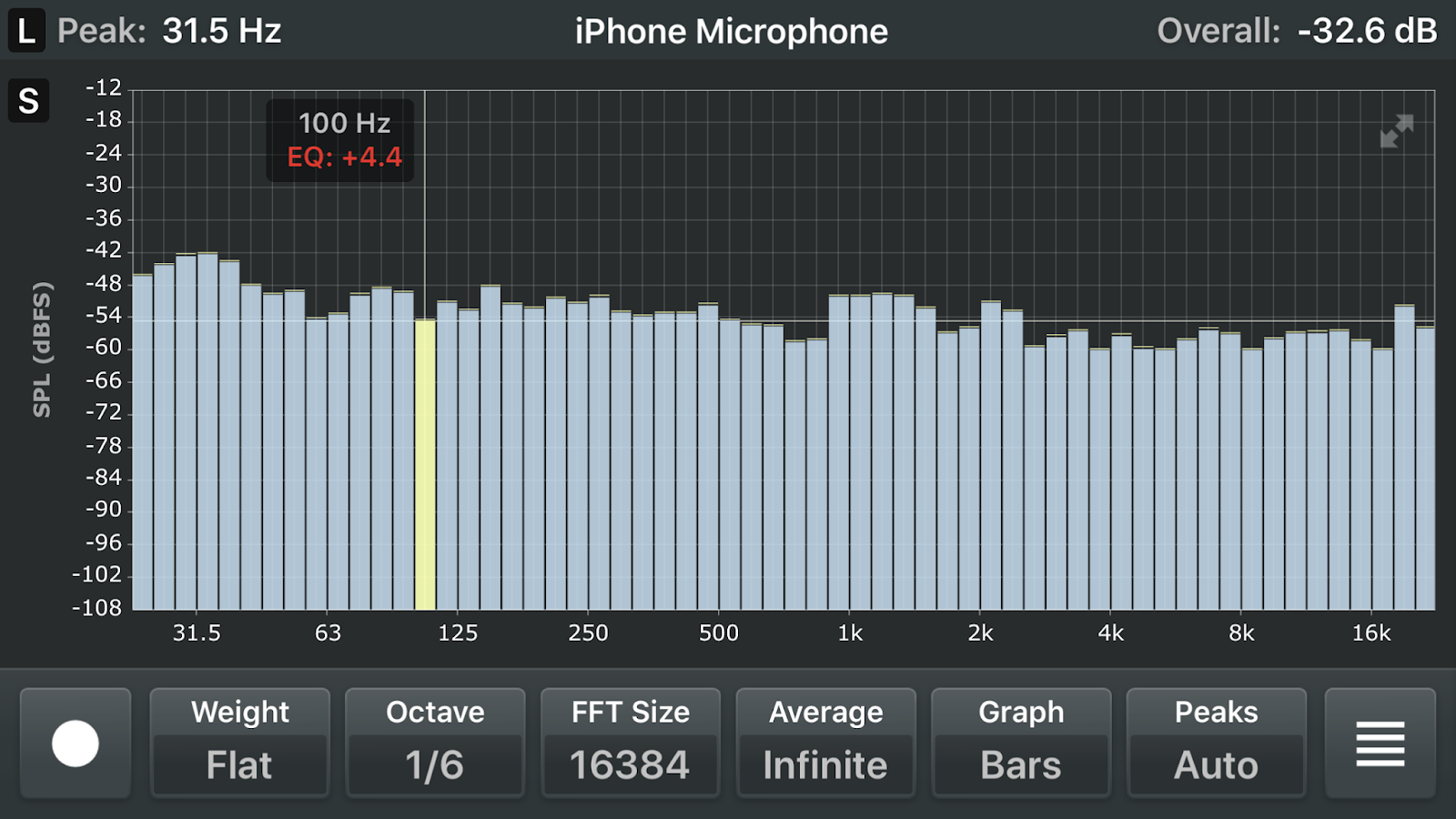
I did the best smoothing job on both the swept and 1/6 octave measured response with 90 minutes of sweeping and measuring.  The result being this


There still appears to be a slight depression at 100 Hz.  But this slight depression is not obvious when sweeping the oscillator, in fact 100 Hz "sounds" louder than frequencies below it.  In my interpretation, we are looking at essentially flat response from 50Hz to 20kHz, within 2dB (when averaged by usual methods) except around 30Hz, where the additional weight may be helpful.  I've almost always had a far more elevated bass response than this, only getting enamored with "electrostatic bass" in the last couple years, in other words essentially flat "room curve" except now below 40 Hz.  Also notice an extremely gradual "tilt" downwards with frequency.  Many designers over the years have come to appreciate this downward tilt as being sonically beneficial.  In my case, the downward tilt is extremely small, about 2dB down at 10kHz (it used to be identical to 1kHz until I added a new EQ there last week, to make the highs flatter from 3kHz-20kHz).  As good as it gets!  (Well, for now anyway.  Until tomorrow's adjustment.)

You can see the plateau from 90 Hz on down which led me to add a second notch around 80 Hz as well as the existing one at 71 Hz.  There was a larger roller coaster without notching 80 Hz down.  When sweeping the oscillator, you hear the exact inflection points (even if you don't know exactly what they are with my not-remaining-calibrated oscillator) and can sweep the EQ's as narrow as possible to cancel peaks resulting from modes and resonances.

I am always disinclined to provide "boost" for various reasons.  Since I run my digital processors close to 0dB there is essentially no extra headroom.  If there was a pure tone at the exact frequency, the boost could cause digital clipping.  However, at 93 Hz, the subwoofer drive is already being attenuated by about 5dB because of the LR4 crossover at 100 Hz.  So I think adding back in 2dB of boost is fairly (if not perfectly) safe.  (Perfect safety may require as much as 6dB of headroom WHENEVER you apply a boost or do anything tricky, then you can be sure sample-overs or other peculiar waveforms aren't going to cause clipping either.  Countering one EQ against another isn't perfect protection from clipping, I've discovered on numerous occasions.  I'll have to see how this current boost goes in practice, but it seems like it ought to be mostly OK, with possible clipping once every month of Sundays a small price to pay for solid and true bass with no annoying notch near 100 Hz.)

Here are the latest left channel EQ's:


Sadly, all this work didn't seem to remove the dip or notch in the stereo-correlated pink noise response for both channels.  So, all this work, and I didn't address that problem at all, which seems to be above 100 Hz and not below it anyway.


Tuesday, January 14, 2020

Adjustments and Discoveries

That dip in the left channel frequency response around 100 Hz was bothering me.  It seemed this might result from improper adjustment of the time delay between woofer and panels.  I played pink noise on left channel only and seemed to improve the situation slightly with some adjustment.  Then I played stereo and the dip got worse.

At first, I believed this was an old problem I'd never solved before (but, I solved it tonight!).  It turned out to be another problem I would shortly discover.

The old problem was that the woofer to panel distances are not equal for right and left.  There has always been insufficient space to do that.  However, over time, the direction of the difference has changed.  Originally, the right panel and speaker were the closest.  But when I got the 2+2's, I had to squeeze in everything more away from the door, and not it's the reverse.  The right panel and speaker are now the closest.

But for many years, it has seemed that I could NOT set delay times differently for the left and right channels in the Behringer 2496 DEQ's I use for both crossover and EQ.  I typically set the delay time after experimentation in the right channel, and then just accepted whatever resulted for the left channel.  Sometimes I tried phase reversal of one unit or the other, and sometimes that phase reversal was required (or not) because of how I had most recently replaced a defective plate amplifier in the subwoofers.  There is a LONG history here going back 5 years and more if you count the time I was using DCX units which did allow me to set the delays differently.  Finding the polarity adjustments on the subwoofers to have weird results, I tended to use an XLR polarity reversal device.  I was still using that by mistake until at least November.  Currently I am not polarity reversing either subwoofer as I find the two subs sound out-of-phase when I do that when I play them with panels turned off, and I believe that to be an important requirement (even though it more illustrates the out-of-band performance of the subwoofer than the in-band performance).

However, it occurred to me I might have left some polarity change setting set in the left subwoofer because I have to crawl behind equipment and on top of it to read the settings, which is hard to do and I sometimes forget.

So, I did just that, bringing a mirror with me to read all the electronically displayed settings of the left channel PB13 Ultra.  I find that once you start adjusting or reading a setting, the only way to get back to the menu is to just let go of the knob, let the display time out after a few seconds, and then press the knob again.  Even just letting go, the adjustments you have made remain selected.  If you hold the knob down, the sub turns off instead of returning to the main menu.  I find this counterintuitive but finally figured this little detail out.

Well, it turned out I had set a 15 degree phase change in just the left subwoofer (it was zero degrees phase change on the right subwoofer).  That was not intended, or at least I did not remember it.  I readjusted the phase change back to zero.  This seemed to flatten the left channel response around 100 Hz.  But when playing pink noise in stereo again, it didn't seem to help the 100 Hz suckout much.

Looking at the right channel by itself (and I should keep reminding myself to only do adjustments looking at one channel at a time for the bass) I found the bass had been turned way down.  It had been set to -20dB at the PB13 control panel.  I flattened the bass out by raising it to -16dB.  But when I do that, this channel definitely needs a 100 Hz EQ notch with at least -1.5dB to have flat response, previously I had that notch as big as -6dB.

The current situation at 100 Hz is this: the response in either channel and with uncorrelated pink noise in both channels in flat.  But when playing correlated pink noise (centered) there is still a notch.  This is still a puzzle.  I usually adjust bass using the uncorrelated pink noise finding the correlated pink noise is always tricky.  But in some ways, and especially the bass, the correlated pink noise is more like real music.

Despite not fully fixing the 100 Hz dip (it does seem a bit better) actually many other aspects of the bass are now fixed and obviously better.  (For example, the right channel was very lean in the bass, and the left channel had a notch and other issues caused by unintended delay.)

Actually, maybe I dialed in the 15 degree delay at some time in the past to try to fix the 100 Hz dip in stereo.  But it doesn't.

Future adjustments may be more productive because I've now figured out how to adjust the delay separately in each channel of the Behringer 2496 DEQ.   The trick is you have to hold down the "B" button next to the Left/Right switch on the delay page to get it to shift from Left+Right Together to Left or Right Independently.  Then you can tap it to adjust only the left or right channel.  Not being able to do channel independent adjustments has been a huge problem for 5 years since I replaced the DCX's with DEQ's.  It took a careful re-reading of the manual to figure this out, it would have been more intuitive if the independent adjustment were the default but it appears not to be.  Behringer considers it a feature you can adjust delays independent regardless of stereo-link or dual-mono modes which normally control how the Left/Right switch works on other pages.  But that also means you have to toggle the Right/Left switch between together and independent modes, just for the delay page.

I also adjusted the 45 Hz notches separately for right and left subs.  They very much need to be adjusted separately, the left channel requires notching at 45 Hz but strangely the right channel doesn't seem to need it anymore, and I wonder if my Etrap in the far right corner of the hallway helps that.  Notching 45Hz when a notch isn't needed adds to undesired depression at 56 Hz.

By the afternoon of January 14, I had gotten impressively flat uncorrelated stereo response (btw, it's flatter than the scale on the right suggests, divide those numbers by about 6 because they're not the kinds of numbers we are used to, they are sixth-octave-bin-weighted dB's, I know this now as I can "move" the graph by an apparent 3-6dB or so with only a 1dB adjustment on my EQ).


This is also showing my new EQ's in the highs I worked out this morning.  I've progressed from one "Gundry-Linkwitz" dip to two tailored dips also helping with Acoustat resonance around 6kHz, to now 3 tailored dips in the 2-9kHz region, yielding very smooth and flat response.  As I added a new upper notch, I found I had to strengthen the other notches or else they seemed to bulge up.  In the end, these are the notches (as of Jan 14 at 1:41 CST):

9037 Hz, 1 octave, -2.5dB
5200 Hz, 1/2 octave, -4.5dB
2729 Hz, 1/3 octave, -2.0dB

I tuned the 9037 notch entirely by looking at pink noise on the RTA.  When I set the bandwidth less an one octave, it was clear that there was bulging around the edges of the notch.  Only with 1 octave bandwidth, and centered at about 9kHz, did I get essential flatness.  It might even look slightly flatter at -3dB, but that made it sound dull, I thought, so I backed off to -2.5dB.

Normally I have used an log dial oscillator and ear to set notch frequencies and width along with rough level.  Level is then fine tuned with RTA and music listening.  That's my "basic PEQ method" and it's essential for the bass where very steep EQ's are generally required to compensate for room nodes.  For upper frequency issues, and especially wide bandwidths, the oscillator isn't much use and just using RTA might even be better.  It's certainly easier.  I should go back and double-check these adjustments with oscillator.  That's the final part of "my method."  Always going back and double checking, sometimes using a different method.

Only the people I know who are far removed from science seem to think such relentless double checking is not a good idea.  Cranks think you can simply take one perfect test or measurement and be done with tests and measurement.  Things don't work that way.  Where I've tended to fail is not in relentless repetition, but in establishing the narrative so I remember what I was most recently trying to do by what I did, and so on, so I invent false narratives sometimes and end up going around and around in circles before I get the correct narrative sorted out--if I ever do.  (I believe that's not uncommon among audiophiles, only most do this differently--because they depend on highly unreliable and improper listening tests, so poor judgments are initially made, only later to be reversed--if the audiophile is sufficiently open minded to even reverse an earlier bad judgement--many simply double down.)

Establishing the narrative correctly is what I'm trying to do with this blog, and hopefully better this year than in the past.  Having a notebook and using it correctly was always my weak spot in science class.  I had to work very hard to make things up that I hadn't written down at the time.

Here are the latest EQ settings as of Jan 14 2PM


Here is the Stereo-correlated pink noise response, showing a notch at 112 Hz (either it changed slightly or I imagined it wrong):

Stereo-Correlated Response

Otherwise, it looks pretty good, still showing a bit of peaking at 71 Hz (which I am suppressing with a 13dB notch which doesn't seem justified by the uncorrelated response).  The highs look very smooth.

I have dialed back the notches on both sides of the 112 Hz notch, and nothing seems to make much difference.  It varies greatly by room position, suggesting it is a center room cancellation mode, not something caused by other EQ's.


Right Channel
 As stated (I got something right for once) there is no "100 Hz" or nearby notch at 100 Hz in the Right Channel, in fact there is a slight peak at 100Hz (which is already being suppressed by EQ in this channel so it isn't far worse).  At the same time, there isn't ANY peak at 45 Hz, the frequency that has dogged me since I first got subwoofers.  The EQ for 45 Hz in the right channel is dialed back to zero.  This hasn't always been true in the past, I remember it being as high as -9dB.  It may be because of the ETrap in the far right corner of the hallway nearby (but I should test that idea).  This channel is not contributing directly (or uncorrelatedly) to the notch at 112Hz in the correlated response.


Left Channel
Nor is there a notch at 112 Hz in the Left Channel, however there is a tiny dip (remember, 6dB on these scales is really like 1dB) at 100 Hz.  I am not attenuating 100 Hz in this channel.  Conversely, there is a slight rise at 45dB in this channel, which would be far worse if I were not already attenuating it by 4dB.

Both channels need to be heavily attenuated at 40Hz, where there is still a rise showing.  But I do not attenuate below 40 Hz.  I used to even have difficulty getting a solid 32 Hz for some reason.  That appears not to be the case now (but the only thing I seem to have changed is the Acoustats, which aren't even playing at 32 Hz).  32 Hz is musically very important.  If I were to attenuate it, I'd weaken that musically critical region, and experience important regions below.  I think the bulge at 32 Hz is also position dependent also.  But mainly, it's new, I haven't investigated it, and I don't even think it's a problem yet.

Many Audiophiles use Room Curves ramping up to as much as 20dB below 100 Hz.  A tiny octave bulge around 32 Hz of 2dB or less is not only not a problem, it's possibly beneficial.  (Divide the scale numbers shown by 6 because we are considering the whole spectrum.)

Possibly the solid 32 Hz is because of the center room position.  My previous position, before the 2+2's, was about 1/3 from the front.


Friday, January 10, 2020

Home Sweet Home

My almost annual trip to California resulted in visiting only one currently active audiophile, the very industrious Roger who always has endless audio construction projects and modification experiments in process.  Well this time I thought his sound was far better than in a long time, and possibly due to his use of actual commercial amplifiers, Manleys, which looked sufficiently muscular and I'm sure were undeniably hifi.  Previously he was into SET's with a home made SET having an enormous tube.  SETs can have serious rolloff, and I think his might have.  However, Roger attributed the most recent improvements to damping, specifically the metallic 3M damping material he is now applying in over inch thick layers to potentiometers.  (This looks like great stuff BTW and I think I will start trying it myself in applications where hockey tape wouldn't work.)  He's tossed his transformer volume control (very complicated and expensive) because, in the end, he was unable to find a way to properly damp it (all those transformers!).  Still present were a few of his amazing huge clamps, (everything must be clamped rigid, Roger believes) but fewer clamps than before, or so it seemed, maybe I wasn't looking hard enough.

His system IMO has generally lacked high frequency bandwidth as it's first offense.  He's somewhat apologetic about that, claiming great hearing loss.  However, this time it was much more extended than previously I thought, despite his still taping off the electret tweeters on his Zu speakers.  It actually sounded tolerable bandwidth wise, also with new subwoofer.  (Perhaps the bass even makes the highs sound better.)  It even had one positive quality, solidity, which my system relatively lacks.  A lot of speakers based around cone speakers in small rooms have solidity, though it's often too much in-your-face solidity, Roger's was about just right, in that one parameter.

However, come home, and the improvement otherwise in my system is staggering.  I don't have a thin midrangy system like ESL-57's.  With my gigantic subs, electronic EQ, and huge Acoustat 2+2's, I still rate well on solidity, though it's highly dependent on the actual crossover, EQ, delay, and other adjustments.

And then soon my system became even better.  I was then so inspired to do some more oscillator sweeps, and 1/6 octave phone analyzer readings on the Stereophile Pink Noise track.

I clearly did show some loss at 100Hz in one channel.  Strangely there was NO notch at 100 Hz, (though I had set a notch to 104 at one time, the size was 0.0dB) just notches at 72.6 and 130 which I changed to 72.6 and 140, which somehow made a larger difference at 100Hz than you might expect, not flat but not terribly sucked out anymore.  This improved the "solidity" significantly.  Note the subwoofer is crossed over at 100 Hz, but notches as high as 140 make a significant difference to the sound.

I also fine tuned the Linkwitz range notches to 2729 Hz (1/3 octave, -1.5dB) and 5200 Hz (1/2 octave, -3.5dB).  These not only make for a smooth dip in the 2-3Khz range as various people have recommended, it flattens some issues with the Acoustats themselves, which actually seem to have a slight peak right where it hurts the ear the most around 6kHz and also around 2.7Khz  Previously I used a single notch around 3.5kHz, but that left lumps at the new notch frequencies.  I'm not sure when I zeroed out the sub 1000 Hz notches in the midrange.  When I got the 2+2's at first those EQ's, which I had tuned using the 1+1's,  seemed OK, but later it seemed they didn't quite fit where notches might be useful, and they weren't as much needed.  I didn't photograph the midrange EQ in November when I did my first official 2+2 sweeps and adjustments.  I think I might have zeroed out the sub 1000 Hz notches then, and/or added two notches above 2 khz, but they weren't exactly the same as now, or I added different sub 1000 Hz notches.  Anyway, in the interests of restoring solidity, and perhaps more, I've removed all sub 1000 Hz notches for now from the midrange, and have once or twice tweaked two notches above 2kHz (there could possibly usefully be a third around 8-10 kHz, just to flatten/smooth the response, but that "artistry" will require a lot more development).

The sound even more improved, and more solid, I had accidentally moved the listening chair too far back during packing but lined up to the original tape which puts the ear about 6 inches beyond the peak of the roof, works great.  I started going through my favorite "special" discs, DVD-Audios and SACD, and then just kept up playing CD's mostly, my new years resolution being to play more music, and now I'm pretty much keeping it always playing, most recently from discs since they are easy to collect from my racks (not so easy to put back).  Each different method of selecting music (each different App, or physical media storage system, etc) makes you choose different music--a sadly uninvestigated phenomena.

I've also recently sweep tuned the kitchen subwoofer for greatly improved sound.  It turns out the room exaggerated 41.8Hz, where I now have a -15dB notch 1/2 octave wide.  With this change, FM no longer makes one sick near the sink, for example, because of throbbing bass.  I may now be able to switch back from the remarkably fine Sansui TU-D99X, thin but possibly their actual finest model which introduced the Walsh-type FM decoder they patented, to my still best tuner of all time, the Kenwood L-1000T.  The latter had become intolerable because of the bass exaggeration.

With these minor (though, possibly the most important) changes out of the way, I then moved on to Tweak-O-Mania!

Just before my trip I had been in crunch mode getting my house "ready" for the trip in various ways.  The biggest project of the year was making the old Kimball organ redundant by sampling it, and then getting it taken by Salvation Army.  But projects continued right up to the last minute, including fixing tile in the small bathroom, hoping to make my house perhaps just enough more liveable for someone to move in (which, wouldn't be expected, but there is always a remote possibility, and those possibilities are important if for nothing else than one's own self esteem--I promised to get rid of the Kimball 6 years ago for one thing, and I'd been promising to fix the tile for several years).

So anyway, I don't really mean to complain so much, but because of all the other stuff, highly visible audio project were being deliberately postponed.  If I barely have enough time for all the other stuff, which indeed I barely did, just barely completing everything I'd planned to do, I wouldn't have made if I had dilly dallied with audio projects of questionable importance.

BUT NOW I COULD DO THEM!!!

So finally I had time to fix the big speaker wire messes, including the ways that both supertweeters were hooked up with big extra coils of wire and stacks of connectors that would be hard to explain to another audiophile (but could be explained, if I only had the time, and a patient enough listener).

The supertweeters are now (20 days after returning home) hooked up pretty much correctly, with the wires from the amplifier running to "connector blocks" where they are merged with the thinner gauge wire that connects to the roll-off capacitors and both supertweeters.  The connector blocks are actually repurposed Furutech tightening bananas, which accept a huge gauge of input bare wire.  I strip and twist a generous portion of all the wires together and shove them all into the bare wire inlet of the Furutech and then tighten the two screws as much as possible.  They most connect to the two of 11 gauge wires for each polarity of the Canare 4S11 that runs up to the connector block, together with the 16 gauge wire stranded that runs to the capacitors and speaker terminals.  They do this easily.  This is one idea that I've sort of adopted from my friend George, who uses a special kind of copper ring for joining pairs of speaker wires by a similar method.  He claims his copper ring is the best, blah, blah.  But the same principle can be used with most anything that clamps onto wire, I decided, and one can hardly beat the finely gold plated copper used in the Furutech connectors.

Actually, I fear this clamping method isn't as perfect as George believes.  If there is any room for oxygen, the copper will corrode, and corroded bare copper is a semiconductor.*  The bare stranded wires are not being clamped tightly enough to eliminate copper corrosion.  It's better to have silver plated copper in the first place (George strongly believes that silver or silver plating causes harsh sound, but that's because his reference is the softened sound he expects despite his transducers), then clamped strongly or soldered in some way that doesn't permit air oxidation.  But as far as resistance, etc., the fairly large mass of wire now clamped with two screws in the Furutech connector is good enough for the supertweeters, I have decided.  And it neatens up the wires, gets blocks of connectors off the floor, and it makes the wires as short as possible, with a new twist I'm also employing in the midrange.  I use lower inductance and resistance wire (the Canare 4S11) for the longer runs, and the slightly higher inductance and resistance wire (my silver plated teflon coated milspec copper stranded wire) for the shorter side.  It just naturally happened I had already set things up this way for the super tweeters, but I had a coil of the teflon wire on one side connected to a block of connectors because I had never had time to get around to trimming the wire connections to fit (ever since I had to move the supertweeters inboard of the Acoustats after upgrading to the Acoustat 2+2's).

(*George used to use copper stranded speaker wire that had turned sea green because of corrosion.  He said it's the best just like that, determined by his listening to it.  I'm not sure what kind of wire he was using when he quit playing his stereo 3 years ago, but it's certainly not silver plated.  He generally likes to space wires as much as possible, which creates a huge amount of inductance.  This is all NOT high fidelity to me, but it works for him.  He says that what I do, and things I often say, don't make sense.)

In redoing the supertweeter speaker/amplifier wiring, I discovered that one supertweeter was formerly out of polarity, or at least so it seemed.  Everything is now visibly correct from the speakers to the amplifiers.

I also had a very ugly block of connectors for the right Acoustat, where connected a short piece of 4S11 to a short piece of 16G "audiophile" wire (using polypropylene inner sleeves protecting the bare copper with the corrosive and poor dielectric contact with the vinyl covering) that actually connected to the acoustats.  This ugly block of connectors sitting on the floor consisted of a pair of Furutech locking bananas, a second pair they were screwed into, and a third RadioShack Gold connector merely to keep the two pairs of pairs of Furutech connectors properly spaced.

This all became necessary when the original short piece of custom terminated 4S11 was no longer long enough, either because I have moved the 1+1's out from the wall more (which I started doing in spring of 2019) or because I switched to the 2+2's when then had to be moved as far as possible to the sides, with the supertweeters now on the inside because I can't fit them on the outside and still have a passageway through the room.  So I've had this ugly block of connectors on the floor for about 6 months or more and it's bugged me every day.

My first approach, however, didn't seem fully satisfactory.  I simply soldered 5 inch pieces of the teflon solid wire to the ends of the Canare 4S11.  This solder joint was made in a fairly convenient but questionable way.  I simply wrapped a loop of the silver coated solid wire around the stranded copper, squeezed it down as tightly as possible, and soldered with eutectic solder.  After the pressure of the iron was removed, the wire always slinked a bit, making me worry about cold solder.  I worked on this through numerous attempts for two hours, and finally decided it was good enough, the joint looked smooth all around, just not quite as shiny as I would have liked.  I then was unable to find my "rescue tape" and all my shrink wrap was too small, so I had to cover up the joints with vinyl electrical tape.

That got rid of the connector blocks, but it looked ugly to audiophile eyes and thinking.  It would be much better to use a single piece of wire, preferably the 10G solid core silver plated teflon coated hand twisted wire I use for most everything else now.  But I would only want to do this if I had a locking banana of the "straight" kind, and not the "bent" kind like all of my Furutechs (which I just seem to have run out of again, I buy them in bunches now).

Well, it turned out that in fixing one side of the supertweeter wiring, I freed up a short piece of wire that had exactly the right kind of "straight" locking banana I needed, AND it had locking screws.  (I have some other pairs, of terminated 4S11 with straight locking bananas, but the 4S11 wires are crimped into the bananas, not screwed.)

These straight locking bananas were just what I needed to take one existing short piece of teflon twisted pair wiring and put it to use for the right Acoustat.  Crawling around the floor and especially making the connections behind the highly modified QSC ABX box I use for amplifier switching still took almost two hours of work, but finally the right Acoustat was wired nicely by audiophile standards, with no electrical tape or ugly solder joints.

At first, however, it sounded harsh.  I had the wire almost 18 inches off the ground, going up and over the Acoustat interfaces and the stack of digital equipment down to the ABX box connectors.  It occurred to me this "high" run could be picking up distant interference, or perhaps vibration.

I lowered the wire by bending it (solid core wire must be bent to each new shape) down closer but still about 7 inches above the floor mostly.  I also "damped" the piece of wire by hanging a Velco strap tied to a loop of phone wire serving as a dumb weight, in the middle of the wire run.

At this point it sounded great, and the soundfield seemed more unified than ever before, or at least a long time.

I then remembered that by switching from 4S11 to 10G twisted pair I was approximately doubling the inductance and 50% increasing the resistance.  This would make this shorter run of wire from the ABX box more similar to the twice-as-long wire (now 4S11) running to the other speaker.  So, for the first time in a long time, perhaps, I have basically equal speaker wire inductance on both sides, and the resistance is fairly close also.

I've never been one of those people to axiomatically cut all speaker wires for stereo channels to the same length.  I know this has virtues, but it then leaves you with useless coils of wire, which may better pick up noise and have leakage characteristics.  And with all the wires I have, it gets maddening very quickly.  So instead I terminate each wire to the more-or-less exact length needed (usually with some extra margin, but over time, I've been finding margins not useful anyway, and I just cut things pretty close to the lengths needed).

So just 20 days back home, I've made major improvements some delayed perhaps by years, and I'm enjoying music more than ever.

The rattle in the right Acoustat has not been noticeable, even though I'm consistently playing at the "realistic" level (1.0V input max to the Hafler which is just below it's rated sensitivity for full power).


Sunday, November 24, 2019

The Plot Thickens

I found I could eliminate all the rattles in one speaker playing Grouse by lowering the level to -14dB (0dB is approximately amplifier rated output and speaker maximum undistorted level).

Grouse We want to be loved is a veritable audio torture test, as it turns out, with extremely high peak levels, probably loaded with inter-sample-overs too (where the output level goes above 0dB between samples after oversampling...I've noted other post-2000 albums that do that a lot...this can add up to 4dB to the actual output level, I've seen so far) too.  Even though it doesn't sound like the bass or anything is hitting the stops, on this album, it actually is.

I thought of it as an amazing, and pretty good recorded album.  But I tried listening to it at the level of -14dB where it seems no speaker anomalies occur.

At this lower level, the album goes from interesting to uniquely magical.  The transparency of some recorded bits is mind blowing.  There's a bit (perhaps overplayed) that sounds like an old tube amplifier going into high frequency oscillation.  This has an almost impossible you are there quality, but only played at -14dB.  I get the sense, momentarily, that I'l at John Iverson's house listening to his Corona plasma speaker, except that he'd be playing 20dB louder.

One also hears quite a bit of clever panning and other fakery.  It's great fun, even more fun than at -6dB where I had been naively listening the first time.  That seemed like about all I could stand, the album seems far louder than the playback level, even for an experimental rock-or-whatever album.

But thinking about the improvement in sound information at lower levels...surely that's not my perception at work.  Normally we hear more and more at higher levels.  Listening to the album at -14dB (which was very late at night, perhaps 2am, and very quiet) for the first few minutes, I was nearly kicking myself to kick it up a bit.  I argued with myself that I was goind to do this for an entire song (and then, the entire album) as an experiment, which I didn't want to shortchange myself over.

What must be going on is that the speakers themselves lose it more and more at higher levels.  Especially with torture albums which are slapping them around to the maximum extent.  There may be some kind of internal vibration, which gets more and more intense.  Finally, because of some crack or whatever in the internal supports on one speaker, causing a distinctly audible buzz.

But even before that buzzing occurs, there is already sufficient internal vibration to obscure information, leading to greatest effective transparency in the speaker-ear system at some lower potential level.

I had thought that something like this was going on before, but never had such a clear indication.  The Acoustats are like 2 speakers, one with Quad ESL like transparency at Quad ESL like levels.  And then also a head banging speaker which will play much louder, but loses that magical transparency at higher levels.

And it's why some people have gone to extreme measures with floor and ceiling braces to try to fix the Acoustat internal vibration issues.

(There is also an effect in human perception, where we lose information at higher levels.  But that would only be at way higher levels than I was getting to at -6dB.)

In some sense, the audible buzz is a warning indicator.  Turn the level down for better sound.  But I do intend to fix it anyway.

Saturday, November 23, 2019

Ohoh. Rattle in the 2+2's

In the past few days, I readjusted the bass EQ using my method (sweep with oscillator and adjust parametric EQ functions to fix all the bulges).  Last weekend the right sub wasn't even working (not sure how long) but after fiddling with it (I suspect loose something related to AC power) it started working again and I'm now keeping it in the "ON" rather than "AUTO" mode which might keep it warm enough to keep from dropping out again.  The faulty speaker is near the doorway were it may get more humidity.  Before I replaced the plate amplifier about a year ago, I had always kept this unit turned on.

I did the EQ adjustments (notch filters) basically from scratch, staring with the biggest bulge (either 40Hz or 45Hz depending on side) and working on down.  I can't remember the last time.  Anyway, it worked out fabulously, better than ever before, very flat bass response and no 100 Hz bulge (which has been one of the toughest to deal with).

So, on Friday I was enjoying some of the most transparent sound I've ever heard, if you can call it that playing electronic music from William Orbit and Grouse.  But then, playing Grouse (which itself is full of "deliberate" rattles and distortion) it became clear there is a rattle in one speaker.  I reversed channels and it was still there.  I tried squeezing the speaker (which seemed to help at first), slight shaking, etc., nothing helped.  I turned out lights and did not see any sparks or smell anything.

I isolated a 15 second piece of music which curiously doesn't sound loud but has a very high peak to average ratio and seems to include a bunch of tones which harmonically beat somehow and stimulates the problem consistently.  Playing that over and over, it seems I can sometimes get the rattle to go away, but then it comes back again.  Sometimes playing at the loudest possible level actually suppresses it longer--but then it starts again.

I'm pretty sure it's "mechanical," a broken stator wire support or something like that.  It probably wouldn't be hard to fix, once I get the stock off of the speaker, which I've never done before, mostly fearing the part of putting the sock back on--which is near impossible to do as well as the factory did it (no wrinkles, etc).

I'm not going to bother fixing this until mid January at the earliest.  It's another "opportunity" to do something I've never gotten around to doing before.

Thursday, November 21, 2019

Acoutstat 2+2

I haven't written this up yet?  The Acoustat 2+2's that I set up in July have of course made the biggest difference in 11 years, since I got the Acoustat 1+1's.  Speaker upgrades are big.

I had for long doubted the 2+2's were even better than 1+1's, for the reason that the 1+1's are more like a line source, or so it seems at first glance (more about that later).  So, I reasoned, the 1+1's are the perfect speaker for my small space, because I don't really need more dynamic range (not really, as it turned out) just the thinner profile which works better being closer to.

So, even the likes of Mr Acoustat, a late longtime fan on DIYAudio (and no connection to the original company) preferred the 1+1's, for his mostly smallish rooms.

However, as time went on, I was beginning to think there was a certain loudness I really could not (or was never tempted to ) exceed, because the 1+1's were sounding more closed in, so I always kept the levels somewhat below the 1+1 maximum output levels, so I became more interested in what the 2+2's might actually sound like, or even thought of getting a high output level 2nd set of speakers just to hear "louder" when I really wanted to.

It was about that time, 3 years ago or so, that a friend acquired a pair of 2+2's.  I heard them in his much larger room, and I was blown away.  I felt there was nothing lacking at all, they were simply better in every way.

It was exactly that same pair that came up for sale, with an interface refurb and mod (because the owner feared he might have damaged them).  They still seemed OK if not as glorious as I had remembered them, so I bought them.

It became clear after a day that one speaker had far less treble, and I couldn't even adjust the difference out using the level controls, nor did the "air" mod help.

Fearing the worst, I went through a process of system substitution, and narrowed the fault to one interface unit, and then to the HF transformer.

Well, as it happened, I had a spare NOS Medallion HF transformer to replace the HF transformer.  The rest of the transformers in these 2+2's are NOT Medallions, as I had hoped.  But actually, this makes LESS difference with the "C" mod that has been performed on them.  The C mod reduces HF transformer saturation, so the enhanced anti-saturation construction of the Medallion transformers is less critical.  These units ALSO got the "air" mod and switch added, but the "air" mod seems to bypass all the attenuation, possibly putting more voltage on the HF transformers, and frankly I don't like the way it sounds anyway.  The C mod design, and with the variable attenuator knob type interface, seems like the best interface design to me, and can be dialed in to perfection (though I have only moved the controls a hair off center) with ease.

I had almost finished re-connecting the new transformer, I was on the last lead when I noticed the original had not been wired correctly.  The - HF and - LF leads were reversed.  Well, that for sure was the source of the problem!  But having only one more solder connection left to finish the job, and compared with hours of work (possibly breaking something) removing the new transformer and re-installing the old transformer.  So I decided to leave the new transformer in place, and now with the correct wiring too.

This restored the amazing sound I had originally heard years before.  It was simply better in every way.  Even the "line source" issue is not as I had imagined.  And, it doesn't seem that having one Medallion HF transformer significantly unbalanced the system either.

Many things are at work here.  First, having twice the membrane area means that for any SPL level, there is half as much panel movement, therefore half as much distortion from that mechanism.  And there's less saturation in the transformer as well, and half the level from the Amplifier is required, meaning less distortion also.  So, no matter how loudly you play, having twice as much panel area gets you half as much distortion, and this seems apparent in the effortlessness of the speakers as well as the greater information.  That was the key thing I noticed from the very beginning (and in fact before I fixed the transformer: more information.

It's much like that 70's photo of the listener being blown away, as if the speakers were something like a hurricane.  But in this case, there no physical force or movement of one's body or hair, it's a change in one's mind: there's more there there somehow, at every level, it's more real and satisfying.

Greater information at all levels is the biggest improvement, but there are others.  Perhaps the second is that I have finally adjusted the highs correctly.  With the 1+1's, with their newer style box, one can't just "turn a knob" to change the HF level.  It's not that hard if you have the interfaces unscrewed, as I always did.  But it was hard enough, that I never even bothered to try.  I just left the HF adjustment alone, figuring it was "correct."  But I have no idea if the previous owner adjusted them.  It didn't look like he had, but also it seemed my resistance values were significantly lower than TheAcoustatAnswerMan at DIYAudio said was the factory default.  When he said that, I didn't believe it, because my boxes looked so untampered with.  But now, realizing how the 2+2's sound at about their central position, which appears to be right (for them) but midway in the HF attenuator, I realize I was playing the 1+1's too hot.

So this improvement is actually something I could have had with the 1+1's, I just never tried it.  BTW, the 1+1'\s require a different attenuator setting than the  2+2's, precisely because there is also a LF transformer setting change which gives the LF transformers less "gain."  So, by design, the 2+2's are set to a "central" attenuator setting, whereas the 1+1's are set much higher, according to the factor spec I have heard, just not as high as mine were set, which was about as hot as they get.

Now, I had compensated for the too-hotness of the 1+1's in a peculiar way, which negated the problem for serious listening (actually, NEGATED it too much, I always thought, but it was hard to do otherwise without creating a super tiny sweet spot, head in a vise) but meanwhile meant, for casual listening every where else, I simply got the too hot highs in even greater measure.  And it turns out a lot of the listening I do is casual listening, even from other rooms, because I like the way that works out as opposed to having background music piped in to every room--because then it's too much in your face, it's actually, as I'm quite honest with myself in admitting, a form of information reduction because quite often that's better for background listening.

The method was this: I was listening far off of the central axis of the speakers.  On the speaker axis, the sound is way too hot and even slightly brittle, and very much head in a vice.  Of axis a little, it gets a little better, but the head in a vice got better and worse.  Finally, between 18-28 degrees off axis, there's a range where the high attenuation seemed about right, but all the venetian blind effect was gone, all of it.  So it seemed the best positioning was about 23 degrees off axis, giving full relief on either side from that pesky vice.  That position was also, a bit too much attenuated at the listening position, but it was OK, especially with my super tweeters crossed in at 20kHz but contributing lower.  It was often unnerving, however, to have the highs bright (and sometimes uplifiting because of that) and then sit down and have the highs greatly collapse, even if actually being somewhat more natural but from the other side.

Well, now, I have none of those issues.  The 2+2's are just fine head on, and may be optimal at a more useful angle of 12 degrees or so off of the speaker axis.  The brightness with the level control centered is just about perfect at the listening sweet spot and everywhere else.  This is big, very big, for my casual lifestyle.

So part of this was my previous ill-adjustment, and the other part was something I'd never even imagined before.  The 2+2's are two vertical columns of electrostatic elements, and those two vertical columns are in fact themselves angled slightly from one another and from the central speaker axis.  That slight angling has many useful effects.

For one thing, when one is right on the 2+2 speaker axis, neither element is facing you directly.  As before, I believe these Acoustat electrostatic drivers seem to have a slight issue exactly head on, by themselves, but here they have no issue on the speaker axis because then you are off axis by small amounts (5-10 degrees I figure) which is right where the Acoustat panels my themselves sound best.  But then, as you move off the center of the 2+2's, you get more on-axis with one panel, and less on-axis with the other panel.  The blending effect of that eliminates the worse beamy qualities at every angle, at least in the range of plus and minus 25 degrees.  So now,  I can pick whatever angle works best for other reasons, and not be constrained by a horrible venetian blind effect right at or nearly at the center of the speaker.

Other speakers do similar things.  The top Martin Logan models have for many decades used a horizontally curved membrane.  In my opinion, that introduces many technical issues.  It was amazing that they got it to work at all, but the earliest models weren't very good sounding IMO.  Now I think the latest ones may be fine, but it's still complicated thing to do, as the mebrane must stretch and relax far more as it goes in and out.

The Sound Labs use lots of little speakers arranged in a cylinder.  That has advantages, but disadvantages also.  To get the same amount of radiating area, you need a substantially bigger speaker, and it's far more expensive to make.

Given such possibilities, the Acoustat way of simply angling the two columns a speaker is amazingly elegant and works amazingly well, IMO.  Perhaps, overall, it's the best approach.  It can't be done for more than two columns of panels, and work equally well.  Two vertical columns is the optimal number, as each can be only a few degrees off the central axis.

And that applies to the third improvement.  It could even be that the two angled columns actually produce a narrower effective "line source."  It does require a slightly greater distance from the speaker for full coherency, perhaps 4-5 feet (the 1+1's are coherent at 3-4 feet).  But at that slightly greater distance, the imaging is even better, along with more depth, etc.  The greater information also contributes to this, so the quality of the line source itself may not be much better, but it is far from being worse.  The 2+2's routinely have the spacious depth which I called layered depth that I first heard when I started using the Krell FPB 300 on the 1+1's eleven years ago.

I've continued keeping the minimum (in the back inside) distance from wall at 3 feet, actually 39 inches on the inside to the front wall and 47 inches from the outside to the front wall.  The factory spec of 3 feet in my experience is an absolute minimum you must exceed.  The distances I've listed are the greatest my living room can sustain and still be good for other purposes, as I discovered at my last party.   To make the current speaker arrangement work at all, I had to put the supertweeters on the inside, which is not the best location for them, but works well enough, and allows the 2+2's to be as far apart as possible, which is helpful in my relatively narrow room, and allows for the slightly greater distance from the speaker to the sweet spot, which is now just behind the room center (as I had discovered this year, works perfectly fine with the EQ I had been using, and even better when fully dialed in).  It took a month to find this new slightly further back sweet spot and angle the speakers just right, and then some more time to reset the midrange EQ's to notch out the slightly different LF resonances and the make the usual 2-8kHz slight softening for best sound.

And any amplifier has to work half as hard into the punishing 2-ohm minimum load, which is another big win.  Now I no longer need a 1200W into 2 ohms amp like the FPB 300 (which has now been retired, after one too many failures after professional repairs, when I have time perhaps I'll learn to fix it myself).  The Hafler 9300 sounds equally fabulous without any strain at any useable level.  The Hafler is somewhat power supply limited (compared with the Krell) but with the 2+2's it's become a non-issue.

So, it's a win-win-win-win!!!!  And now I have the incredible 1+1's to use as my Laboratory speaker (though that took clearing out all the junk, which could not have been done in months had I not already been retired).