Saturday, November 12, 2011

Parasound HCA-1500A quiescent

After about 2 hours of idling, the Parasound HCA-1500A is drawing 65 watts.  Heatsinks seem to be measuring max temperature around 108 degrees F, mostly mid 100's, measuring through the highly ventilated top cover, might actually be a bit higher with cover removed since cover may be confusing my IR probe.

After overnight idling, the draw is 63 watts.  Heatsinks are like before, with max around 107.


At low levels, Aragon amp is Class A

I was surprised to see power consumption hovering around the quiescent 160W (+/0 4W) playing KPAC radio at medium level today.  I had Tact volume set to 82.1 and Behringer level set to -6.1 (bass is at -7).

If power consumption doesn't increase, it's operating like Class A.

This might not be a surprise with many speakers, but the Acoustat 1+1's pull voltage and current unlike just about anything.

My Aragon 8008 BB Warmup


Time, total amplifier power consumption, emitter resistor voltage
1min, 140w, 21mV
2min, 160w, 25mV
3min, 175w, 28mV
4min, 186w, 29.5mV
6min, 192w, 30.3mV
8min, 190w, 30.1mV
10min, 187w, 29.8mV
?, 175w, 27.9mV
?, 171w, 27mV
20:30, 168w, 26.5mV
?,162,26.5mV
30, 158, 26.1mV

All measurements taken from right channel (what Klipsch calls "outside" channel).  While Klipsch information suggests inside channel is to be biased higher, I measure higher temperatures (by about 3 degrees F) on the outside channel, therefore I suspect my early production unit has the same bias (much higher than Klipsch specified) in both channels.

Beyond 30 minutes, the voltage continues to fall to about 24.5mV, the starts rising again toward 26.5mV peak.  After 10 hours of idling (with covers on) there is still a little oscillation, but it's close to 160w and therefore presumably 26mV.  The temperatures in the middle of the heat sink measure between 130 and 136 degrees F, it gets cooler toward the edges, down to 125 or so (but possibly also measurement error, given that my IR probe has some width function.

Thus, there appears to be a damped oscillation, the "mass" effect probably coming from thermal mass, and the "loss" coming from convection.

When playing music at moderate level, the heat sinks do not appear to get much beyond 136 degrees, and in fact cool down with music at moderately low level.  I haven't yet seen temperature above 137 degrees.

Now Klipsch called for 8mV for inside channel, and 12mV for outside channel, but that doesn't fit with my numbers at all.  And in fact it doesn't seem to fit with the Klipsch specification of 120w power consumption for 8008 mkII (same as BB) amplifier.  Looking at my numbers, an easy extrapolation shows that 120w would correspond to emitter voltage of 17mV.

From that number, or any of these numbers, given the assumption of equal biasing in both channels, we can figure out how much power the output transistors are dissipating at idle and therefore how much the rest of the amplifier is dissipating.

I'm going to use one of my best numbers, the 30 minute reading of 158W and 26.1mV.

26.1mv across 0.33 ohms is 79.1mA
79.1mA across 140V (+/- 70V rails) is 11.1w  (Note: I didn't measure rails. AC was 123V)
11.1w for 6 transistor pairs is 66.6w
66.6w for 2 channels is 133W
That means the rest of amplifier must have been consuming 25W, quite plausible.

Now that I can estimate the actual factor emitter voltage (17mV), I can calculate the maximum class A power for an amplifier with that level of bias current.

17mV across 0.33 ohms is 51.5 mA
51.5mA for 6 transistor pairs is 309mA
Maximum Class A average power into 8 ohms is 2RIb^2 1.53w (or 3.06w peak)
Maximum Class A peak power at any impedance is Vr(2Ib) 43.3w  (Vr is 70v)
Maximum Class A average power at any impedance is 21.6w
The impedance for maximum Class A power is V/I  113.3 ohms

That would seem to be the Class A specifications for a factory biased 8008 BB or 8008 Mk 2 operating at 120W idle.  It would have less than half of the 8 ohm Class A power as mine, but still well exceeds 1w.

On the other hand, an amp biased according the the Klipsch memo at 12mV inner channel and 8mV outer channel would do this:

12mV across 0.33 ohms is 

Thursday, November 10, 2011

Now I need ESP950 to Stax Amp adapter

They are available commercially through A Pure Sound at $140, seems like ripoff.  They will also modify your Koss with new cable and Stax plug for $150, and that seems like a lot better value.

Here's a thread about where you can buy the 5 pin Stax Pro Plug.

It's said to be the same as 6 pin microphone connector, minus the center pin.  One manufacturer is WBI.  Allied used to sell them.  It may be called "6 pin XLRM"

Koss E-90 Energizer Inside


The inside of the small Koss E-90 energizer is fully stuffed with two circuit boards.  It's easy to get the above view simply by removing the back cover.  From there, however, disassembly gets tougher, you have to remove the feet (which would presumably need to be glued back on), the volume control, and the front headphone jack to get the two circuit boards out.  I didn't feel sufficiently motivated to do that.

The bottom board appears to be mainly power supply, and ends in a row of electrolytics that couldn't be much bigger and still fit.  The upper board appears to be the amplifier, and seems stuffed with small transistors, resistors, and other parts.  Notably toward the front there are a few mylar caps which might be easily replaced with polypropylene.

Everything I've seen continues to convince me that the power supply is almost certainly a switching design (down to the choke in the back similar those seen in all switching supplies), and most likely the amplifier is a kind of switching type (actually Pulse Width Modulation) too.  One interesting feature is the ribbon cable that connects bottom board to top board.  This is independent of all the signal connections, which are quite obvious.  Is this because the top board needs many different independent power supplies?  That may be part of it, but it could also be that the top board ultimately synchronizes with the bottom board through multiple phases of a high speed clock.

Now PWM amplifiers are VERY efficient, and usually quite capable in delivering full power at any frequency, attributes that appear in the E-90.  But where they fall down is that there is not as much resolution in the upper frequencies as in the lower frequencies, because as the audio frequency approaches the switching frequency, it can only be constituted from a smaller number of up and down choices.  This is a problem with all 1-bit-like systems, including the DSD system used with SACD, despite the 2.88 Mhz sampling rate of DSD, a huge amount of digital processing called "noise shaping" is used to shift the noise (i.e. low resolution) from upper audio frequencies into the supersonic.  Earlier PWM systems attempted to use frequencies as low as 500kHz, which is obviously way inadequate.

Although Infinity and Sony made PWM amplifiers in the golden 1970's, the idea became unpopular either for real or rumored reasons.  Bob Carver has always wanted to make the highest power highest value and highest efficiency amplifiers, and said he tried to make a good sounding PWM design, but gave up, and instead went with the rail voltage switching designs he dubbed Magnetic Field amplifiers with characteristic flair (i.e BS).  The rail voltage is switched to whatever the current signal level requires, allowing the rails to stay as low as possible, therefore requiring the amplifier to dissipate as little power as possible (most of the energy going into the load instead of into amplifier heatsinks), even less than an Class AB amplifier, though otherwise it is made just like a Class AB amplifier.  Actually the idea seems a bit rube goldberg, but Carver got it to work by using chokes to store energy sufficient to kick the rails up when needed, and that's where the Magnetic Field name truthfully comes from, but reading Carver's ads you would think of something entirely different.  Since the late 1990's, however, electronic technology has advanced to the point where very high speed PCM digital systems could drive a PWM amplifier much more accurately than previous analog systems could.  So PWM amplifiers are back on the scene in a big way, even made by high end manufacturers such as Tact and Rowland Research (the latter formerly known mainly for building massive high bias amplifiers).

But now that I've also mentioned the rail switching design, it is entirely possible that the E-90 is a rail switching design also; it would provide the needed efficiency and eliminate the need for significant heat sinking just as in Carver's Magnetic Field amps.  Koss is rather mum about how their E-90 actually operates, giving only the barest of specifications to a direct inquiry.

Stax, in contrast, has gone for Class A electrostatic headphone amplifiers.  Class A amplification is the most linear and needs the least corrective feedback to work decently well.  It is also the most inefficient, consumes the most power, and needs the most heat sinking.  But many think it's the way to go for audio because it is the highest quality.  Stax is the commercial leader in making electrostatic headphone amplifiers, it's a veritable giant compared with the tiny perfectionist operations that make amps like the Blue Heaven.  That being said, even Stax is fairly small as electronic companies go, and even smaller since the 2000 bankruptcy in which all other business lines were dropped but headphones, their most well known product, were continued (thank goodness).

Stax tube amplifiers may be the most famous and popular among it's top line products, and many feel give the right harmonic balance to the otherwise slightly bright sounding phones, Stax has made transistor Class A amplifiers for headphones since the 1970's, and many feel the transistor amps offer the greater ultimate resolution and clarity.  My view is that the Stax tube amps aren't worth the money.  The tubes used do not seem to me like the right choices.  From reading many reviews (never tried one myself) it seems the tube amps seem deliberately down rez'd to soften the music.  If you want tubes, get a true perfectionist tube design like the $4995 Blue Heaven I described in an earlier post. But there is little such complaint to be made about the Stax transistor amps.  They seem honest designs, if not as far out as some made by elves.
Stax srm 1/mk 2
I have now bought a Stax SRM-1 MkII Pro for $325 (the low price coming from the fact that the seller can't actually test, but he is allowing me a 7 day trial and examination).  That is a Class A solid state amplifier similar in concept and execution to Stax's latest top-of-the-line amplifiers (which cost up to $2400), but made from 1982-1995.  It's said to be better than the current lower end Stax amplifiers, if not quite as good as the current top-of-the-line.  Picture below is from article by Ken Rockwell which you can read at this link.


Wednesday, November 9, 2011

More thoughts about Koss ESP950

I've been reading this great thread about headphone waterfall plots.

The author has measured Koss ESP950 and likes them a lot.  They have very flat and smooth frequency response compared to most, and very good lack of stored energy in the upper mids and highs (just some tiny wriggles, similar to but possibly even better than most Stax electrostatic headphones, which are typically much more expensive).

There is considerable stored energy in the lower mids and upper bass.  This is possibly attributable to the less-than-open enclosure.  The author strongly disagrees with the proposition that the Koss is bass weak, in fact he thinks it has a slighly dark sound, partly from the orientation of the stored energy, and partly from rolloff in the extreme highs.  However, there is rolloff in the very deepest bass.

He believes the ESP950 sound much better through a midrange Stax transistor amplifier, the 323 (which sells for about as much as the entire ESP950 package, with other stax amplifiers selling for far more).  He feels it opens up the sound compared with the Koss E90 amplifier, however waterfall plots show essentially no difference in the mids and highs.  There is one measured difference, a significant extension of the deepest bass.


I've studied some response curves, and decided Koss would sound a tad better with a mild boost starting around 2.5k, and possibly more up higher.  Tonight I tried 2dB and 3dB boosts at 3k, which is the lowest my Tact digital pre will do an easy treble boost from.  These boosts are surprisingly subtle, but both seem to make the sound lighter and have a more open quality, more like my old Infinity ES-1 headphones.  I'm sticking with the 2dB boost for now on the least harm principle, though 3dB might actually be better.  And guess what, bass instruments sound less muddy also.


One thing nice to know is that apparently the Koss E90 doesn't do any special equalization.  Other than the deeper bass response shown with the Stax 323, the frequency response is the same.

Elsewhere, I've been reading many many blogs devoted to making electrostatic headphone amplifiers (usually for Stax, but often for the Koss as well).  Often these amplifiers are very elaborate, and even the parts cost might exceed the price of all but the most expensive Stax amplifiers.  There is an enormous and unexpected number of websites and articles devoted to such projects.


Above is picture the first tube amplifier from about 10 years ago by Kevin Gilmore, who went on to design others.  He complained that the Stax SRM-T1S tube amplfiers use 6FQ7, which isn't really up to the job.  He uses 654A's.


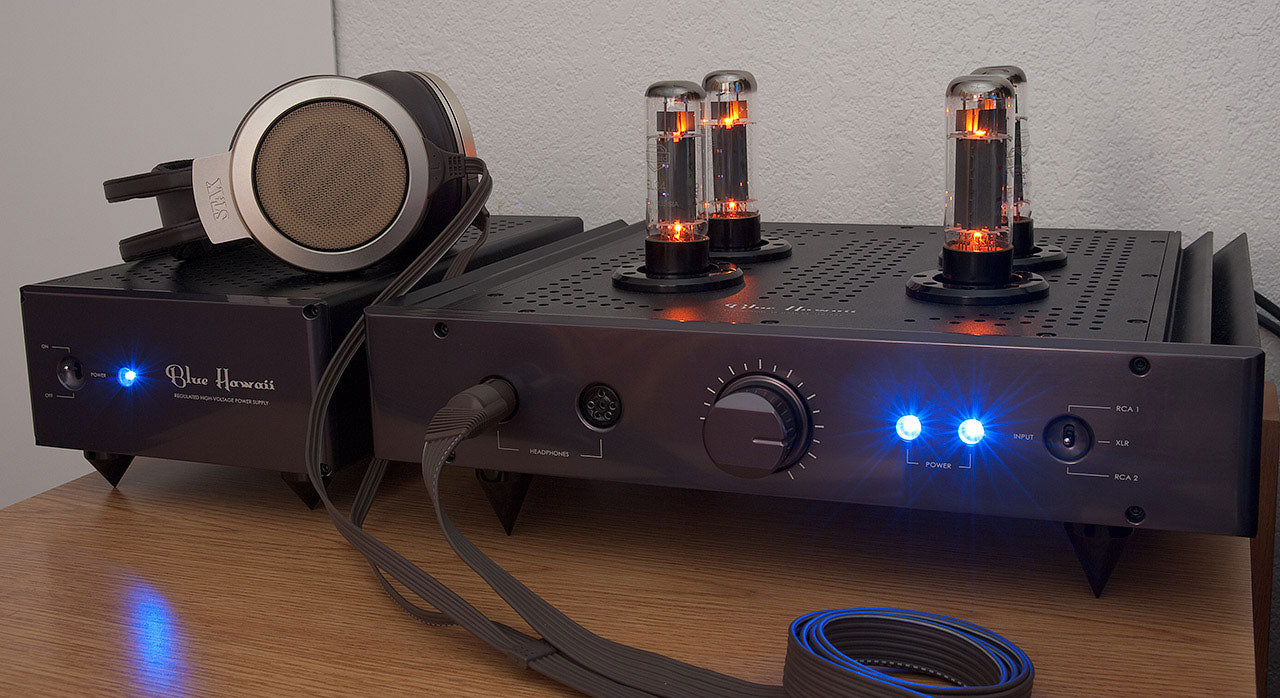
Above is pictured the prototype of the famous Blue Hawaii amp also designed by Kevin Gilmore.  It's a hybrid transistor/tube design with EL34 outputs with current source loading, and power supply in separate chassis, and the whole package looking mind boggling.


Above is the commercial version of the Blue Hawaii and another electrostatic amp.  Kevin Gilmore also designed the KGSS (the KG is Kevin Gilmore again) can be ordered from HeadAmp!  Well, actually the KGSS does not appear on the order page, but the Blue Hawaii does, as does a fancier but ultimately not as serious looking all tube amp, the Aristaeus.  You don't actually order these because they are cheaper than currently available Stax units, the Blue Hawaii, for example, appears to run $4995.00, and they want 1/4 down payment up front, that's about double the price of the top Stax tube unit, but it looks worth the extra cost in sophisticated parts and design (read the Blue Hawaii link above to hear Kevin Gilmore describe it).  HeadAmp says they make their own products in the USA and can customize just about anything.  I suspect they'd be able to build a KGSS if you really wanted it.  It appears that unlike Gilmore's prototype, the commercial Blue Hawaii has two pairs of outputs for two heads.  Four EL34 tubes in all.

One much simpler change involves merely changing the AC wall wart.  The Koss E90 amplifier is powered by a small 9VDC 1amp wall wart.  This provides rather high impedance power.  Unloaded, it actually puts out 12VDC, though the constant draw of the Koss brings it down.  Some people report significant improvement using lab grade power supplies instead, with DC voltages as high as 12V.  I'm wondering if lower impedance power might help with the bass response.  Most E950 tweakers, however, think a whole new amplifier is needed.  Removing the back felt is said not to be a good idea, that's the only defense against dust getting on the diaphram, a potential cause of the infamous E950 squealing that may be the number one reason units are returned to Koss.


I got my Koss a nice Stax HPS-2 stand (I was worried about spilling a drink on the coffee table and mucking them up) and Stax CPC-1 dust cover, very nice.

Class A power from Class AB Amplifiers

I started a thread about calculating Class A power from Class AB amplifiers at DIYAudio, one of my favorite sites.  It was inspired by the fact that I calculate the Class A power from my Aragon 8008 BB as 3.58 watts per channel into 8 ohms (as described in an earlier post).

(Note: the full Class AB power is 250 watts, and about 500 watts into 4 ohms, and even more into a still lower impedance, so the amp has plenty of power available, but the question is specifically how much "Class A" power the amp can produce with all transistors operating in a linear range, therefore having the most quality)

Meanwhile, Mondial and Klipsch (the first and second manufacturers of Aragon amplifiers) claimed it had a maximum of 26 watts Class A power.

Much lively discussion ensued.  It turns out my calculation of the Class A power into 8 ohms was correct.  Furthermore, if my amp used the lower bias suggested in a memo from technical support, it would have 0.8 watts of Class A power into 8 ohms.

And it turns out that Mondial and Klipsch were correct also, at least for one channel of an Aragon 8008 BB...but misleading.  It's quite possible to get 26 watts of Class A power from a factory specified Aragon 8008 BB, but you must use a higher impedance than 8 ohms, probably more like 50 ohms.  So this is not really a relevant specification, but rather a way of crafting a technically correct but deliberately misleading specification.  Also, given the lower bias, it appears likely their "Class A" power was actually peak power, not average power.  So two tricks were used to craft a misleading specification.  And possibly two more tricks, read on.

The most reduced formula for Class A power calculation is 2RII where I is the fixed quiescent idle bias current, and R is the load resistance.   Since this I could be confused with the current-available-in-class-A, which is twice as much as the idle bias current, I've now decided a better description is 2RIb^2 ("two R Ib squared").  This is an algebraic reduction of the more transparent calculation (based on P=I^2R, Ia=2Ib, and Pa=Pp/2):

2*Ib  *  2*Ib * R / 2

This formula yields "average" power (sometimes incorrectly called RMS power, see the link above for some discussion of that), that's the reason for the final 2 divisor (from Pa=Pp/2).  Peak power would be 4RIb^2.  So obviously increasing R gives higher power and reducing R gives lower power.

But the increasing the R value runs into a limit when the full Class A current available to the load (2I where I is idle current) causes the voltage across the R to reach the maximum voltage available from the amplifier.  In the case of my amplifier, that occurs around 65 volts.  Given maximum current available in Class A, 0.946 amps, and maximum voltage, 65 volts, it is straightforward to calculate peak then average power:

Pp = 0.946 * 65 = 61.49W

(R = e/i = 65 / 0.946 = 68.71 ohms)

Pa = Pp / 2 = 30.75

OK, so my 8008 BB seems to exceed the factory "spec" of 26Wpc maximum Class A power (into specially chosen resistance) by just a tad.  But the amplifier idle bias current recommended by tech support is more than 2 times lower.  So an amplifier with that level of bias could not meet factory specification even with any specially chosen resistance.  There are two possible interpretations:

1) The factory idle bias current was actually much higher than specified in the memo (shown in earlier post 12mv inner channel and 8mv outer channel), and just short of what my amplifier has.

2) The factory "maximum class A power" specification was actually a peak power specification as well as specially chosen resistance specification.

I think I believe interpretation (2).  Assuming that is correct, what would would the bias current need to be?

Pp = 26W, therefore 2Ib = 26 / 65 or Ib = 26/130

Ib = 0.20a

Therefore emitter resistor voltage for 6 transistor pair 8008bb would be

0.33 * 0.2 / 6 = 11mV

Just a tad below the "inner channel" specification of 12mV emitter resistor voltage recommended by Aragon technical support.  But it seems the outer channel specification of 8mV would never make it, nor would the same values get there with the 4 transistor pairs in an Aragon 8008 ST:

0.33 * 0.2 / 4 = 16.5mV

So even with two tricks used to get the maximum specification, it only applied to the inner (left) channel on an Aragon 8008 BB, unless the bias was set higher than specified in the memo (which is possible, it's quite possible that tech support recommended an especially conservative bias to prevent subsequent failures for people who already had one problem).

****

My Aragon 8008 BB has 3.58 watts Class A power into 8 ohms, and 1.79 watts into 4 ohms, and therefore meets the "first watt" requirement popularized by Nelson Pass, whereas a factory specified unit would not.

My amplifier is biased more like an Aragon Palladium amplifier (just slightly more, actually).  But since those amplifiers are bridged monoblocks, and mine is not, that actually gives me another advantage in Class A power at 8 ohms and less, since each half of a bridged amplifier sees only half of the total load.

So mine is actually better than an Aragon Palladium.  It's an Aragon Platinum!