|
| Entry Switchplate (Labeled) |
After decades of thinking and dreaming about such things, I've finally automated my main audio system. I think it's the best upgrade ever, and I'm still working on making it even better.
Automation, in the context of audio reproduction, means two things (and preferably both):
1) Powering up and making whatever other connections, protocols, or other actions are required for the system to begin to play music.
For a personal device system, this includes:
1) enabling device, getting past authentication
2) dealing with personal device issues necessary (upgrades, identity issues, expirations, selection menus, etc) to run app, and running music app.
3) Connecting headphones to device, and headphones to ears.
Good luck automating that. This is also an illustration of why I have kept personal device centered audio, and even USB (which means some sort of authenticating computing environment) away from my living room system. Computer based systems nowadays are designed to authenticate and then spy on you, while gaslighting you to gauge your preferences ever better. The whole point is to keep you making choices through actions. Being able to bypass all that crap and just press a single button to start the music would be antithetical to that primary point of such systems to their makers.
I want a realm if not an eternity away from the general issues of such devices, which are anything but relaxing and inviting in my opinion.
I deal with the much conceptually simpler situation of automating the powering up my living room audio system, which I can and do listen to from all other rooms in my house. Especially from the Kitchen, which also serves as my home office, audio and video mastering center, as well as kitchen, dining room, and snack bar. Nowadays it's the single room I spend the most waking hours within, so it's also where I listen to the most music in Background.
The kitchen has it's own fairly high end audio system, featuring Revel M20's plus a subwoofer, AND surround speakers. It's a fine system for mastering or watching video. But as Background Music, I find playing the living room stereo much much better. It is of course fundamentally a better sounding system, because full range electrostats combined with subs and supertweeters and far more and better fine tuning. I lose the stereo image from the Kitchen. But for Background Music, having no stereo image makes it less distracting, and that's the key. If it were more distracting, I couldn't tolerate it and get other things done. Not only is there no stereo image, I do strongly get the feeling that the music venue is in an adjacent room. Therefore it can't get in my way, but it can create an ambient vibe that helps me feel better, like being in your own private room at the club.
I consider background music just as important as serious listening. Not because serious listening isn't a wonderful peak experience (when everything works and it clicks) but it's comparatively rare event in one's life, at least in my experience--I never had very much time for it. Background music may ideally be something for nearly every waking hour, except when you need absolute silence for perfect concentration or talking to somebody. But if it's not easy to start up your main system for this purpose, you might hardly ever enjoy it for such.
If all you ever use your main system for is serious listening (and/or serious listening or other tests), then I suppose a fairly time consuming startup procedure may be tolerable, or even help prepare the mind. Many audiophiles have startup procedures taking many minutes. I've always wanted to make system startup as quick and easy as possible, in the hopes that this would get me actually listening to music more, and I started using home automation devices for this purpose inconsistently and with varying success since the 1980's. Mostly, recently, I've had no automation whatever, and had to power up the amp and fiddle with preamp and other components before starting, and that almost always involved getting down on my knees to fiddle with the preamp buttons, often waiting to scroll through volume levels for an appropriate volume...
2) Selecting the music, playlist, or station to begin playing.
This is really the important thing, and I believe, ultimately the most difficult thing. And I mean in merely selecting what to play next, though in some cases the mechanics of getting that thing playing may be considerable also, though I usually count those actions as part of step 1 above.
When I started on this article in January, I had no idea I was going to be able to construct an automatic playlist generator this year, if ever. Having a computer program select the music seemed too far fetched an idea.
Partly it's because my dreams were too far fetched. What if the computer, acting as your personal concierge, would sense you mood from moment to moment, and pick the perfect music to elevate your spirit? Well, yes, that would be nice. Closer to earth, algorithms in Pandora are supposed to select similar music, but in continuous varying mood, because that's supposed to be better. Perhaps.
My own finding is that given the set of music I like as both background and partly as foreground, that is particularly to me music without words, or too much stress, which can be classical, jazz, electronic, or ambient, I can just mix it up at random--done properly without replacement to minimize repeats and let you hear everything in shortest order, and these simple playlists have revolutionized my music listening more than anything.
With the new playlist generator I am programming now, I can listen to automatically generated playlists designed to play so I hear everything in my music library with as few repeats as possible--that is until everything has been played (or at least auto-selected and possibly skipped).
Roon automatically loads my playlists. For other programs, though I have not tested this for other audio programs yet, I can also create virtual directories of soft links which take very little space, and works unless the audio folders are moved, which isn't an issue for a near daily playlist generator, and would be the case for a normal playlist also.
I haven't yet set this to automatically make a new playlist every every day. But generally it takes very little action on my part, at least when the still under development playlist generating program is fully working despite yesterday's changes. [As of June 2021, the playlist generator has a known bug when a too high percentage of albums has been played, which I haven't quite reached yet, but will require a major rewrite to fix.]
If I ever work this up for Rock music as well, I'l have to improve the customizeability. In that case it might be more like the computer program making suggestions I can accept. I think this approach is far better than the old logo what do you want to do today. I don't know what music I want to play today. It's great to have a program make suggestions if not the choices...and in many cases the choices themselves ...or perhaps the choices following a chosen scheme. Making more choices is hard work. Too hard to bother with in the course of daily living. Let the computer do the choosing. If I'm in the kitchen or phone I can skip an unwanted track or album in the Roon interface.
Automated System Start Up
This is something that seems of zero interest to any of my audiophile friends. They've simply not responded to my self congratulation. I've had great difficulty writing about it, because among other reasons I want to capture why I believe it is most important, yet others can't see why it would be necessary or even useful.
In the pursuit of audio perfection, many if not most audiophiles have the opposite of automation. They have start up procedures that may take many minutes, perhaps even an hour or more for total warmup. Of course they believe that all these steps they must take before playing music are absolutely necessary (though skeptics may wonder if they aren't superstitious rituals). And while many of these audiophiles have been devotedly making the circuitry in their system components ever "simpler," through adept acquisition or modification or construction, this often means even more work in starting up each day. Or switching from one source to another. They may have to replug whole chains of equipment to switch from analog to digital sources (which I'm including in the "startup" part of the equation).
Many audiophiles also believe any attempt to make anything automatic must involve compromises at some level. They would be utterly opposed, for example, to adding switch devices in any AC path. I will have to explain why the switching I do is perfectly fine, at least in the living room system, yet I'm sure many audiophiles will never believe me. However, I should note that I've been unable to add any kind of automated AC switching device in the kitchen, where due to multiple outside antenna grounds, AC grounds, and whole house network connections, and low power devices on micro switching supplies, is a virtual RF oven in the AC path of the power amp. Anything but the most highly shielded AC cord introduces hum and noise. But the living room has no such problems, despite 3 AC circuits, and network connections from the Kitchen. This is an issue I hope to get fixed sometime possibly by moving some things around.)
Now you might think that turning on the stereo to play FM would be a fairly simple process taking about 5 seconds, as it once was for me, long ago, when I used a Marantz 2270 receiver (purchased in 1974). To play FM, I would press the ON button and turn the selector switch to FM and possibly readjust the volume control, with all those controls being in one fairly convenient place.
But in fact it hasn't been that simple since the days when I had my Marantz 2270 right next to my bed, in my college dorm room, which was long ago and not for very long. And of course for anything other than FM there was a matter of deciding what media object to play, obtaining said object, preparing it, mounting it on the playing device, and initiating playing. So playing anything beyond a favored FM station can be a lot of work, which is impossible to have the time and energy to do, simply for background music.
Before long my Marantz receiver, and/or the Kenwood KT-7500 tuner I later plugged into it for better FM reception, was not right at hand, but typically across the room from my bed or chair. I did that mostly by something like necessity, but often rued the day when I had to give up direct reach control of my system for "passive" line level switching and attenuation boxes. (I denounced passive as lossy sometime around 1998 and stick to that now btw, but I was a passive fan from 1980-1998.)
By the early 1980's I owned a house with stereos in both living room and bedroom. Partly because of inconvenience, and partly due to lack of free time, I didn't actually use either one very much. The living room stereo had grown (and kept growing) into many components. I once figured I spent far more time modifying audio equipment than actually using it. I had become similar to what one friend calls a build-o-phile from 1980-1982 when I finally built my own tube preamp after having been a tube modifier for 5 years. Well, so what, if I was having fun that way? But it would have been nicer to run that show with music but in fact I rarely did. One a handful of occasions by the late 1980's I had enjoyable audio parties. But it was only on a small multiple of other occasions did I have time for extended serious listening. And it almost never worth the bother to switch on my tri-amplified system of 1985 just to play background music on FM. If I did switch to FM, it was only after already having played something else, and not being able to decide what to play next, I put on FM, which more often took more work than I wanted to bother with. It should be the other way around, being easy to pop on FM at the spur of a moment, or perhaps the beginning of the day, and then switch to some collected music in higher fidelity form when time and energy permits and desire calls for it.
Some time around 1985, I set up my most beloved FM tuner, which was then a Fisher FM80R which always sounded marvelous (though in mono, I didn't care) atop the side table near my listening seat. This was a marvelous innovation, as once again I could tune in different FM stations without having to get up. And that was particularly important then as there were two fairly nice, if still far from perfect, FM stations, but between the two of them I could usually find something good to listen to. But generally I didn't start my system to play FM. If I started it to play a CD, and the CD ended, I have to walk across the room and fiddle with several controls to get it to play the FM tuner right next to my listening chair playing again. Which I rarely did. But at least I did that more often than switching on the system just to play FM.
I spent much time imagining a system which would let me switch from CD to tuner without having to get up, or maybe do anything at all. I imagined a system which would sense that the music was not playing anymore, and then automatically switch to the FM tuner. I figured I could simply add some relays somewhere, and I think I purchased a couple relays, but that was as far as this kind of automationproject ever got, until now, 35 years later.
But even with these early insights, I could begin to see the essential ingredients in effective automation:
1) It should be convenient, eliminating the need to get up and do things, such as with a push button reachable from where you are sitting without getting up. It could be even more convenient, such as turning on music from a background source automatically when the primary source has stopped, or perhaps even when you get up in the morning, etc.
2) It should simplify, reduce, or eliminate the need to make decisions about what to play next. Channels such as FM radio stations can do this, as do streaming channels or Pandora. (One complication may be that FM stations are not always good to listen to and you may want to choose another FM station or source. I am very fortunate in having a very good listener supported Classical Music FM radio station I love. But it's not merely good fortune, because it's also something I've contributed to for about 30 years. Some sort of personal contribution is probably necessary to make any such channel good. Recently is the second time in 25 years I've been nagging them to clean up their sound, now they have a digital skipping problem which is apparent on both their analog and digital feeds.)
So the two essential ingredients are (1) reducing/eliminating need to do stuff, and (2) reducing/eliminating the need to make decisions. Frankly I believe that it is the decision making that is the hardest of all. Yet I've never heard other audiophiles even think about it. Perhaps it's something that's uniquely hardest for me.
Enter Sonos
I may have thought about it the automatic music selection problem, but didn't do much until I learned about the Sonos system in 2006. I quickly obtained a Sonos ZP80 and CR100 and a Windows XP machine to work as my Music Server. Sonos didn't originally support Macs, and my Mac was ancient anyway. These support uncompressed digital over wireless or ethernet, produce bit perfect (when no volume control or other features used) reproduction over their digital outputs, and have fairly decent 44.1 uncompressed digital analog to digital conversion for one analog input. I wouldn't bother with their amplifiers, speakers, or other devices. I have "high end" component audio systems in every room.
With Sonos, I could control everything (except turning my components on and off) with the convenient CR100 controller, which I kept on my bedside table. Up until 2009, my primary audio system was the one in the bedroom. The living room stereo was lower spec components I used only when playing the living room TV, which I only did for parties. In 2009 I had a dental near death experience which opened me up to splurging on my dream system with electrostats and subs, as I imagined in 1992 when I bought the house.
Thanks to its combination of hard and soft buttons, the CR100 still represents a high water mark in semi-automated audio convenience. I rued the day that Sonos no longer supported it. Smartphones are not a very good substitute because you must do a lot of fiddling just to open the phone, select the Sonos app, and then get it to do some audio thing. This is by necessity a two-handed operation which may even require putting your glasses on, and often results in failures and curses for an endless number of reasons, such as unsuccessful overnight smartphone update. With the CR100 I could simply reach over and press the Play button to start when I woke up in the morning. No securanoia. And then press the Pause button when going back to bed. Sonos occasionally did do updates, but back in the early days they went quickly and always succeeded. No passwords or passcodes were ever required.
One of the reasons I bought Sonos devices was that I really lusted for the Random play mode, which Sonos had from the day I bought it. I imagined this would finally solve the Selection problem, which had always been the key stumbling block to having music playing all the time, or even very often. The other reason was line-in, which enabled me to play the FM tuner, which only worked decently on an indoor antenna in the living room, in the bedroom. Running a cable between the two points was highly impractical.
I soon discovered it was very useful to organize my music files not just in one folder but in multiple folders. When Sonos became available on the Mac, I created one folder for Classical and Ambient music suitable for background music in one folder, the original iTunes folder actually, and all the Rock and Jazz music which was too loud, jarring, or distracting for background music in another folder, which I called altTunes. I imagined being able to play the background music randomly forever.
This seemed like a dream come true at first. I also added an X10 Appliance Module* to start my power amplifier so I wouldn't need to get up from bed to turn it on. The subwoofer plate amplifier has a music sensing auto switch.
For a few years after 2005, X10 appliance modules were still working in my house. But about then they started becoming more and more unreliable because they are sensitive to the noise created by DC power supplies, particularly things like cell phone chargers and computers. The noise created by DC power supplies blocks X10 transmission. There are various means of fixing this, such as using line filters and X10 signal extenders. I clung to X10 for another 4 years accumulating all sorts of additional equipment like filters, extenders, and X10 signal vs noise meters. Finally around 2014 or so I abandoned X10 for Insteon, which has been my chosen home automation device brand since then, working very reliably after being not-always-easy setup, and for which I also use a Universal Devices ISY994i controller, which is key to the way I do things in Home Automation now, and gets my highest recommendation of all. It allows very flexible programming which I would not be happy without. Universal Devices supports Insteon and some other automation device standards.
But back in the day, I could have done just about as much with simple X10 modules as with Insteon (or other systems) now, if only X10 had just kept on working, using the fairly open computer programs and interfaces available. Notably I do not at all believe Scenes are necessary, or in most cases even useful, except that certain things with Insteon (like full control of the lights on touchpads) require you to use Scenes. The old Macros I used to cook up for X10 could have been about as useful as the combination of Programs and Scenes I use on Insteon now. In my view, this is another area of geekdom where everyone says you must have this shiny new idea, but actually the old approach could have been made to work almost as well. I think I would actually have hated Insteon because of all the more complex, but closed and ultimately more limited controllers made available from Insteon itself. The magic piece is the ISY994i, which opens up the system to more capable programming.
I show the Living Room wall controller at the top. This is right by the front door. Most often I don't much bother to label the wall switches and mini controllers because I know which button does what (including a few choices that require 2 button presses).
 |
| Bedside Insteon 8 Button Module (unlabeled) |
*****
But soon I found that simple "random" song playback as implemented by Sonos was unacceptable for various reasons. Despite my using separate folders for different kinds of music, so I could have all classical/ambient music which is suitable background music in one folder, and loud talking music which demands your attention in others.
Some of the reasons included:
1) The Sonos random play seemed always to start from a particularly tedious small file. From this I concluded that Sonos implemented a deterministic randomization procedure. It is much better for this purpose to seed the random number generator from a non-deterministic or at least less-deterministic source, such as clock time, or as exists in Unix and MacOs, the number of clock clicks since startup (which is a larger number and therefore better than the number of seconds since starting). Then it should never start the same way or repeat the same random pattern.
2) Also the fact that Sonos random play started from the same song revealed another fault. It implemented a simple with-replacement randomization strategy. Thus no matter how many times a thing has been played before, it would still play as the first song at the beginning of a deterministic random play. The with-replacement strategy also means you will hear other songs you had heard at the beginning of the last random play. (They might have fixed this since then.) A with-replacement strategy also has many other faults. One is that there is no guarantee the same song won't be played twice in fairly close succession. A Square Root of N Rule applies: you will hear a repeat about every square root of N times, where N is the number of songs in your library. Finally, sometimes, without-replacement search rule is implemented, sometimes it may be lost every time there is a power cycle or power failure. So then you're back to the same only forever heard songs. Finally, the Square Root of N rule also has a dark side: as well as some songs being repeated over and over, there seem to be an endless number of songs which are never heard at all.
3) In my opinion anyway, whole album song play is better. In other words, albums should be selected randomly, then all the songs in that album played in their correct order. (If an album contains multiple Titles, it might be OK to play per title, so long as the titles are not too short.)
So while it seemed like Sonos random play ought to be the new millenium in automatic music, it wasn't. I quickly grew tired of it. (Cynically you might wonder if that wasn't the plan.) Before long, I had subscribed to Pandora and quickly upgraded to Pandora Premium. Pandora did a pretty good job of selecting new music to my taste and in different categories. However, I would never use Pandora as a Featured source, it was just some level of MP3 compression. I discovered a lot of new-to-me artists on Pandora. But sadly, eventually even Pandora became tiresome as background music.
I haven't used Sonos Random Play in over a decade. All services push Radio Stations which i haven't yet found acceptable in digital form. I like my local classical radio station KPAC best broadcast in FM Stereo.
Just as my 1980's automated background music idea centered on FM radio, so did the beginning of my new one last year.
Actually, it started from an attempt to improve on the time shifting of my favorite program on KPAC, Performance Saturday. Often I was at the Symphony itself, or doing something else on Saturday night. So I recorded via in incredible path. Starting from the indoor antenna in the magic spot for KPAC, to my Pioneer F-26 tuner, into the analog input of a Sonos Connect, through hardwired ethernet connections to my large DLink gigabit switch, on on the hardwired ethernet connections into the bedroom, through another Sonos Connect, and into my Nakamichi RX-505 and onto Chrome tape, with Dolby B. This actually produced wonderful sounding recordings, I still say. But I thought it could be better and simpler.
Plus, it would be useful to have a digital recorder deployed in the Living Room for making digital copies of LP records as well, and LP record tests (which is mainly what I have done so far, yielding hugh improvements in tonearm resonance control). So, sometime in 2019 I purchased a Marantz PMD 580 recorder for the living room. (Strangely, I was not happy with the digital recordings until many furthher changes. Until now, maybe, it hadn't been as good as the previous system based on a Cassette recorder!)
But before I realized the PMD 580 had a crappy sounding analog to digital converter, even crappier than humble Sonos, I figured I was at the dawn of a new era in good sounding FM and recordings from it. (Actually, I was at the bottom of a steep hill.)
While purchasing another impeccable Henry Engineering AES splitter from Markertek for splitting the digital from my Lavry AD 10 analog to digital converter off to the Marantz so I could use the better Lavry for making digital copies of Vinyl, and listen at the same time, I noticed another very interesting product from Henry Engineering. A 3 way AES digital switch using relays.
This is a powered pushbutton switch. You push one of the 3 buttons and it sets the relays for that particular input. And the light on the button lights up (a very cool touch).
And, not only that, this 3-way switch can be controlled by the pins on a DE-9 connector. That was the key ingredient to make automated background music from FM radio work. Those pins work on contact closures which can be controlled by various means, but trivially easily from an Insteon home automation system using the marvelously flexible Insteon I/O module. I use 3 of them (plugged into a Hammond power strip connected to a non-audio AC circuit) for the 3 possible selections: Background Music (FM radio), Feature Music (Oppo), and Mute.
One absolutely essential thing for Automated Background Music is an independent volume control for the foreground and background sources. You may have been listening to vinyl last night with the system cranked all the way up. Or cd's. The system has to set the volume for the background music source independently of that somehow to make automatic switching useful.
Modern Day Levinson preamplifiers feature something that would work. You can assign relative and starting volume levels for different sources. Sadly few other high end preamplifiers, or any preamplifiers, have such a feature. My Tact digital preamplifier, just as costly as a Levinson when new, does not.
But using the Henry Engineering switch at the to switch the input to my miniDSP crossovers from the Tact to a new separate digital converter for the background music source, and I could use a Behringer DEQ 2496 to fine tune the digital level, aka volume, specifically for the FM tuner.
So that was the answer for me, with zero degradation, to switch the AES balanced digital stream (with relays) from one path to another. I needed to create a new digital conversion path for the background music source, my Pioneer FM-26 tuner.
I had originally figured I'd use the Marantz PMD-580. But by the time I'd purchased the Henry Engineering switch I'd already decided the PMD-580 conversion just didn't sound good enough. I couldn't use my Lavry for this because if I were using the Lavry for something else, such as listening to Vinyl, then I couldn't just go to the FM signal at the push of one button. Many changes would need to be made...changing the source input on the XSP-1 preamp, and changing the level. I still can't automate that.
But in my closet I had a never-used-by-me nice looking (and it turns out, very nice sounding) Analog to digital converter. It's a Black Lion Sparrow (now known as the Sparrow 1). And in my testing it sounded even as nice as the Lavry on FM when buffered and stepped up slightly by minty Musical Fidelity X-10 V3. The AES digital from the Sparrow then feeds a Behringer DEQ which trims the level. Levels from -15dB to -6dB are useful, I generally like -12dB or so for background. Sure I lose resolution by this attenuation, but only in the context of 24bit audio transmission. Subtract 12dB from the 24 bit resolution of 144dB and there's still 116dB.
 |
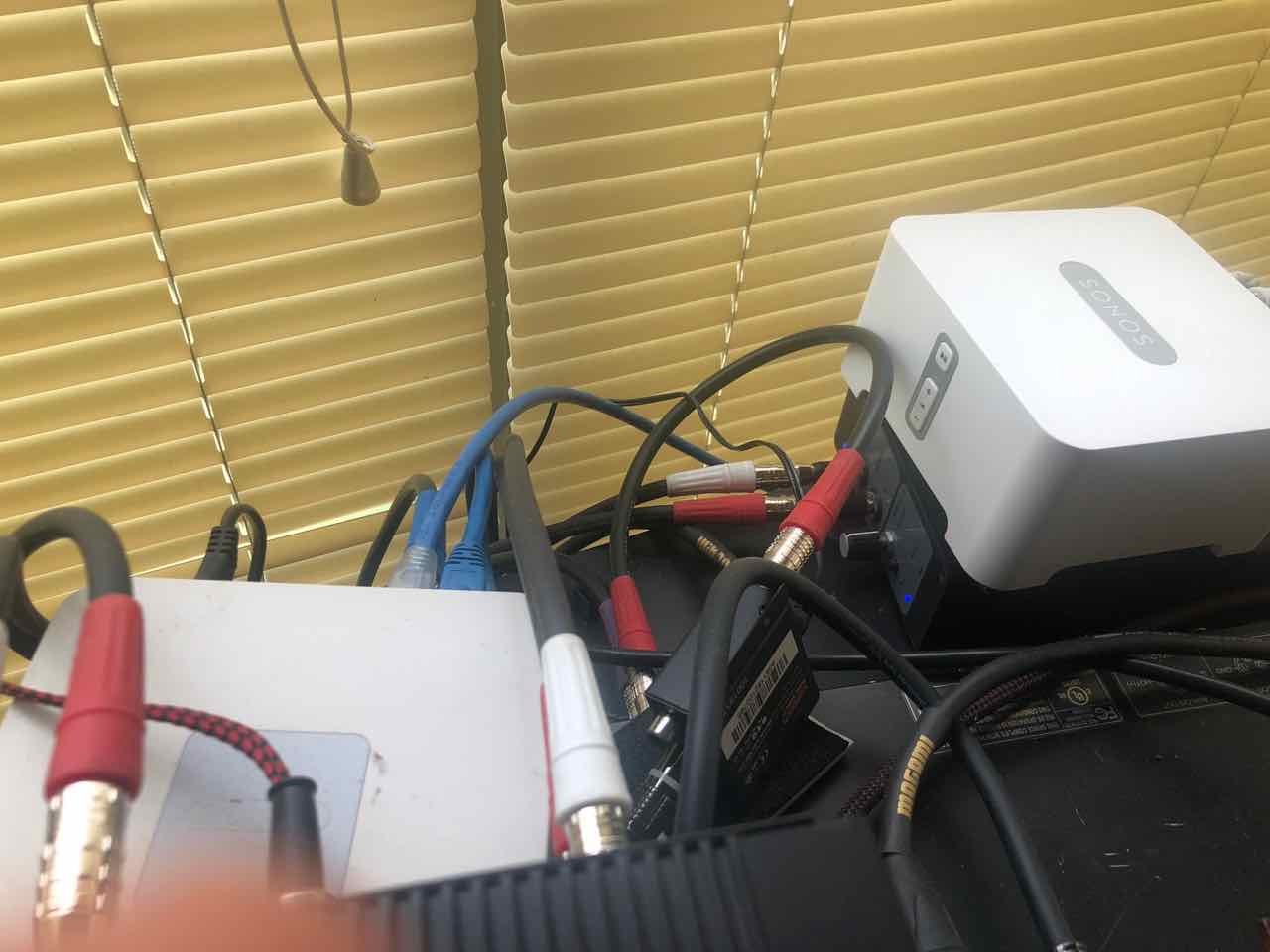
| Sparrow ADC shown beneath Sonos Connect in crowded back of shelf |
 |
| Marantz reccorder, Behringer EQ, and Musical Fidelity Buffer |
The Fixed Output of the Pioneer F-26 FM Tuner goes to the Musical Fidelity X 10 V3 tube buffer. The unbuffered output goes to a Sonos Connect, the buffered output goes to the Black Lion Sparrow Analog to Digital converter running at 48 Khz. The AES digital output of the Sparrow goes to the Behringer, which fine tunes the output level in digital usually with about a 12 dB reduction. The adjusted digital signal then goes out from the Behringer in AES balanced over mogami cable to the Henry Engineering 3 way AES switch. The switch feeds an AES splitter which feeds the 3 miniDSP digital processors that make up my "crossover." The Tact is completely bypassed when I'm listening to the tuner, and therefore the Tact digital level control has no effect on FM, only the "Feature" source.
The Optical Digital output of the Behringer is converted to coax by an adapter and fed to the Marantz PMD, which also accepts an balanced AES digital from the Lavry I used when digitizing vinyl through a Henry Engineering digital splitter (the other path is for my stereo itself). In no case do I use the analog inputs (and therefore the analog to digital converters) of the PMD 580 which I consider inferior and grainy sounding.
This new pathway for the FM tuner, combined with now using an outdoor antenna run through the Kitchen have improved the sound of FM immensely. This, and the electronically controllable an lossless audio signal switch, and the independent level control, were the essential ingredients of an automated background music switch.
But you'd still need to turn the power amp on and off. I find, that on the living room circuit, and Insteon On/Off module works flawlessly, adds zero noise, grips the outlet and the plug very tightly, and has no detrimental sound quality impact. This works perfectly with the Hafler 9300 which is well within the ratings of the device. It did not work so well with the Aragon 8008 BB which has 2.2kW of primary power transformers. The Insteon is rated at 1800W. Strangely, however, in the radio frequency tunnel of my kitchen, the 2 inches of unshielded wire inside the Insteon On/Off module picks up noise big time, like you can't ignore it. That was true with unshielded power cords used there as well, on an otherwise equivalent Hafler 9300 I use for the Revel's in the Kitchen.

So now I can turn on the Living Room stereo to play the FM tuner, regardless of what it was playing just before, and even turn the amplifier on if needed through 3 wall keypads in my house and keypads by my kitchen chair and bedside. And mute or turn it off too. It turned out that when the Henry Engineering switch is set to an input with nothing conveniently, very conveniently the 3 miniDSP crossovers which are in line with it's output (through a Henry Engineering AES splitter) mute perfectly. Even when the Hafler power amplifier is turned off the muting is important to keep the subwoofers and supertweeters from playing.
And then the third button (and corresponding Insteon I/O module) selects "everything else" other than the FM tuner. I originally called the FM tuner input Background Music and the "everything else" input "Feature Music," thinking like a Featured artist is why you go to the concert, the Feature is what you must select, whereas the Background is preselected.
However it did not occur to me that the term Feature Music has the unfortunate initials FM, which could be confused for my FM tuner used as background music.
Anyway, the Feature Music designation itself is somewhat obsolete since now my "everything else" can be preselected by my computer program, not actually human selected/featured.
Now on the Living Room wall keypad, I've designated the two selections as FM (as in FM tuner) and DVD (as in my Oppo BDP-205, which serves as my high resolution disc player AND streamer with SPDIF 24 bit digital output to the Tact digital preamplifier) even though that would also be the selection for listening to Vinyl (with a different selection on the Tact). It would be nice if I could control the Tact as nicely as I do then Henry Engineering source switch, with contact closures. The Tact has a proprietary digital interface that its program on a 2000 era PC communicates with. I very rarely use that since I do not use the Tact's room correction or even measurement anymore.
But it was still a bother to get up from the Kitchen to switch the Oppo in the living room on to listening to harddrive and streaming musing through the Oppo 205 digital output which feeds my Tact. Those work best using the DC triggers. So I have a pair of Insteon On/Off Modules which power regulated 12DC adapters which are connected to the trigger inputs of the Oppo 205 and the Emotive XSP-1. The Oppo is automatically turned on whenever I select "DVD" in any of the wall switches and keypads in the house. The Emotiva is best switched on by the ON button of the other On/Off module. Both are automatically turned off for "bedtime" or when the mute button is pressed a third time. (The first press is soft mute, which permits background music to come on in one hour, the second press is hard mute which keeps the music off indefinitely, and the third press is system off.) The two Insteon modules are connected to an all metal noise reducing power strip which is connected to the "main" living room circuit and not any of the 3 dedicated audio circuits. I bought that strip for reducing the pops in my stereo system created by switching the Tensor lamp for the turntable and other purposes, but it is also good for giving Insteon modules a true AC connection (not going through my Panamax) and not polluting my line audio devices with yet more DC power supplies.

My Playlist Generator for Roon (which is my current music program). Sadly it seems you can't trust streaming services, or even subscriber-funded Roon it seems, to implement a decent playlist program. Like everything else, Roon is always trying to sell you new music. That's what Roon Radio does. I find that when any program (except Pandora, which did it fairly well) tries to sell me new music, I hate nearly every song it selects. Especially the first one.
But, fortunately, Roon does provide a way to import playlists, including from simple M3U files. I've recently discovered what a powerful idea this is.
What needs to be created is a Daily Playlist. That's not too often, I think just right. Thanks to using an across-session without-replacement randomization strategy (based on a stored dot file listing all the files currently played) combined with automatic-replacement-reset-on-exhaustion, you can be sure that today's Daily Playlist won't repeat something on yesterday's, or in my case going way back, except in the rare case that still occurs right after a reset. To overcome the reset problem, an additional reset window is applied for N/4. For the first N/4 of random selection, nothing in the previous N/4 is permitted.
It is also critical to use an unbiased shuffling algorithm, like Knuth's (also given other names). The most intuitive shuffling algorithm is biased, meaning it can only reproduce a limited number of the possible shufflings. I believe this can lead you to just feel what is coming up next, and make everything seem dull.
Roon applies a very nice level compensation on an album basis to keep the playlist at the same level without compromising the musical integrity of any album. Roon also nicely stops and remembers its position when the Oppo is shut down through my automated system. (I keep it going until I hit the sheets at bedtime.) However, Roon does not restart the playlist when I restart the Oppo. I wish it did that though I'd have it apply only to trigger-starts not front panel pushbutton starts. Now I have to go into a Roon interface such as on my computer to restart the playlist playing, which is very easy since it brings it right back to the position when the Oppo was shut down.
 |
| Roon playing playlist generated by my program "mplay" |
Roon doesn't list track numbers any more, which is a misfeature in my opinion and others. Track numbers have been replaced by "play" buttons. Somehow I remember calling for visible play buttons in the past. Perhaps I even said they could replace the "useless" track numbers. Well now I find those track numbers are not at all useless to a serious music lover, for which we play a hefty fee. If I asked for this, I was wrong, and I am sorry. Somehow the track number should be made into a visible "play" button, combining both concepts. Or just bring back the track numbers and have a Play dropdown menu if the combo I describe is impossible for some reason.