Monday, February 7, 2011

Quad Esl-63 impulse response

Here are the Quad Esl-63 impulse tests done by John Atkinson (halfway down page):


His actual impulse response test is done with 55us pulse.  That would correspond to about 19kHz frequency, thus it does not show effects from overall group delay down to 20 Hz.  Nevertheless, what you see is a big positive pulse followed by a smallish overshoot, about 15% at most, but which lasts a bit longer then the initial impulse.  Thus from one cycle input you are getting two out, but the second is greatly reduced.  He claims that the length of the tail on the impulse response corresponds to 12kHz resonant frequency.

I wonder what this would look like with a 1ms pulse.  Probably more complex, like I get from my Acoustat.

Then he shows calculated step response.  If reproduced accurately, that wouldn't even be a half cycle.  But it does show initial decay in about 1ms, overshoot, and some LF resonance after that (drumhead?).

He shows pretty nice squarewaves also, with 12kHz ringing.

Charles

What can/should a loudspeaker impulse response look like?

  If you have a positive unidirectional pulse, which seems to be what the Tact actually uses, what do you get from a speaker through a microphone.  It cannot be an identical positive unidirectional pulse!  The speaker/microphone system is a bandpass system which has to, at least, be adding at best about one additional "cycle."  It cannot reproduce DC, so a signal with DC offset has to be bent somewhat around that limitation.

The response you could get could start with a brief negative leading edge cycle, the positive cycle of the large body of the pulse itself, and a trailing negative restoration cycle.  So 3 half cycles from 1, and I think that's about the best that can be done from any speaker without DC capability (the best actually might be more like two half cycles, depending on duration).  Assuming the pulse is long enough to have significant low frequencies, like 1-10ms, so perfect reproduction of the pulse would otherwise require DC capability.  (The Tact seems to use two pulses in measuring actually, for higher and lower frequencies, and have separate correction algorithms for each.)


In fact, that is the kind of thing I see if I measure bandpass curves electronically from my crossover, not even going through speakers.  In fact, doing this led me to believe it is not a good idea to use very high order Linkwitz Riley LR48 in the extreme treble.  You get at least an extra cycle of ringing from that, in the electronic signal itself, and Butterworth 24 gives about the cleanest impulse short of single pole.  Strangely, at lower frequencies used for my subwoofer crossover, the high order LR48 high pass impulse electronic response looked more OK, or at least just lays on top of the panel response less objectionably.  Note that you can't entirely judge a crossover by looking just at its high or low pass section in isolation; used together the combination should approximate some kind of ideal.  But the ideal ideal is most often an "all-pass" response which shifts phase, only acoustic 6dB/octave crossovers can do better.  Nevertheless, in practice the ideal will not be achieved, so it's best if each drive signal stays as simple as possible.

After much work (!), that's also what I can get from my very complicated system.  Actually the impulse looks like about 3 full cycles, with the subsequent two being greatly reduced in level, plus the usual digital aliasing stuff around the edges.  My truly great achievement was getting a combined system response, including sub and tweeter playing at uncompromised levels, that has an impulse response that looks barely different than the Acoustat alone playing by itself.  I never expected that, I only expected that the acoutstat-by-itself would look a bit simpler, because I hadn't thought about the issues very much.


And another enduring question is what is the correct polarity?  I believe the correct polarity is not that of the leading transient, which may be always out-of-polarity in the ideal bandpass case, but that of the larger square wave what follows.  BTW, I inverted the tweeters to give them a puzzle-fitting response.  Just by themselves, the acoustats seem to have out-of-polarity leading edge and half cycle followed by full positive cycle, somehow I needed to invert the tweeters to make it fit precisely.*  (Strangely, the tweeters actually have a kind of quasi-DC response... More about that discovery later...)

I wonder if some would claim the correct polarity has the leading edge in polarity, so I could be wrong.  Perhaps it depends on the number of octaves in the bandpass, and what the bandpass functions are. And perhaps also it becomes fundamentally a subjective question in the case of a system with sufficient group delay (as probably most are).   Do you want the bass in polarity or the treble in polarity (assuming you have to make the choice)?  If the leading edge defines the treble, but a larger partial cycle follows in opposite but correct polarity, that indicates the treble is out-of-polarity but the midrange--if-not-the-bass--is in polarity.

Another interesting (and now very important) issue is the fundamental panel resonance.  I believe there is some fundamental panel resonance in the region of 55 Hz.  That resonance is how the speaker maintains frequency response to 40 Hz in spite of being a narrow dipole, I think.  Well, it has that resonance when manufactured, but age probably causes membrane to get loose, hence less controlled, which may mean higher resonance harmonics, and that is what seems to be happening, I get buzzing around 110 Hz (on one recording anyway).  Well, I need to fix the speaker, the Acoustats use HS65 which is actually 6.5 mil heat shrink.  The fix is to use hair dryer to shrink the membrane back to tightness.  It's supposed to last about forever if you keep doing that.  Other than that, the panels cannot be repaired, you can scavenge old units or make new ones using the same principles (people have claimed to do that and say they never want to go back, and one beauty of the acoustat design is that there is nothing in it that couldn't be done in a garage with readily available and cheap materials).

In the meantime, and this is what I did before and now discovered I must do, I raise the crossover point to 121 Hz and the problem disappears at reasonable levels.  I thought I could get away with lowering the crossover point (and with brand new panels, I ought to be able to do so) but apparently not for now.

But anyway, my original question relates to this because we have to consider the panel not as a DC tracking system but a fundamentally resonant system, with fundamental low frequency "drumhead" resonance and high frequency "breakup" resonance.  These affect how impulse is going to look, even in the absense of crossovers, reflections, diffractions, etc.

Speaking of which, I should dig out the old impulse picture from an ESL63, which I thought looked pretty good.

Room Correction Weekend ends with A Story

I did some other fun things also, but the bulk of the first weekend in February 2011 was spent making microphone measurements of my audio system using my Tact Room Correction System (RCS) 2.0 Preamp, making correction curves, and listening to them (Saturday night didn't end until 7am because I couldn't quit listening because it sounded so good).  A gazillion measurements were made, and I made many new important discoveries.   Photos were taken of many graphs, but it will take a week just to sort through them.  It ended on a mixed note, however, so-to-speak.  Playing through Sonos the Pat Metheny track "A Story Within A Story" revealed a buzzy bass note in the intro.  Damn.  I need, someday which will probably not be soon, to take the Acoustats apart and give their membranes the hair dryer shrink treatment.  However, I can fix the buzz by running the Acoustats as I did last year, Crossed over above 120hz.  (Actually, I think I previously crossed at 116, but with current correction curves I need to cross at 121, and higher might be even better wrt reducing potential for buzz.)

This time, since January I had tried to cross the Acoustats in at 104Hz to avoid a disturbing room resonance.  The subs cross out at 85Hz also to avoid that resonance, the resonance pick up the tab in the middle giving reasonably smooth response (and nicely boomless) without correction.

Great idea I thought, which could be applied to most speaker systems: stagger the sub crossover around the room ceiling resonance around 100Hz.  And the Acoustats are a "full range" speaker (as some people define it, anyway) that has audible bass (with room gain) down to 40Hz or so.  So there not only shouldn't have been a problem changing crossover from 116 down to 104Hz, that should give the system cleaner "panel bass" (actually, many people think panel bass is fake sounding, but flat speaker lovers usually think cone bass is fake sounding).

But there is a problem, because of my 20 year old panels and my desire to listen at pretty substantial (not ear damaging) levels, and because of room correction itself.  Because the Acoustats have a deep midbass depression in their response between 110 and 400 Hz, the room correction is fixing that with midbass boost.  That midbass boost is pusing the speaker into noisy distortion around 110Hz.  Without the boost, I wouldn't get the distortion without playing considerably louder (though I have not tried this, I simply switched to correction Bypass and the buzz went away at the same level).

But the panels clearly have a problem, and even if boost is required to make them sound bad on A Story Within A Story, they could be distorting less noticeably on other music, and in some cases, without boost.

You could pin the problem on the crossover point, the room correction, the loudness level, and ultimately the speakers.  In the sense that the speakers shouldn't have this problem at this frequency and level, it is a speaker problem that ultimately needs to be addressed (and yes I have even thought of buying a totally different kind of speaker, like Magnepan 1.7's or Linkwitz Orion).  But meanwhile, I can work around it by judicious choice of crossover, and as long as I don't play too loud.  Using current room correction curve (measured for 104Hz panel crossover) #2, but with post-correction change to 121Hz crossover, I can play A Story Within A Story to 81 gain level on Tact preamp without distortion.  At 82 the distortion is barely audible, at 83 he distortion sounds like "just a normal part of slap bass" (but it's being exaggerated by speaker distortion to sound qualitatively different than the actual recording).

I don't want to give up the correction.  The perfectly calibrated midbass boost brings life back to music.  The music sounds so much more real with good midbass, even if I have to compromise that midbass slightly by leaving a hole in the midbass between 104Hz and 121Hz by moving the panel crossover up to 121Hz.  That is peanuts compared with having the whole range depressed.  By the way, I think the whole range depression may result partly from the infamous dipolar cancellation.  Linkwitz deals with this in his design by calculating the effect and deliberately equalizing it.  I'm canceling the effect by measuring the system and room correcting it.

So I'm listening with the small hole in the midbass instead of the big midbass depression that I had previously.  Eventually I'll have to go back and do a whole new series of corrections based on the new crossover.  I was going to tell you how much work that was this time (I did two sets of 6 corrections over the weekend...I had to run a second set because I made a couple of mistakes in the first set; each set has two measurements (for helpful redundancy) for regular, no supertweet, and no sub or supertweet conditions).  But I before I do that, I also need to see if I can push the subwoofer to cross over slightly higher.  That work will require more measurements and tests too.

I can just press the Bypass button on the Tact remote to bring uncorrected response.  It's no longer the uncorrected response from January, as prelude to Tact correction I changed tweeter highpass to 20kHz and changed from LR48 to BU24, level reduced by 2dB net, and fine-tuned crossover delay.  That made for something like perfect impulse reproduction, at least with the supertweeter adding to the Acoustat nicely and even making impulse sharper.  And now, of course, bypass now has both the hole in the 104-121Hz midbass AND the 110-400Hz depression, whereas before it just had the depression, so now bypass is slightly worse in the bass, arguably better in the treble than it was before.

Anyway, though the bypass is slighly different than before, I don't believe it has gotten much worse.  But compared to the corrected response, you just don't want to listen to it anymore.  Sure it's very open.  But it's very thin and bright sounding, with too much highs above 1kHz (just consistently bright) and no midbass.

That was why I do room correction!

While great progress was made, now I know that even more work will be required that I was expecting to be sufficient, with no end in sight (such as working on the speaker itself).

But that's the way life is, isn't it?  If there were nothing more to be done, how fun would that be?
.

Saturday, February 5, 2011

OK, perhaps I should worry about group delay

After studying the loudspeaker crossover issues in the 1977-1983 time frame, I came to the conclusion that the Linkwitz-Riley was by far the best kind of crossover for most drivers.  Generally speaking the 24-dB per octave (LR24) would be the best crossover choice.  Linkwitz concluded that the group delay (a compromise) introduced in the overall response of the crossover (by design, the drivers are always in phase with each other through the crossover region) was not audible and of negligible importance.

Only a few crossover designs, like the 6db per octave acoustic crossover used in Thiel, Vandersteen, and some others, can achieve total  lack of group delay in the summed response.  And that requires multiple other design compromises.

When the Behringer DCX 2496 digital crossover came out, we were treated to LR48 achieved in hirez digital.  What could be better?  That's what i have adopted uncritically since 2005; I now use the Behringer in both living room and bed room systems.

Now, I have figured out how to examine the impulse and frequency response of the crossover network by itself, and I am not so sure LR48 is the best choice.  For augentation purposes, where there is no perfect cancellation of phase artifacts, Butterworth 24db per octoave (BU24) looks like the choice that gives the best compromise between steep cutoff and lack of visible time dispersion.

LR24 might be a better choice if you had a perfect acoustic LR24, something very hard to achieve in practice,  but given lack of perfection, the best bet is probably to minimize time dispersion in each crossover member with one that provides less dispersion

In a quasi-augmentation mode, or as a solo highpass network, the LR24 increases time dispersion AND reduces sharpness of cutoff compared to BU24.  Im not sure of the advantages of the Bessel, it may have he steepest cutoff, but it is marred by 20dB passband irregularities.  It might be OK for supertweeter where, say, above 20K you don't care about passband irregularities.

I think it's possible that in the low frequency crossover (the highpass on the acoustats is currently set to 104Hz) LR48 works OK, and is extremely beneficial in reducing panel flap at high volume levels.

The visible difference between BU24 and LR48 is pretty small at 104Hz, the LR48 does have a bit of initial out-of=polarity undershoot, and somewhat more overshoot on the trailing edge followed by slow recovery.  Whereas the BU24 almost looks untouched, the perfect Tact impulse (that is, as perfect as the Tact gets) almost. But it just doesn't phase me much, at least on screen.

But what has been driving me apoplectic about this is the supertweeter highpass.  It turns out that the highpass signal from LR48 at 15.5 or 20 kHz has 3-4 cycles of ringing at 20kHz.  That's all there is, it doesn't look like an impulse at all, just ringing.  Superimposed on a perfect impulse, it smears it out considerably.  My time domain purist friends should be laughing at me now.

That's exactly what I've been seeing in the system impuse time response.  And it bugged me so much I refused to print it yesterday.  Now I've figured it out, at least partly.  Even if the supertweeter is reproducing the signal that it receives perfectly, that impulse response looks like 4 cycles of ringing at 20kHz because that is the signal that the crossover is providing.

Now in the context of a perfect LR48 crossover, with perfect high and low frequency drivers crossing over, the majority of the phase anomalies might well cancel out (I am not entirely sure of this...) and it wouldn't look so bad.  Maybe.

But in the context of the kind of slap dash (if infinitely pondered) systems which are the only kind I can put together, not being able to hire a team of engineers, it's looking to me like simpler is better, probably BU24, the time domain smearing is cut in half or less, in fact it doesn't look like ringing anymore, it looks like a double pulse, which probably adds nicely with the low frequency system pulse.

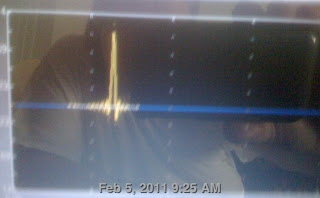
The perfect Tact impulse


Well, there it is, I connected one channel Tact output to it's very own input through a Harrison Labs 3dB attenuator.  Inside the attenuator is a 2k or thereabouts resistor, which actually causes more like 60dB attenuation into the microphone input load.  (Perhaps that explains why previous numbers were in something like the -60dB range.)

Notice that the pulse is positive only.  And notice that the pulse has leading and trailing ringing caused by digital processing.  If the speaker had perfect response, it would have identical leading and trailing ringing in it's Tact measurement also.

The leading edge ring relative amplitude looks like about 5% and the trailing edge about 10%.  That is considerable.  If the speaker lacks those (as, say, the Acoustat by itself might) that actually means it rolling off the highs.  If the supertweeter adds them back in, it is not adding ringing so much as restoring the ringing "in the signal" (though it's really in both the signal and the measurement thereof through limited digital means).

It's possible the ringing is at precisely the kinds of high frequencies the supertweeter is supposed to be adding too.  Actually, I can test that precisely, by measuring the supertweeter line signal...

Highpass super as high as possible?

I've made lots of interesting tweeter measurements.  I can get incredibly steep cutoff simply by moving the crossover cutoff to 20kHz.  Loss of volume at the acoustic crossover point is minimal, actually just a 2-3dB.  So just boost the level even more.  This suggests a rule for supertweeters, at least mine.  Highpass supertweeter as high as possible then adjust amplitude up to compensate.  The high efficiency "universal" supertweeter seems to be designed like this anyway, though simply for universality, not to optimize cutoff steepness.

The apparent increased highpass steepness at 20kHz crossover could be some combination of tweeter passband inaccuracy, room response, reflections, and, the thing I was obsessing over recently, the supertweeter's own crossover.  It makes sense that to make the Behringer highpass interact as little as possible with the Elac's built-in crossover by moving the Behringer as high as possible.  However, what one wants is correct operation, not necessarily minimal interaction.  But somehow the minimal interaction seems to work out give desired or at least desirable results, which can simply be compensating by raising the level.  (Or lowering the level of the other drivers.)

Oh, yes, and it could also be measurement error.  I haven't been showing the impulse response, because it looks terrible.  My purist friends should be shouting "told you so".  The Acoustats by themselves have a very nice impulse.  The supertweeter, right now, is simply messing that up badly.  Which then brought to my rationalizing mind the question, what does the perfect Tact response look like?

Friday, February 4, 2011

Fun Fun Fun with Tact Measurements

All the last times I've done Tact Room Correction System (RCS) 2.0 corrections on my living room system, I've been in too much of a hurry to really do it right.  That's not saying much, I'm sure that will be true this time too.

I'm torn between wanting to get it done badly, and wanting to really dig deep into understanding how I can make my system sound better, using the wealth of potential diagnostic information the Tact can show it it's measurements.


Look only at the steeply rising curve on the right; ignore the room noise from dishwasher etc on the left (low frequencies).

That's my supertweeter, with the full +15dB level and a 15.5kHz crossover.  But it looks nothing like the idealized picture that I had in mind (though it's not too far from my Genrad measurement) of a supertweeter with flat response 10-35kHz crossed over at 15.5kHz.  Instead, it looks like a highpass filter around 18kHz or so, starts out pretty steep, then gets shallow after awhile, then steep again.  You probably can't read the scale, but the range is 50dB and the tweeter is showing 45dB attenuation from the quasi peak at 18kHz and 3kHz.  Unfortunately, the Tact isn't showing frequency response above 20kHz.  My measurements show a flat range from 16Khz (just above crossover) to 24kHz; none of my microphones are calibrated now and none were calibrated above 20kHz, so I really can't be sure of anything above 20kHz and I have no reason to doubt Elac's 35kHz spec, though perhaps that's a 3dB downpoint.

Anyway, even if we assume more-or-less flatness above 18kHz, why is there so much attenuation between there an the crossover point of 15.5kHz?  Funny you should ask, because a Linkwitz-Riley crossover attenuates each driver 6dB at the crossover point.  What is the attenuation shown above at 15.5kHz?    Let's look at the raw numbers from the Tact (which are not easy to understand at first glance).

18.290kHz     -57.34
15.493            -59.97

That's only about 2.7dB attenuation, not the 6dB ideal.   So the suspicious looking drop from 18kHz isn't even sufficient?  Without checking the theoretic curve, I can't be sure, because even 20kHz isn't sufficiently above the 6dB attenuation point at 15.5kHz to be "flat", the crossover is already attenuating a bit at 20Khz, so I would need to know what the theory would say the response should be at 20kHz (or 18.29kHz).

Anyway, I think it's about right, actually, though it might still be a tad too much attenuation at 15.493 (the closest the Tact lets me measure to 15.5kHz).

Now where do I measure -6dB?  The closes point I can find to -6dB from the maximum level of -57.34dB is at 13.811 kHz.  This seems to fit with my intent to cross over at that point, but I'm not sure is correct.

Also, the microphone may not be very accurate at these frequencies, and perhaps I erred by aiming it directly at the speaker, and perhaps I am not using the correct Tact, and perhaps (many people
believe this) the Tact microphone calibrations are not very accurate, one might even be better off using a generic calibration with fewer tiny irregularities (some do this).

So there's lots of wiggle room here.  Perhaps this is indeed showing the intended LR crossover applied to a roughly flat supertweeter response.  Or perhaps, for some reason, this setting is providing the "acoustic" crossover that is more like 14khz, which is after all what I intended to do.

OK, that's one aspect of this, how accurate is the top above the crossover.  The answer is, it appears to be not too far off, actual acoustic crossover somewhere between 14kHz and 15.5kHz.

But the other aspect is below the crossover.  Is it really crossing over at 48dB per octave.  We would expect to see about 48dB attuation around one octave lower.  (I don't think you actually achieve 48dB plus 6dB initial attenuation, because during the first octave the attenuation is just ramping up, or down, so to speak.)

At 10.6kHz, about half an octave below the nominal crossover point of 15.5kHz, the response is attenuated by 18.3dB.  That doesn't sound adequate (though it is clear I really need a nominal Linkwitz-Riley crossver calculator) because I would think the attenuation should be more like 24dB.  And clearly the supertweeter is not much getting out of the way of the Acoustat peak around 14khz, though it is attenuated roughly 6dB there.